How My Husband Named His Secret Contact Mike and Met My Father’s Iron Trust

The coffee in my ceramic mug had gone lukewarm about ten minutes before the phone on the quartz island gave that short, dry rattle against the ceramic coaster. It was a modest vibration, the kind that only catches your ear when the house is entirely empty except for the low hum of the refrigerator in the corner. I did not reach for it right away because after twenty-six years of marriage to a man like Arthur, you learn that not every screen lighting up requires your attention.
Arthur was upstairs taking his morning shower, the old copper pipes wheezing through the drywall behind the pantry with a sound I had known since we bought the place back when our daughter was still in her high chair. When the notification banner popped up a second time, the words sat there on the glass clear as day while the kitchen sun slanted across the granite. Mike: Don’t forget the gray cashmere sweater you left on my chair last night. We need to talk about the $120,000 transfer before noon, babe. I sat completely still with my hands wrapped around the warm stoneware, feeling the cool air from the back door draft across the floorboards. Arthur was fifty-two years old and the senior managing partner at Vance & Associates downtown, a civil engineering outfit where I knew every single name on the payroll down to the summer interns who mowed the lawns.
I had hosted their annual barbecue in July, pouring lemonade for the draftsmen and handing out paper plates to the accountants while Arthur talked drainage pipes by the grill. There was no Mike at that firm, not in the field office and not in the main administrative bullpen. More than that, Arthur had lost his favorite gray cashmere sweater two weeks prior, claiming he had left it in a utility trailer on a Rockford job site where half the crew were roughnecks who probably traded it off for a case of beer. The water upstairs stopped suddenly, the heavy silence rushing in to fill the gap before the bathroom door creaked open on its brass hinges and his leather dress shoes began their measured, familiar tread across the oak floor of the bedroom. I did not flip the phone over, I did not slide it into my pocket, and I did not wipe the screen with my thumb; I simply pulled my hands back to the warm ceramic and looked out the casement window at the winter garden bed where the dead stems of last year’s perennials still poked up through the mulch like stiff gray needles.
Arthur came down the stairs five minutes later, smoothing down his silk tie with two fingers and smelling faintly of the sandalwood soap I had bought him for our anniversary. He looked every bit the respectable corporate officer he had spent three decades training to be, his posture straight, his graying hair trimmed neatly around the ears, his eyes clear and steady as he stepped around the edge of the island. Morning, Loretta, he said, his voice carrying that smooth, professional cadence he used when he was briefing city council members on bridge safety. He reached down without breaking his stride, picked up the mobile phone from the counter, and slipped it directly into the interior pocket of his wool overcoat without so much time spent glancing at the display as you would give a speck of dust. Did you leave the tax receipts out on the credenza in the study like we talked about last night?
They are right where you usually put them, near the green ledger, I told him, and my voice sounded flat even to my own ears, though Arthur was already checking his wristwatch and thinking about the municipal parking garage downtown. Good, because I have two site inspections in Aurora this morning and then a luncheon with the county commissioners that is going to drag on until at least three, he said, leaning down to press a cool, dry kiss against my temple that smelled of peppermint mouthwash. You know how these municipal budgets go, he added, grabbing his briefcase by the handle. I likely won’t be back until late, so don’t wait up for dinner if the traffic on the tollway acts up again. A long day, I repeated softly, watching the way his fingers curled around the leather handle. He gave a short, agreeable nod, the kind he gave clients when he wanted them to sign off on an extra fifty thousand for soil testing, and then he walked out the side door into the garage. I heard the sharp double-chirp of his sedan unlocking, the heavy rumble of the engine catching in the cold air, and then the tires crunching slowly over the gravel drive until the sound died away down the lane.
As soon as the street was quiet enough to hear the crows in the oak trees, I stood up from the stool and walked down the short hall to Arthur’s private study. He was an exceptionally orderly man who kept duplicate files in a heavy steel cabinet tucked behind his oak desk, locking the bottom drawer with a small brass key he always hid beneath a stack of out-of-date zoning maps. I knew where the key was because I was the one who had dusted that cabinet every Thursday morning for twelve years, and I knew the filing system because I had typed his initial partnership agreements on my own old typewriter back when our office was a spare bedroom in our first rental house. I knelt down on the patterned wool rug, slid my fingers under the maps, and pulled the brass key out into the light. The bottom drawer slid open with a soft, oiled hiss that smelled of old paper and printer toner.
I did not have to hunt through the folders because the secondary bank statements were right there in a crisp blue folder labeled with the name of a commercial credit line we had opened eighteen months ago under his sole corporate entity for independent consulting work. I pulled the papers out and laid them flat across the blotter, my eyes scanning the rows of black ink without needing to pause for translation. Over the past eight months, exactly six wire transfers of $20,000 apiece had been shunted out of that secondary business line into a private escrow account held at a downtown branch near the river. Twelve puluh thousand dollars in total, moving out like clockwork on the first Tuesday of every month while we discussed whether we could afford to replace the roof shingles before the autumn rains set in. Beneath the bank slips lay a small, thermal-printed parking receipt from a public garage on Elm Street in Chicago, dated just three nights ago at eleven-fifteen in the evening.
I set the papers back down, my fingers dry and steady against the grain of the wood, and picked up my own cordless handset to dial the direct desk line at Vance & Associates downtown. Clara, who had managed the main reception desk for fifteen years and knew every secret in the county before the ink was dry, answered on the second ring with her usual crisp efficiency. Vance & Associates, Clara speaking. Hi Clara, it’s Loretta, I said, keeping my tone light and neighborly, the way I always sounded when I was calling to remind him about his dentist appointments. Arthur left his reading glasses sitting right by the toaster this morning, and since I have to run some errands near the courthouse later, I thought I might just drop them off at his office. Is he in conference or out with Mike today? There was a small, three-second pause on the line during which I could hear the faint, rhythmic clack of Clara’s fingernails hitting her plastic keyboard.
Mike? Clara asked, and her voice had that polite, guarded neutrality that meant she was trying to figure out if I was checking up on him or just being forgetful. Which Mike would that be, Loretta? Mike from the project team, I said smoothly, letting out a small, dismissive breath as if I couldn’t be bothered to keep track of his endless stream of junior engineers. Arthur mentioned he’s been spending most of his field hours with him lately on those northern drainage audits. Loretta, we don’t have a Mike on any of our audit teams, Clara said, and she sounded genuinely puzzled now, her professional mask slipping just enough for her to sound like a friend. The only Michael we have on the payroll is old Mr. Vance’s nephew, and he’s been running our branch office down in Naples, Florida, since before the pandemic. Arthur’s entire field team right now is just young Kevin and Sarah.
Oh, I must have gotten the name mixed up with one of the contractors from the county board, I said, feeling the blood settle hard and cold in my chest. He probably said Mark or Miller or something similar. That must be it, Clara laughed softly, her voice dropping back into its normal rhythm. He’s always buried in those municipal reports anyway. If you bring the glasses by before two, I can slip them right on his desk before he leaves for the site meeting. Thanks, Clara, have a good afternoon. I laid the phone back in its cradle, looked down at the thermal parking receipt from Elm Street, and saw that the unit number written in pen on the back margin was fourteen-B.
I drove the twenty-two miles into the city without turning the radio on, keeping my old station wagon steady at fifty-five miles per hour in the middle lane while the semi-trucks blew past me with a deep, hollow roar that rattled my side mirrors. The sky over the lake was the color of a wet slate shingle, low and heavy and smelling of coal smoke from the railyards near the river. When you live with a man for twenty-six years, you do not break into pieces all at once when you find out the foundation is hollow; instead, you feel a cold, methodical curiosity take over, the same feeling you get when you dig into the garden in early spring and find that the frost has rotted every single bulb beneath the surface while the topsoil still looked green and promising. I parked in the public garage directly across the street from the high-rise on Elm Street, paid the attendant the flat morning rate of eighteen dollars, and walked out into the sharp wind that came sweeping off the water.
The building had a polished granite lobby with a young security guard sitting behind a high mahogany desk, looking bored as he scrolled through his phone. Good morning, I told him, stepping up with my handbag tucked firmly under my arm and my winter coat buttoned to the chin. I’m here to leave a small package for the tenant in unit fourteen-B. The guard looked up, his fingers pausing over his screen, and tapped a few keys on his directory monitor. Ms. Vance isn’t in her unit right now, ma’am, he said, his tone entirely polite. She usually heads down to her studio around nine-thirty. Would you care to leave it with me for her drop-box? Ms. Vance. Michelle Vance, the thirty-two-year-old daughter of old Arthur Vance, the founding senior partner who had retired to Arizona two years ago and left my husband holding the reins of the whole operation.
She was an interior architect who had taken over the firm’s commercial design division around the same time my husband started talking about expanding our investment portfolio. No, that’s quite all right, I told the guard, my voice level and dry as old parchment. I’ll just catch her another time. Thank you. I turned on my heel, walked back out through the heavy revolving glass doors, and stood on the sidewalk for a long moment while the city buses ground their gears in the street beside me. It all fell into place with the cold, brutal simplicity of an arithmetic problem you had spent months doing wrong on the scratchpad. Arthur wasn’t just having some cheap affair with a secretary from down the hall; he was buying his way into the old man’s family through the back door, using our shared financial security, the savings we had scraped together from twenty-six years of deferred vacations and modest sedan purchases, to finance Michelle’s independent design studio so her father would hand over the controlling shares of Vance & Associates before the end of the fiscal year.
He had taken our life savings, our retirement cushion, and the roof over our heads, and he had hidden her number in his phone under the name of a man who didn’t even exist. I got back into my station wagon, pulled my tablet out from beneath the passenger seat where I kept it for checking grocery lists, and synced it to the family cloud account that mirrored Arthur’s phone backups. It took me twelve minutes to find the message logs stored under the contact name Mike, hidden deep within the encrypted folder of a messaging app he thought nobody else knew how to access.
The conversation history went back seven months, hundreds of little digital ghosts marching across the screen in neat, polite rows. There were dinner reservations at restaurants where the entrees cost more than our weekly grocery budget, hotel confirmations for weekend trips to Santa Barbara that he had logged on our shared calendar as regional zoning conferences, and photographs of architectural blueprints marked up with red ink and sweet, familiar little notes signed with a single initial. And then, dated three days ago at eleven-twelve in the evening, there was a high-resolution photograph of a formal investment agreement for Vance & Associates Commercial Design LLC, with Arthur’s signature scrawled across the bottom as a silent guarantor for the exact sum of $120,000, accompanied by a short note from the sender: Don’t forget your sweater, babe. We need this cleared before the board meets on Thursday. I did not cry, and I did not slam my hand against the dashboard; I simply plugged my portable printer into the accessory port, routed the document queue through my phone, and watched as twelve pages of text messages, bank routing slips, and signed partnership guarantees slid out of the small slot one by one into my lap like autumn leaves falling onto a frozen porch.
When the last page finished printing, I picked up my phone and dialed the direct number for Richard Vance, no relation to the firm, but rather the stubborn, old-school probate attorney who had handled my father’s estate when the farm was sold back in ninety-four. Richard answered on the first ring, his voice gravelly and sharp like it always was when he was sitting behind his cluttered desk in the red-brick office off the square. Loretta? Is something wrong with the title on the north forty? No, Richard, I need an immediate administrative freeze placed on our joint commercial line of credit, I told him, and my words came out slow and distinct, each one measured like lead shot. And I need formal legal separation documents drawn up and delivered to my kitchen counter by four o’clock this afternoon. There was a long, heavy silence on the other end of the line, broken only by the sound of Richard clearing his throat the way he always did when a client was about to do something irreversible.
Loretta, are you entirely sure about this? Arthur is a partner in good standing, and, I have the bank routing slips, the escrow receipts, and seven months of text messages from his mistress sitting right here in my lap, Richard, I said. I am entirely sure.
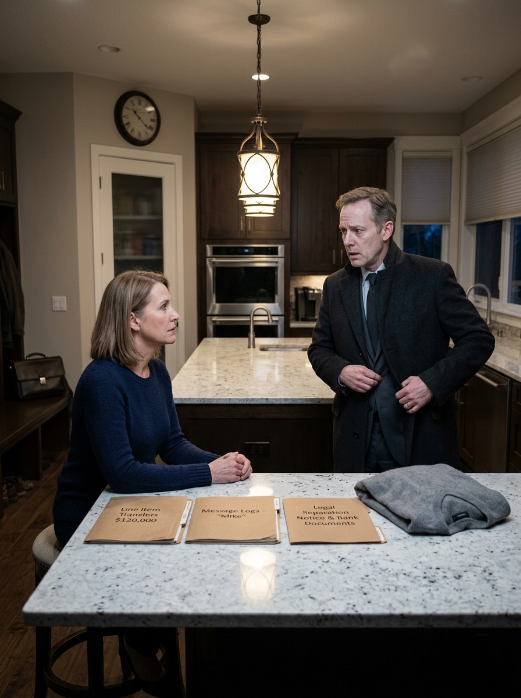
By five o’clock that evening, the winter sun had dropped below the ridge of the hills behind our property, leaving the yard in a cold, blue shadow that turned the frost on the lawn the color of old zinc. I sat alone at the kitchen island with the kettle cooling on the burner behind me, watching the shadows stretch across the white quartz surface where three clean manila folders sat in a straight, uncompromising row. The first folder held the bank statements showing every single dollar drawn from our secondary line of credit without my knowledge or consent. The second folder contained the printed message logs from the contact named Mike, every hotel stay, every restaurant bill, every photograph of the partnership agreement signed in secret. The third folder held the formal legal separation notice drafted by Richard’s office, along with the bank’s certified confirmation that our joint accounts had been secured and Arthur’s corporate access tokens revoked until further notice.
Right beside the folders lay the gray cashmere sweater, which I had retrieved an hour earlier by walking straight into Michelle Vance’s downtown design studio on Huron Street, telling the young receptionist at the front desk that I was picking up the sample knitwear Mr. Vance had left behind during yesterday’s architectural review, walking out with the gray wool folded neatly inside a brown paper shopping bag while the girl didn’t even look up from her computer screen. At seven-ten in the evening, the twin beams of Arthur’s sedan swept across the kitchen windows, painting the white cabinets a pale, sudden yellow before dying out in the gravel drive. I heard the car door slam shut with that familiar, heavy thud, the sound of his footsteps crunching up the cedar steps, and then the key turning in the deadbolt of the side entry door as he stepped into the mudroom and dropped his leather briefcase onto the wooden bench with an audible sigh of exhaustion.
Loretta? he called out, his voice carrying that slightly rasped edge of a man who had spent ten hours arguing with municipal inspectors about storm drains. It was an absolute disaster downtown. The zoning board dragged their feet on the riverfront project until nearly six o’clock, and then, He stopped dead in the middle of the doorway as he came around the corner into the kitchen, his coat still half-unbuttoned at the throat. His eyes moved from my face to the three manila folders laid out in that neat, military row across the white granite, and then they dropped down to the gray cashmere sweater resting right beside them. The color drained from his skin so fast that under the harsh fluorescent overheads he looked like something carved out of old tallow, his mouth opening slightly before he managed to pull his breath back in. What is this? he asked, and the professional authority in his voice had vanished completely, leaving behind a thin, dry rattle that sounded like dry corn husks in November.
Mike called, I said softly, keeping my hands resting flat on the counter. He said you forgot your sweater at the office.
Arthur took two staggering steps backward, his shoulder hitting the edge of the pantry doorframe with a dull thud as his hand flew automatically to the breast pocket of his coat where his phone usually rested. Loretta, you… you don’t understand what you’re looking at here, he stammered, his eyes darting frantically from the folders to my face and back again as his mind raced to build a wall out of nothing. The name in the phone… that’s just an internal joke with the engineering group. Greg and I use it as a placeholder for third-party vendors so the auditors don’t get confused by personal contacts on the corporate lines. I went to your office this morning, Arthur, I said, and my voice did not rise by so much as a single decibel. I spoke with Clara. There is no Mike on your team, and there never was. Then I went down to Elm Street, and the young man at the front desk in unit fourteen-B told me all about Ms. Vance’s design studio.
Arthur’s hands began to shake visibly now, his fingers twitching against the wool of his coat as he realized that the net had already closed long before he walked through the door. Loretta, please, just listen to me for one minute, he whispered, his voice dropping an octave into that pleading register he used when he was trying to settle a bad claim out of court. It’s not what you think. Michelle and I… it’s purely a corporate arrangement. Old Arthur is stepping down next month, and if I don’t secure the equity backing for her new branch, the whole regional partnership goes to that fool from the Denver office. I did it for us, Loretta. For our retirement. So we wouldn’t have to sell the house when we hit sixty. You took one hundred and twenty thousand dollars out of our line of credit without my signature to buy your way into your boss’s family, I said, pointing a single finger at the second folder.
And you lied to my face every single morning while you slept beside me in our bed and saved her number under a man’s name like a coward. It was a security precaution! he shouted suddenly, his face flushing a dark, ugly purple as the panic finally broke through his professional veneer. I was going to put the every last cent back as soon as the partnership papers were signed next week! You’re destroying thirty years of our life over a standard business maneuver! The separation papers are in the third folder, Arthur, I told him, and I did not look away from his eyes. Richard has already notified the commercial division. The escrow account is frozen, and your corporate cards won’t even buy you a cup of coffee tomorrow morning. Arthur stared at the manila folder as if it were a loaded pistol lying on the table, his chest heaving under his woolen vest as he tried to find some leverage, some old piece of authority he could use to make me small again.
You called Richard? Are you out of your mind? If old Arthur finds out about a formal financial freeze involving his daughter’s company, my career at that firm is finished! I’ll be ruined! You should have thought about your career before you left your sweater on her chair, I said.
Arthur did not sleep in the house that night, nor the night after. He spent the first two hours pacing back and forth across the hardwood floors of the kitchen, shifting wildly between shouting about my lack of loyalty and begging me to call Richard back and tell him it was all a terrible mistake. He offered to sign over his share of the truck, to transfer his personal retirement accounts into my sole name, to cut all ties with Michelle and walk away from the partnership track entirely if I would just tear up the separation papers and let him stay in the guest room. I did not raise my voice once, and I did not argue with his bargains; every time he tried a new excuse, I simply slid the printed message logs a fraction of an inch closer to his elbow on the granite counter. By ten o’clock, when the house had grown cold because he had forgotten to turn the thermostat up, he finally realized that the door was not going to open back up for him.
He went upstairs, packed a single leather suitcase from the back of the master closet, and walked out through the mudroom without looking at me or saying another word. The heavy silence that followed his departure was different from the silence of a normal evening; it felt lighter, cleaner, like the air after a summer thunderstorm has finally cleared the dust out of the valley. Over the next three weeks, Richard handled the communications through Arthur’s legal representative with the cold, efficient precision of a threshing machine. Because the $120,000 had been drawn from a joint commercial line without my signature on the escrow release, Arthur was forced to liquidate his personal shares in the firm’s pension plan to cover the debt and satisfy the bank before they could press civil charges for corporate fraud. When old man Vance found out about the financial irregularity and the nature of his daughter’s involvement, he didn’t give Arthur the partnership; instead, he forced his immediate resignation and left him with nothing more than a lukewarm letter of recommendation for a minor desk job with a failing sanitation outfit down in southern Indiana.
I stayed right here in the house, where the morning sun still hits the kitchen window at six-forty and warms the blue ceramic butter dish my grandmother handed down when we were first married. I changed the locks on every door, bought a new set of heavy-bottomed coffee mugs, and spent the first week of April digging out all the old, overgrown boxwood shrubs along the front walk so I could plant fresh white hydrangeas that wouldn’t need anyone else’s help to grow tall and strong. Yesterday afternoon, while I was clearing out the top shelf of the hallway closet to make room for some winter blankets, I found an old canvas utility tote Arthur must have left behind during one of his hurried trips back for his winter coats. Inside the pocket was a spare set of house keys on a rusted brass ring and a small black leather notebook filled with his old field measurements and bridge calculations from twenty years ago.
I did not open the pages to see what else might be written in the margins, and I did not spend any time wondering what he is doing down in Indiana with his new apartment and his secondhand car. I simply walked out to the garage, lifted the heavy lid of the green municipal trash bin, and dropped the tote bag straight down into the bottom among the empty boxes and the grocery bags. Then I walked back inside my warm, quiet kitchen, bolted the side door behind me, and set the copper kettle on the burner for tea.