How My Husband Lied About Our Newborn in the NICU for an Inheritance Check and Met State Security

The notification light on my hospital room phone blinked three short, sharp amber pulses against the dark bedside table at 4:12 in the morning, right when the anesthesia was starting to wear off and leave that dry, metallic taste in the back of my throat. My lower abdomen felt like someone had dragged a rusty pocketknife across the skin, but that wasn’t why my hands were shaking so hard the plastic water pitcher on the tray rattled against its ring.
Brian had leaned over my mattress just twenty minutes earlier, smelling of cold morning air and expensive coffee, smoothing back my hair with that gentle, careful touch he always used whenever he was setting up a piece of bad news. He told me Leo had a little fluid in his lungs and the pediatrician had moved him down to the neonatal intensive care unit just to be safe, telling me to sleep and let the pain meds do their work. I didn’t know then that the phone alert was a digital banking confirmation for an eight-hundred-fifty-thousand-dollar estate disbursement, and I certainly didn’t know that my mother-in-law, Evelyn Carver, had already parked her silver town car in the ambulance bay with the engine running and a hard-shell infant car seat sitting empty on the passenger floor.
Evelyn had arrived at St. Jude Memorial Hospital three hours before my emergency cesarean section, carrying a full set of monogrammed leather luggage and a clipboard filled with notarized medical directives she had drafted without telling me.
Back then, during the rush of the surgical prep when the nurses were taping monitors to my chest and shouting about elevated fetal heart rates, I just thought she was being her usual overbearing self. Evelyn treated every family gathering like an executive board meeting she was being paid to run, and Brian always stepped aside whenever she gave an order, nodding along and telling me to just let his mother have her way to keep the peace in the family. I had spent five years married to Brian writing off those little moments as harmless domestic tension, believing he was just caught in the middle between a strong-willed mother and a wife who wanted to build a quiet life in our small South Carolina town. But when the door of recovery room 214 clicked shut behind him and the heavy oak latch settled into place, the quiet in the room felt less like peace and more like the air being sucked out of a airtight box.
I tried to shift my weight to reach for the call button, but the sharp, white-hot pull across my lower stomach pinned me back against the thin mattress with a sickening jolt. That was when the door handle turned again, slow and quiet, and Nurse Mae Rowland slipped into the room without making a sound on the linoleum floor. Mae was a woman in her late fifties with tired eyes that had seen every kind of human misery from midnight heart attacks to domestic violence drop-ins, and her jaw was set in a hard, straight line that immediately told me something was profoundly wrong. She didn’t carry a fresh pitcher of ice water, and she didn’t check the IV bag hanging from the metal pole beside my bed. Instead, she walked straight to the door, slid the deadbolt over, and turned back to look at me with a look of absolute, unshielded pity that made my stomach drop further than the surgery had.
“Leah,” Mae whispered, her voice low and raspy from thirty years of hospital shifts and double shifts. “Can you stand up if I support your weight by your shoulders?”
“What’s wrong with Leo?” I asked, my voice catching on the dry cotton of my hospital gown as my pulse hammered against my ribs like a trapped bird. “Brian said he had fluid in his lungs. He said the pediatrician moved him to the NICU.”
“Your baby is not in the NICU, Leah,” Mae said, stepping right up to the mattress and lowering the metal safety rail with a soft, practiced click. “Your son is in Nursery Three down the hall under routine observation, and he is breathing room air just fine on his own. But ten minutes ago, your husband and his mother handed the floor clerk an unauthorized bypass transfer authorization to have the infant discharged directly into Evelyn Carver’s physical custody. They told the charge nurse you were having a severe postpartum psychiatric break and were medically incapacitated.”
A cold, heavy numbness spread outward from my chest, freezing every thought in my head until I couldn’t even find the words to form a question. Before my surgery, while the contractions were hitting every two minutes and the surgical nurses were rushing around the bed with consent forms and iodine prep trays, Brian had shoved a heavy plastic clipboard into my trembling hands and told me they were routine intake addendums required by hospital billing for insurance processing. I had signed my name where his finger pointed because I trusted my husband with my life, never imagining that the signature lines at the bottom of those dense legal pages were actually giving him emergency medical guardianship and sole decision-making authority over our newborn child.
“I need to get to my son,” I whispered, the fire in my surgical stitches flaring up as I swung my bare feet over the cold edge of the bed and felt the linoleum freeze the soles of my feet.
“We have to move quietly,” Mae said, her grip on my arm like a band of forged iron as she draped a thick, warm flannel hospital robe over my shivering shoulders. “They are at the main nurse’s station right now trying to push the paperwork through before the seven o’clock shift change brings in the day staff who know you. I am putting you in the clean linen supply room directly behind the central desk, and you are going to hear every single word they say for yourself.”
Every step down that short, pale green hospital corridor felt like walking barefoot across broken glass, but the physical tearing in my lower abdomen was nothing compared to the hot, suffocating panic clawing at my throat. Mae guided me through a heavy service door marked with a red sign that said authorized personnel only, keeping the room completely dark except for the dim, sickly yellow glow coming through the frosted glass seam where the door met the wood molding of the nurses’ station wall. Through that narrow vertical gap, the voices from the hallway drifted in with terrifying, crystal-clear precision, cutting through the hum of the ice machines and the distant paging tones over the intercom.
“The doctor noted she was combative during the pre-op prep,” Evelyn Carver’s sharp, cultured voice said, sounding as calm and detached as if she were placing an order for catering at a country club brunch. “My son holds full legal power of attorney under the emergency medical directive we executed this morning in the parking lot. We are transporting the infant to my residence in Oak Ridge for his immediate safety and neurological observation.”
“Mrs. Carver, standard hospital protocol strictly requires the mother of record to sign the physical custody release before any neonate leaves the postpartum wing,” the floor clerk replied, the sound of papers rustling sharply against the Formica counter audible through the glass seam. “Even with a medical directive on file, the attending obstetrician has to personally sign the maternal incapacity form on the state registry before discharge papers can be stamped.”
“The attending physician is currently scrubbed into a scheduled surgery that will last for the next two hours,” Brian chimed in, his voice sounding thin and nervous, lacking even an ounce of the warm conviction he had used when he kissed my forehead five minutes ago. “We cannot leave our newborn son unattended in a public ward while my wife is experiencing acute postpartum psychosis. Look at the emergency guardianship petition we already drafted for the county clerk’s office. I am the biological father, and I have primary custody authority under our pre-existing marriage covenants.”
I pressed my palm flat against the cold metal shelving of the supply room to keep my knees from buckling right there onto the rubber floor tiles. Weeks before I ever went into labor, long before my water broke on the kitchen floor, Brian had been preparing court petitions behind my back, structuring our entire life around a legal trap I didn’t even know existed.
“Brian,” Evelyn cut in, her tone dropping into that cold, commanding register she always used whenever large sums of money were hanging in the balance. “Give the clerk the transfer routing slip right now. The driver is waiting by the idling sedan at the south ambulance bay doors. If we do not have physical possession of that child by five o’clock this evening, the probate administrator will freeze the quarterly distribution of the Carver trust, and your commercial real estate debts will be called in by Monday morning.”
“I know, Mother,” Brian muttered, sounding like a whipped dog rather than a grown man and a father. “Just let the clerk stamp the routing form so we can get out of here before Leah wakes up from the sedative.”
The brutal truth hit me right between the eyes with the force of a physical blow, clearing away every remaining trace of the anesthesia fog and leaving behind a cold, calculating maternal rage that I didn’t recognize as my own. Two years prior, Brian’s grandfather had established an eight-hundred-fifty-thousand-dollar family trust disbursement, structured by a clever estate lawyer to release exclusively to Brian on the strict, unyielding condition that he maintained primary physical custody and sole household control of a direct Carver heir before the child reached two weeks of age. Brian had been drowning in six figures of debt from a failed commercial real estate venture in Greenville that he had kept hidden from me for eighteen months, juggling high-interest bank loans and second mortgages on our modest starter home while pretending everything was fine. He never wanted a family with me, and he certainly never wanted the messy, beautiful reality of raising a child; he needed an infant in his physical possession to unlock a trust fund that would bail him out of his financial ruin, and Evelyn wanted to raise the next generation of Carver money in her gated estate without a working-class woman like me standing in her way.
They were never planning to bring Leo back to my recovery room, and they were never planning to let me nurse him or hold him or watch him grow up in our home. They were going to drive my newborn straight to Evelyn’s fortress in Oak Ridge, slap a fraudulent seventy-two-hour psychiatric hold on me using Brian’s forged spousal consent, and lock me away in a private facility until the custody papers were permanently sealed by a corrupt family court judge.
Mae looked over at me in the dim shadows of the supply room, her tired eyes steady and unblinking in the gloom. She reached into the pocket of her starched white uniform tunic and pulled out a folded sheet of yellow carbon paper, pressing it directly into my trembling hand.
“It’s the nursery bypass transfer form your husband tried to slip into the bottom of the discharge pile while the charge nurse was answering a code page,” Mae whispered, her breath warm against my ear. “He even forged the delivering obstetrician’s signature in the provider approval box, which is a federal patient-trafficking violation on hospital grounds. The social worker on duty this morning is named Karen Vance, and she is sitting in Room 104 right now reviewing the chart because the signature didn’t match the handwriting on your admission sheet. What do you want to do with this, Leah?”
The trembling in my fingers stopped entirely, replaced by a strange, icy stillness that made my heart beat in slow, heavy thuds against my ribs.
“Get Karen Vance,” I said, my voice barely audible over the hum of the refrigerator in the corner, but sharp enough to cut glass. “And call hospital security to the nurses’ station right now.”
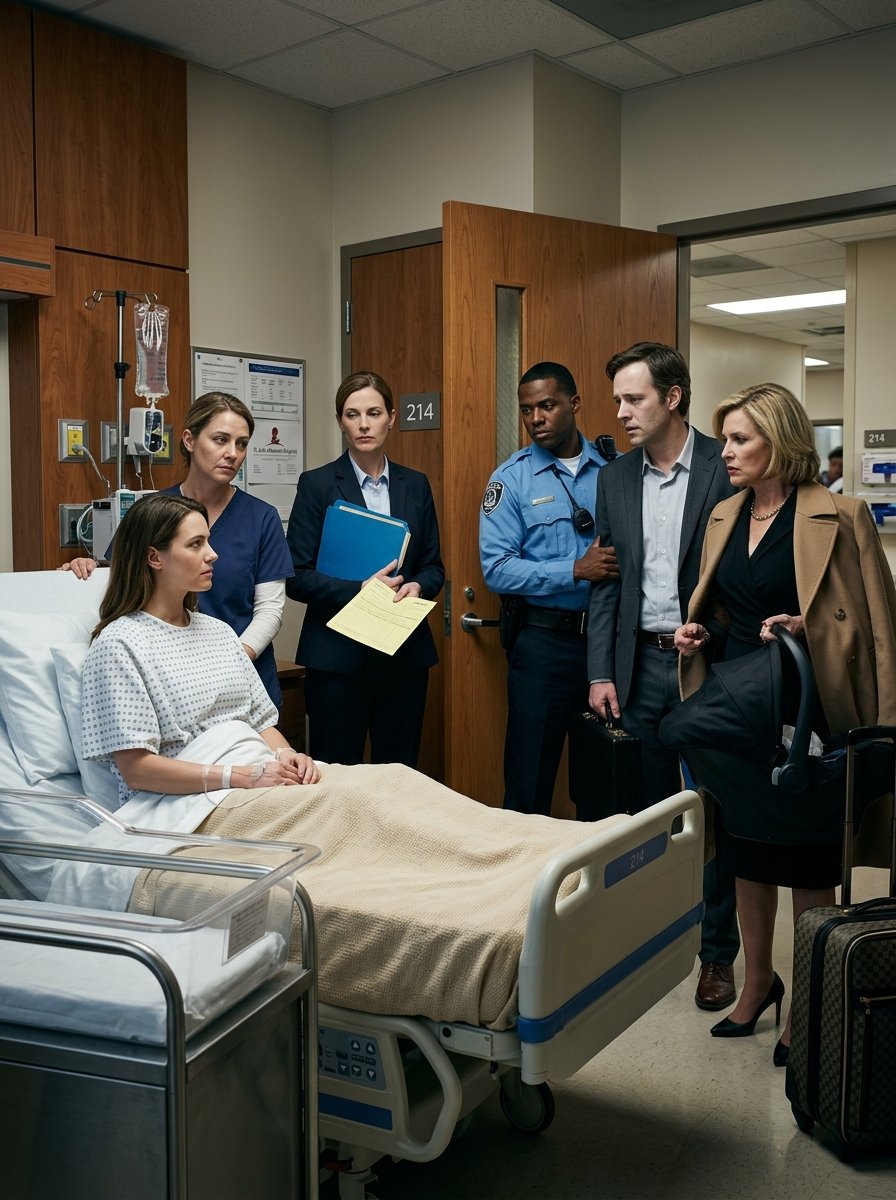
Ten minutes later, the heavy oak door of private recovery room 214 swung open with a sharp click that echoed off the bare walls. Brian walked in first, wearing an expression of practiced, theatrical sorrow that made my skin crawl, his shoulders slumped as if the weight of the world rested entirely on him. Evelyn followed right behind him like an executioner stepping onto a scaffold, carrying the black leather infant carrier balanced securely on her forearm while her heavy designer fur-lined coat draped over her shoulders like a suit of armor.
“Leah, sweetheart,” Brian said, stepping toward my bed with his empty hands outstretched in a gesture of false reconciliation. “I have some very difficult news from the pediatric team. The doctors say Leo’s lung condition is significantly worse than they originally thought, and Mother is going to drive him over to the specialized children’s clinic across the state line right now so he can receive advanced respiratory care.”
I sat completely upright against the pillows, ignoring the sharp, tearing pain in my abdomen and the IV line that Mae had safely capped and taped to my wrist. I didn’t look like a confused postpartum patient waking up from a sedative haze; I looked straight into my husband’s eyes with a cold, level stare that made him freeze halfway across the linoleum floor.
“Which clinic, Brian?” I asked evenly, my voice as flat and unyielding as a slab of granite.
Evelyn stepped forward past her son, her thin mouth tightening into a hard, irritated line of pure disdain. “It is a private pediatric facility in East Tennessee, Leah, and you are far too emotionally unstable and physically compromised to process medical logistics right now. Brian has already signed the legal transport forms under his statutory authority as the father of record. Now lie back down and go to sleep before you make your condition worse.”
“Leo doesn’t have fluid in his lungs,” I said, each word dropping out of my mouth like lead weights hitting a wooden floor. “He is sitting right now in Nursery Three down the hall, and you don’t have an ambulance waiting at the south bay doors because you sent your private driver away twenty minutes ago.”
Brian’s face went completely, perfectly blank, all the color draining out of his cheeks until he looked like a ghost standing under the fluorescent lights. He glanced frantically toward the hallway door, his hands twitching nervously against the fabric of his trousers. “Leah, you’re confused and exhausted from the surgery. The medication is making you paranoid and you’re not thinking clearly.”
“I heard every single word you said through the supply room door, Brian,” I said, leaning forward until the hospital gown pulled tight across my chest.
Evelyn let out a sharp, dismissive scoff that sounded like a dry autumn leaf scraping across a sidewalk. “This is completely absurd and I refuse to stand here and entertain the paranoid delusions of an unstable woman. Brian, go get the charge nurse right now so we can have her chemically restrained. We are taking the child off this floor before she harms herself or anyone else.”
“You aren’t taking anyone anywhere, Mrs. Carver,” a crisp, professional voice announced from the open doorway behind them.
Karen Vance, the hospital’s senior risk management social worker and patient advocate, walked into the room holding a thick blue vinyl file folder under her arm with an expression of utter, bureaucratic finality. Right behind her stood two uniformed St. Jude hospital security officers, their heavy duty belts jingling softly and their radios crackling with low-frequency static.
“Mr. Carver,” Karen said, her tone completely professional and entirely devoid of human warmth. “I have the electronic birth registration terminal right here in my hand, and under state health code statutes, until a formal custody order is granted by a district court judge, an infant cannot be removed from this facility without the direct physical signature of the delivering mother on file.”
“I am his biological father!” Brian snapped, his carefully practiced composure finally shattering completely as his voice cracked and rose an octave in sheer panic. “I have an emergency custody filing right here in my briefcase!”
“You have an unsigned petition that hasn’t even been docketed by the clerk of courts,” Karen replied, holding up the intercepted yellow carbon bypass slip like a smoking gun. “And you have an unauthorized nursery transfer form containing a forged provider signature in direct violation of state medical licensing laws. That is a Class C felony committed on hospital property during an active patient recovery.”
Evelyn stepped aggressively in front of her son, her chin lifted high in the air as if she were addressing a disobedient servant at one of her charity luncheons. “Do you have any remote idea who my family is in this county? My late husband endowed the entire pediatric wing of this hospital with a two-million-dollar donation. We will have your nursing licenses revoked before the sun comes up tomorrow morning.”
“Mrs. Carver,” the lead security officer said, stepping forward until his heavy leather boots were planted two feet from her designer luggage. “You and your son are officially being served with administrative trespass notices under hospital operating code four. The hospital administration has revoked your visitor privileges effective immediately, and you have exactly sixty seconds to vacate this floor before we assist you out to the public parking lot.”
“Brian,” I said, my voice cutting through the noise like a cold wind off the river.
My husband turned his head slowly to look at me, his face the color of skim milk, his eyes darting frantically between the security guards and the heavy wooden door. For five long years, I had believed his softness was kindness and his compliance was just a sign of a gentle soul. Looking at him standing there with his empty briefcase and his pathetic excuses, I saw only a weak, indebted coward who had tried to sell his own newborn son’s mother down the river for an eight-hundred-fifty-thousand-dollar inheritance check.
“You will never touch my son again as long as you live,” I told him, every syllable carrying the weight of a final judgment. “Get out of my sight.”
Brian opened his mouth to stammer out another defense, but the two security officers didn’t wait for him to finish; they each took him and Evelyn firmly by the elbows and turned them around toward the hallway. Evelyn hissed something venomous about high-priced lawyers and civil lawsuits over her shoulder, but Brian didn’t say another word, keeping his head ducked down toward the floor as the heavy fire doors swung shut behind them with a dull, heavy thud.
Forty minutes later, the room was quiet again, save for the low, rhythmic hum of the medical monitors and the soft scratching of Karen Vance’s pen against her tablet. Nurse Mae wheeled a clear plastic bassinet through the door, locking the caster wheels securely into place beside my bed with a gentle click. Inside, wrapped snugly in a standard-issue hospital blanket with pink and blue stripes, lay my son, his tiny chest rising and falling in perfect, steady rhythms, crowned with a soft tuft of dark hair that curled against his forehead.
I reached down, ignoring the sharp pull in my lower abdomen, and lifted Leo gently into my arms, holding him close against my chest. His skin was warm and smelled of baby shampoo and clean cotton, and he let out a tiny, sleepy sigh that vibrated right through my collarbone.
Karen Vance sat down in the vinyl chair beside my bed, tapping a stylus against her digital screen with a reassuring smile. “We are finalizing the sole birth certificate registration right now, Leah. Brian Carver’s name is legally omitted from the discharge clearance pending your formal family court protective filings tomorrow morning, and he has zero access to this ward or our nursery records.”
I signed the electronic signature pad with a steady, unshakeable hand, watching the glowing green ink confirm my single authorization. Sole maternal custody.
The Carver family had spent weeks calculating trust disbursements, real estate debts, and legal loopholes, treating my body like an incubator and my child like a voucher for cash, but when Brian walked out of that hospital lobby flanked by security guards, he left with nothing at all. Two days later, my discharge papers were fully processed and stamped by the hospital administrator, and my sister Rachel pulled her modest gray sedan up to the main entrance of St. Jude Memorial. There were no luxury cars, no personal drivers, and no Carver attorneys waiting on the curb to intimidate us, just a cool, crisp autumn breeze blowing through the maple trees and the steady, ordinary hum of morning traffic on the highway.
Mae helped me down the final hallway in a comfortable wheelchair, carrying Leo’s diaper bag over her shoulder with a quiet pride in her eyes. When we reached the glass sliding doors that led out to the parking lot, I stood up on my own two feet, refusing the chair, and walked out into the sunlight.
I strapped my son securely into the infant car seat Rachel had bought for me with her own savings, double-checking every nylon buckle and harness strap until the plastic clasps snapped firmly into place.
I climbed into the back seat beside him, reached out to take Leo’s tiny, perfect hand in mine, and told my sister to drive us home.