How I Captured the Angel Queen to End Our War and Broke the Sky

My hands were covered in cold mountain mud and heavy iron grease when the snare snapped shut on the Obsidian Ridge. I was thirty-six years old back then, and for sixteen of those years, I had worn the heavy iron crown of the mortal realm while watching my people bleed out against the winged hosts of the upper air. Every single spring, our grain fields burned to ash under celestial fire. Every autumn, we buried boys who had barely learned to hold a pike, digging shallow graves into the frost-hardened dirt behind the barracks.
I did not set that trap out of malice or petty cruelty. I set it because my realm was starving, exhausted, and running out of sons to send to the stone walls.
When the dust finally settled over the dark volcanic stone, Queen Seraphine lay trapped beneath our grounded iron nets. Her wings, vast and white like polished marble, were pinned under three tons of counterweighted mortal chain that we had spent six weeks forging in the lower smithies. My generals cheered behind me in the freezing wind, their voices hoarse and jagged with a cruel kind of triumph. They saw the head of our ancient enemy right there in the dirt. They saw a trophy that could be mounted above our high gate to claim an absolute, bloody victory that our grandparents had only dreamed of.
I walked toward her slowly with my greatsword drawn, the heavy steel scraping against my leather scabbard.
My chest ached with that old, familiar exhaustion that had kept me awake for a decade of sleepless command. When I knelt beside the tangled iron mesh, I expected the venomous fury our village priests had preached about from the pulpits for three hundred years. I expected her to curse my bloodline, spit blood onto my boots, and promise divine retribution from her high council before I could even raise my blade.
Instead, she looked directly into my eyes through the narrow gaps in the iron links. Her breathing was shallow and ragged in the thin mountain air. She had a deep, jagged cut along her collarbone, leaking a pale, luminous fluid that smelled faintly of summer rain after a long drought, but her face showed only the exact same crushing fatigue I carried in my own ribs.
“How many of your people died to set this iron?” she asked.
Her voice was quiet, rough, and entirely human, lacking any of the ringing thunder we had been taught to expect from celestial royalty.
“Twelve,” I said, my knuckles turning white on my hilt as the wind whipped our cloaks. “Twelve good scouts.”
“I lost forty-two guardians at the southern river last month,” she whispered back, closing her eyes for a brief second against the pain. “I know the names of every single one. If you cut my throat now, Kaelen, my council will only choose another ruler to burn your remaining valleys tomorrow.”
That single sentence hit me harder than any broadsword ever could. She did not plead for her life or invoke the names of sky gods; she simply stated the cold mathematics of our mutual ruin. My war council caught up to us then, boots crunching on the gravel, shouting over the wind and demanding her immediate execution right there on the ridge.
General Vance drew his heavy broadsword, insisting that her severed head was the only treaty our kingdom needed to finally sleep at peace.
I looked down at her silver-feathered wings, bruised and bent under mortal iron, and then at the dark, hollow rings under her eyes. I had believed our war was a matter of mortal survival against celestial arrogance for most of my adult life. But looking at her in that frozen dirt, I saw no pride left in her posture. I saw a weary monarch who was just as sick of the slaughter as I was.
“Sheath your steel, Vance,” I ordered, rising slowly to my feet.
“Sire,” Vance shouted, his face dark with furious disbelief. “This is the Angel Queen! Her blood pays for three centuries of our dead!”
“And who pays for the centuries after this one if we keep going?” I replied, turning my back on him.
I took the release key from my belt and unlocked the central tension bolt myself, ignoring the protests of my officers. The heavy iron chains clattered onto the obsidian rock with a sharp, echoing ring. I extended my bare, calloused hand to the sovereign ruler of the skies, defying every law of my ancestors, and helped her stand up from the dirt.
Now, sitting in the high solar of the citadel while the wind howls against the thick stone windowpanes, I find myself thinking back to those first three weeks after I brought her here. We did not hold her in the dark dungeons beneath the keep, though Vance and the elder lords argued for it until their faces turned purple. I posted my most loyal personal guards at her heavy oak door, not to keep her from escaping into the night clouds, but to keep my own paranoid nobility from murdering her in her sleep while the realm watched.
For three weeks, we held parley by candlelight over maps worn soft at the creases by decades of strategic retreat. We did not speak like gods and mortals playing a grand game of empires; we spoke like two exhausted caretakers trying to salvage a burning house before the roof caved in. I showed her our granary ledgers, our depleted iron mines where old men worked the veins, and the long lists of fatherless children in our border towns. She showed me the celestial rolls: fallen bastions, vanishing light reserves, and young fledglings drafted into frontline ranks before their wings were even fully feathered.
We realized very quickly, with a sinking sickness in our stomachs, that neither side had gained an inch of territory in over two centuries. Every single battle had simply been an organized slaughter that left both our peoples weaker, poorer, and closer to extinction than before.
As the days passed in that high stone room, the quiet conversations shifted from casualty reports to history. I watched her read by the hearth late into the night, her vast wings tucked neatly behind her high-backed chair, her fingers tracing the mortal script of our old chronicles with genuine care. She was not a monster of the upper air; she was thoughtful, patient, and deeply sorrowful about the harm our ancestors had inflicted on one another. When she smiled at a dry joke I made about citadel rations one rainy evening, I felt an ache in my chest that had nothing to do with war. I was falling in love with the woman who was supposed to be my sworn destruction.
One evening, while comparing our oldest recorded chronicles to find when the border disputes truly began, we noticed a strange pattern in our paired scriptorium codices. Mortal scribes had recorded that whenever our armies clashed along the Great Divide with maximum bloodshed, the sky above remained a bright, placid, dome of gold. But whenever our borders went quiet for more than a few seasons, violent atmospheric tremors shook the earth, and strange, pulsing auroras flared overhead like cracking glass.
“Look at this entry from three hundred years ago,” Seraphine said, her hand brushing mine across the vellum table, the warmth of her skin sending a shiver through my arm. “The mortal king and the angelic queen agreed to a twelve-month truce. Within six months, the high atmosphere began to groan with thunder, and the stars twisted out of alignment. The war resumed immediately afterward.”
“Our priests wrote that the gods were angry because we lacked righteous fury,” I said, remembering the childhood catechisms I had been forced to memorize by the old men in the temple.
“Our high seers were told the exact same thing,” she replied, her eyes wide with mounting dread in the flickering candlelight. “They were told that celestial light could only remain pure if it purged terrestrial dust.”
We spent the entire night cross-referencing our ancient texts, driven by a growing, desperate curiosity. The mortal codex and the celestial codex, written in entirely different scripts and languages that took hours to translate side-by-side, held identical architectural diagrams of the heavens. The sky above our heads was not a natural firmament given by benevolent creators. It was an artificial vault, an engineered barrier locked into place by the friction, hatred, and kinetic violence of our two races.
The war had never been about land, resources, or celestial pride. It had been carefully designed by the Primordial Creator Gods who slept beyond the veil, feeding on the perpetual strife of mortal and angel alike, using our endless hatred as the lock on their cosmic prison while keeping both our races too weak and depleted to ever look up and question our masters.
“If we make a standard peace treaty,” I said, the truth settling heavily into the cold room, “our councils will break it within a generation because the divine pressure will force another skirmish.”
“Then we do not make a treaty, Kaelen,” Seraphine said, looking straight into my eyes, her fingers gripping mine with unbreakable strength. “We unite the thrones. We make a covenant that cannot be broken by law or council. We give them a peace so absolute that the machine fails.”
I looked at her, knowing full well that Vance and my lords would call it madness, and that the celestial hierarchy might call it heresy punishable by death. But I loved her, and for the first time in my life, I saw a path that led somewhere other than an open grave.
“Then we marry at the Great Divide,” I said. “Before both armies.”
Two weeks later, fifty thousand mortal soldiers stood on the southern edge of the Great Divide, and fifty thousand winged celestials hovered over the northern rim. The tension between the two lines was thick enough to choke on in the midday heat. Steel gleamed against celestial crystal, and archers on both sides kept their fingers close to their bowstrings, waiting for a single twitch to turn the valley into a slaughterhouse. Vance stood behind me, his hand resting heavily on his pommel, watching the heavens with bitter distrust in his eyes.
Seraphine walked toward me across the dry, cracked earth of the neutral ground. She wore no armor, only a simple white tunic trimmed with celestial silver that caught the sun. I wore my father’s plain iron circlet and my standard field tunic, leaving my greatsword sheathed quietly at my back.
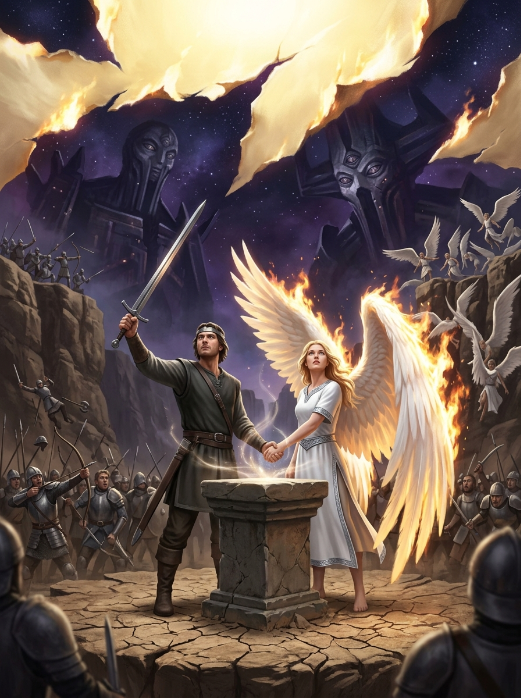
We met at the stone altar that had marked the border of death for three centuries. There were no priests to guide us through the ceremony; neither mortal nor celestial religion would bless our union. We had only our own words, written down by our own hands in the quiet citadel solar.
“I, Kaelen of the Mortal Realm,” I spoke, my voice carrying across the silent gorge to both vast armies, “pledge my life, my kingdom, and my steel to you, Seraphine. Not as a conqueror, and not as a subject, but as your equal in blood and burden.”
Seraphine took my right hand. Her skin was warm, the pale light of her veins mingling with the dark pulse of my own. “I, Seraphine of the Celestial Host, pledge my breath, my light, and my wings to you, Kaelen. We end the long night of our ancestors. We choose each other, and we choose peace.”
As our hands clasped over the altar stone, a strange harmonic resonance began to hum between us. It started in our fingers, where terrestrial iron and celestial light touched, and then radiated outward into the dry earth.
The ground did not shake, but the sky did.
A sound like tearing silk echoed across the entire horizon, loud enough to make horses rear and men drop their shields. The bright, golden dome of the sky that our people had lived under since the dawn of time began to fissure. Giant, spiderweb cracks of dark violet spread from the center of the firmament to the distant mountains, casting an eerie, unnatural light over the valley.
“Sire!” Vance screamed, drawing his sword in panic. “What have you done? The sky is falling!”
Across the divide, the angelic hosts broke into panicked shouts, their wings beating in frantic rhythm as massive sheets of artificial blue and gold began to peel away from the upper atmosphere like burning parchment. The golden light dissolved entirely, revealing what had been hidden behind the war for ten thousand years.
The true cosmos was vast, dark, and filled with cold, distant stars. And floating directly above our world, slowly opening their colossal, multi-faceted eyes, were the Primordial Gods.
They were massive, towering beings of raw cosmic architecture, roused from their long slumber because the battery of our hatred had suddenly gone cold. Their cold, indifferent gaze locked onto the valley below. They had not expected peace. They had expected another five centuries of slaughter to keep them fed and hidden behind their golden wall.
The colossal figures began their slow, crushing descent toward the earth, intent on wiping out both armies and resetting their bloody machine from scratch before anyone else could look up.
Vance dropped to his knees in the dust, staring upward in total paralysis. Along the front ranks, mortal pikemen and celestial archers began to drop their weapons, overwhelmed by the sheer scale of the titans breaking through the ruined sky.
I did not let go of Seraphine’s hand. I looked at her, and she looked back at me. The fear was there, cold and sharp, but beneath it was the same quiet, stubborn resolve that had kept us alive through sixteen years of command.
“We broke their cage,” she said softly.
“Then we defend our home,” I replied.
I drew my iron sword with my free hand and raised it toward the falling gods. Seraphine unfolded her massive wings, igniting them with brilliant, blinding celestial fire, and raised her silver blade beside mine.
“Mortal men of the Citadel!” I bellowed with every ounce of air in my lungs. “Do not look at the angels as your enemy! Look up! There are the masters who fed on your fathers and your sons! Stand with me!”
Beside me, Seraphine’s voice rang out like a great silver horn across the divide. “Children of the light! Fold your ranks with the sons of earth! We fight for our freedom today!”
For three seconds, nothing moved except the high wind howling through the gorge.
Then Vance rose slowly from the dirt. He did not look at me with fury anymore; he looked up at the descending titans, spat on the cracked stone, and drew his broadsword with a heavy scrape of steel. Behind him, the front line of mortal infantry locked their shields together with a deafening crash of iron that echoed off the canyon walls.
Across the divide, the angelic captains did not fly away in terror. They dropped down from the high air, landing shoulder-to-shoulder with our pikemen, their great wings forming a living, shimmering wall behind our shields. Celestial archers notched their glowing shafts, aiming directly between the gaps in mortal armor, aligning their sights on the colossal figures descending through the shattered firmament.
The ancient war between mortals and angels did not end with a parchment signature or a negotiated border. It ended in that single breath when two armies turned their weapons away from each other and pointed them at the heavens.
The golden sky is gone forever. Above us now is the dark, terrifying reality of an open universe, cold and vast and entirely unshielded. But as the first primordial titan breaches the lower clouds, Seraphine and I stand together on the shattered altar at the center of the line.
Our hands are still clasped, iron and light locked tight against the cold. Behind us, one hundred thousand voices rise in a single, unified roar of mortal steel and celestial chorus. We do not know if we will survive the war that begins today, or if our small world will be crushed by the masters who once locked us in the dark. But for the first time in our history, we are fighting for our own lives, under our own names, and we will face the gods together.