How My Husband Humiliated Me in His Mercer and Vance Flagship Store and Met My Underwriting Trust

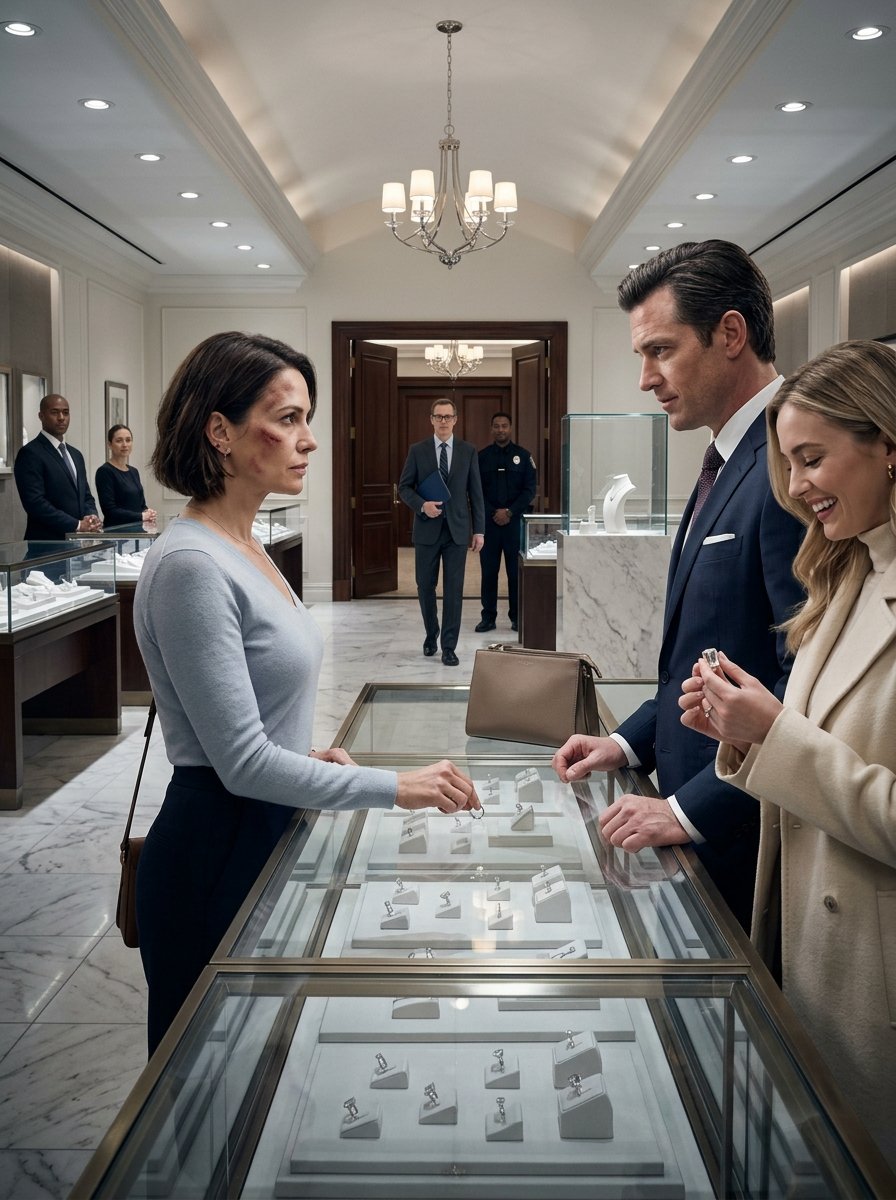
The ringing in my left ear was steady and high, like a small generator humming behind a thin wall, and my cheek felt thick and hot where Nathan’s gold signet ring had caught the bone right beneath my eye. I had spent seven years keeping our supplier ledger balanced across Antwerp and New York, quietly handling the rough Antwerp parcels while he practiced his television smile in the three-way mirror of our executive dressing room. When he swung his hand the first time, it didn’t even cross my mind that he was aiming at me personally; my brain just registered that my left earring had snapped through the lobe and landed on the cold polished marble of the Mercer and Vance flagship showroom with a sharp, tiny click. The second blow was wider, driven by his open palm, and it knocked my hip hard against the velvet-lined display pedestal where we kept the unmounted Antwerp suites. I went down onto my knees, my wool skirt bunching up against the gray veining of the stone, staring directly at the polished leather toes of his Italian oxfords. He didn’t even lose his balance or breathe hard through his nose; he just adjusted the lapels of his charcoal custom-tailored jacket as if he were straightening up after placing a vase on a hall table.
“You don’t walk in here during private client hours and question my ledger, Elena,” Nathan said, his voice carrying clearly and flatly across the vaulted, empty-sounding showroom where the high-security halogen spots cut long cones through the dust motes. “You’re a silent partner at home. You don’t speak on my sales floor. You don’t embarrass me in front of high-value patrons.” I didn’t reach up to touch my face yet, because I knew the skin would be damp and swollen, and I didn’t want him to see my hand shaking before I had my footing back. Over by the central island counter, Julianna Cross let out a soft, dry laugh that sounded like porcelain cups clicking together in a dark kitchen. She was twenty-six, wrapped in a cream cashmere coat that looked like it had been brushed ten times that morning, and she was turning an unmounted seven-carat emerald-cut diamond between her manicured fingers so the table facet caught the recessed lighting overhead. She looked down at me where I knelt on the floor the way you look at a dead moth on a clean porch step, her chin tilted down just enough to show off the sharp line of her jaw.
“Honestly, Nathan,” Julianna murmured, not even bothering to lower her voice as she slid the loose stone across the velvet pad. “You told me your wife understood her place. It’s a little pathetic having to watch this while we’re trying to finalize the setting for the gallery opening.” I stayed down on the marble for three seconds by my own count, letting the hum in my ear turn into a cold, dry clarity that felt very much like the back rooms of the Diamond Exchange where nobody raises their voice because everyone has a heavy ledger in their desk drawer. For seven years, I had told myself that his public posturing was just part of the luxury brand, that a man who sold three-million-dollar suites to people whose names were in the Sunday papers needed to project a certain frictionless perfection. I was thirty-nine, my hair was pulled back into a simple knot that hadn’t seen hairspray since breakfast, and my hands were still stained with cedar dust from the shipping crates we unpacked in the basement warehouse on Tuesday. When we married, Nathan had nothing left after his first design venture went through bankruptcy in Chicago, leaving him with a ruined credit rating and zero commercial borrowing power among the old-line brokers in Manhattan. I was the one who went to the bank with my personal inheritance from my father’s timber holdings in Michigan to secure the initial guarantor bond on the Mercer and Vance lease.
I had mistaken his performative gratitude at our yearly charity galas for real partnership, thinking that because we shared a bed and a brand name, we shared the truth of the ledgers. Then, two hours before, I had gone into his private back office behind the main vault to look for the duplicate keys to the Antwerp courier lockbox and found the red default notices stuffed beneath his leather desk pad like junk mail. Wholesale gem houses in New York and London had placed our accounts on immediate credit freeze because Nathan had not made a consignment payment since the previous November. We were sitting on three million two hundred thousand dollars in defaulted wholesale inventory debt, and the money had vanished into private jet charters to Aspen, three months of penthouse rent in Tribeca for Julianna under a dummy LLC, and six custom European watches that he wore once for magazine shoots. When I walked out onto the sales floor holding those gray past-due notices, asking him quietly near the gold display riser how he intended to answer the consortium before the Friday audit, he had grabbed my arm so hard my skin bruised and dragged me out into the center of the showroom to stage a public demonstration of his absolute control.
Marcus and Sarah, our two senior sales associates who had been with us since the first lease signing, stood behind the high-security glass cases with their hands folded neatly over their belt buckles. Neither of them moved an inch toward me, and neither of them looked shocked, which was the part that made my throat tighten more than the slap. They had seen this quiet sort of degradation before behind closed doors, and they had learned that survival in the Mercer and Vance ecosystem meant staring at the cornices and pretending the floor wasn’t there. Nathan took a half-step closer, his polished shoe stopping three inches from my knee, looking down with that cold, practiced smile he used when he was convincing a trust-fund heir to buy a flawed canary diamond. “Get up, gather your purse, and go home to the townhouse,” he said, lowering his voice just enough to sound reasonable for the benefit of Marcus and Sarah. “We’ll discuss your allowance reduction tonight after the staff leaves.” I didn’t cry, and I didn’t yell, because anger in women like me always just looked like hysteria to men like Nathan, and I had passed the point where I wanted to give him a performance to critique.
I pushed myself up from the marble using my flat palms, smoothed the front of my wool skirt where the gray dust from the floor had left a smudge, and walked directly toward the main display counter. I reached down to the third finger of my left hand, where the silver diamond engagement ring sat loose and heavy against my skin, the same ring Nathan had handed me across a greasy diner table in Grand Rapids seven years ago before we even had a storefront or a logo. I twisted it off with a dry little friction against my knuckle and laid it flat on the glass top with a sharp, clear tap that made Julianna jump slightly. “What is that supposed to mean?” Nathan scoffed, his shoulders shaking with a light, arrogant laugh as he followed me across the floor. “You’re throwing a tantrum like a teenager? You think surrendering your ring hurts me? Keep it or leave it, Elena, because everything in this building belongs to me anyway.” I looked right past his shoulder toward the heavy double mahogany doors of the executive corridor at the back of the showroom, where the brass handle was just starting to turn. “No, Nathan,” I said, my voice completely level, loud enough for the small overhead microphones of the security array to catch every syllable. “It doesn’t.”
The double mahogany doors pushed open with a low, solid thud against the baseboards, and Arthur Cole walked out into the showroom carrying a slim, dark blue leather folder tucked under his arm like a ledger from the old days. Right behind him were two uniformed private security officers from the building’s commercial management division, men who didn’t wear the Mercer and Vance lapel pins and didn’t care about Nathan’s society board memberships. Nathan’s smirk faltered for about half a second, his brow twitching into a familiar shape of petty irritation before he smoothed his face back into the mask of the master of the house. “Arthur, what are you doing out here with these people?” Nathan snapped, stepping between the auditor and the glass counter. “Take these guards and escort my wife off the commercial premises immediately. She’s disrupting a private VIP consultation with a major client.” Arthur didn’t even look at Nathan’s face; he kept his eyes fixed on the silver ring resting on the glass, walked straight past him with the slow, deliberate stride of a man who spent forty years in corporate forensics, and laid a certified document flat over the showcase.
“The time is three fourteen p.m.,” Arthur stated in his dry, flat auditor’s voice, the kind of tone that made tax judges nod in federal courtrooms. “Physical surrender of the primary collateral token has occurred on the commercial premises, witnessed by staff and recorded under standard multi-angle showroom surveillance.” Julianna stopped turning the emerald-cut diamond in her fingers, her hand freezing midway between the halogen beam and her coat pocket as she glanced between Nathan and the auditor. “Nathan, what is he talking about? Who is this man?” she asked, her voice losing that smooth country-club timbre and getting sharp around the edges. “Shut up, Arthur,” Nathan growled, his face darkening from pale pink to a dull, mottled red as he lunged forward and grabbed the edge of the leather folder. “I am the managing partner of Mercer and Vance Fine Jewels. I sign your checks every two weeks. Get out of my showroom before I have you terminated for gross insubordination and trespassing.” Arthur didn’t pull the folder back; he just rested his thumb on the corner of the paper and looked Nathan dead in the eye.
“You don’t sign my checks, Mr. Vance,” Arthur replied, his voice never rising half a decibel above room tone. “You never have.” Arthur turned a single heavy page in the leather folder, pressing the signed corporate underwriting agreement flat against the wood trim of the showcase. Seven years ago, when Mercer and Vance was first incorporated as an LLC in Delaware, Nathan had brought zero capital to the table because his previous design venture in Chicago had left him with a destroyed credit rating and three active civil suits from local craftsmen. The major wholesale syndicates in Antwerp and Manhattan refused to consign a single milligram of gold or a chipped melee stone to his name. I was the sole financial investor, and to secure our commercial lease on the avenue and unlock the Antwerp credit lines, I had placed my personal one-million-eight-hundred-thousand-dollar guarantor bond into an irrevocable private underwriting trust managed by Arthur’s firm. Every display case in this room, every vault lease in the basement, and every single stone taken on consignment existed purely because my personal inheritance stood as the sole legal guarantee behind Nathan’s signature.
Nathan had demanded his name appear first on the brass marquee outside because he said it was necessary for his social branding among the gallery owners. I had agreed to that vanity because I loved him then, and because I thought a marriage was a place where you didn’t keep score of whose name was painted on the glass. But my estate attorney had insisted on one ironclad, non-negotiable protection clause inserted into Section Twelve-B of the master operating agreement. Under Section Twelve-B, my one-million-eight-hundred-thousand-dollar guarantor bond was tied directly to my physical possession of the founding partnership pledge, represented legally by the silver diamond ring on the counter. If I ever surrendered that ring on commercial premises due to material breach, fraud, or personal endangerment, the guarantor bond dissolved immediately, cutting off all personal liability for the boutique’s wholesale debts and revoking Nathan’s operational license. “You’re bluffing,” Nathan said, though the color was now completely gone from his cheeks, leaving him looking older than his forty-two years, his skin the color of wet newsprint. “That agreement requires thirty days written notice for any structural change. You can’t just drop a ring on a glass counter and walk away from corporate obligations.”
“Under normal operating circumstances, yes,” Arthur said, tapping the second document in the folder with the tip of a gold pen. “However, twenty-four minutes ago, our legal counsel received formal notice of default from the wholesale consortium regarding three million two hundred thousand dollars in unpaid gem consignments. Coupled with the documented physical battery that just occurred under high-definition overhead cameras, the emergency dissolution triggers instantly. Mr. Vance, your executive access to Mercer and Vance is revoked as of three fourteen p.m.” Nathan lunged forward with both hands, slamming his palms so hard against the glass counter that the unmounted stones in the tray rattled against each other like dry teeth. “This store is mine! My name is on the front awning in gold leaf! You cannot lock me out of my own empire because of a domestic squabble over ledger entries!” Julianna took two quick steps backward toward the velvet chairs, clutching her cream designer handbag against her stomach like a shield, and quietly tried to slide the seven-carat loose diamond into the deep pocket of her cashmere coat.
“Ma’am,” Arthur said, not even turning his head as he reached out and tapped the glass right where her fingers were hovering. “Do not place that stone in your pocket. That gem is unpurchased consignment inventory belonging to the Manhattan Diamond Syndicate. If you attempt to leave the showroom with that stone, or with the four-strand South Sea pearl necklace currently around your neck, building security will detain you for grand larceny.” Julianna froze, her mouth open in a small, hard O of outrage. “Nathan bought these for me! He gave me the necklace yesterday for my birthday at the club!” she hissed, looking at him as if he were a defective appliance. “Mr. Vance did not purchase them,” Arthur replied, pulling an itemized consignment memo sheet from the blue folder. “He signed for them on a memo slip under the commercial credit line guaranteed by Mrs. Mercer. That credit line is frozen as of three minutes ago. The inventory must remain in the vault for the receiver’s audit.” Julianna looked at Nathan, waiting for him to bark an order, to assert his authority, to fix it like he always claimed he could when things got tight at the bank.
Nathan didn’t look at her; he was staring at the signed revocation certificate on the glass, his hands trembling so hard the gold signet ring on his pinky clicked against the wood trim. “Elena, think about what you’re doing here,” Nathan whispered, his voice cracking slightly at the edges as he reached out a hand toward my sleeve. “If you pull the bond, the suppliers will liquidate everything in forty-eight hours. We lose the showroom. We lose the Tribeca loft. We lose the townhouse. You’re destroying both of us over a temper tantrum.” I looked down at his hand, remembering how those same fingers used to trace the line of my jaw when we sat on the porch of my father’s house in Michigan before any of this gold and glass existed. “No, Nathan,” I replied quietly, my voice steady as a plumb line. “You destroyed yourself when you stole three million two hundred thousand dollars in consignment inventory to buy an illusion. My trust remains completely protected under the insolvency carve-out. I walk away with my capital intact. You, however, are personally liable for the remaining wholesale balance without corporate indemnification.”
The heavy glass entrance doors of the boutique opened with a sharp, cheerful chime that sounded absurdly out of place against the dead silence of the room. Two uniformed officers from the Metropolitan Police Department walked in, their heavy boots clicking against the marble floor with a rhythmic, reassuring authority, followed closely by Detective Miller, whom my attorney had contacted forty-five minutes earlier when I first found the red default notices under the desk pad. “Who called dispatch regarding an assault on these premises?” Detective Miller asked, scanning the high-ceilinged room with the tired eyes of a man who spent his afternoons in commercial disputes. “I did,” Arthur said, stepping forward from the counter. “And the entire incident was captured on our four-K overhead security array. The timestamped footage has already been uploaded to the precinct’s secure digital evidence portal.” Nathan turned toward the officers, his voice rising into a desperate, frantic pitch that bounced off the mirrors along the back wall. “Officers, this is a private family dispute inside my commercial business! My wife is attempting an illegal corporate takeover with forged documents! I want her removed from the property!”
Detective Miller didn’t argue with him or ask for explanations; he walked straight up to Nathan, his face completely unimpressed by the custom Italian suit or the gold watch. “Mr. Vance, we’ve already viewed the real-time feed provided by building security from the patrol car tablet,” Detective Miller said, pulling a pair of steel cuffs from his belt loop. “You struck this woman twice in the face in front of multiple witnesses. Put your hands behind your back.” Nathan tried to pull away, his face twisting in genuine horror. “You can’t touch me! Do you know who I am? Do you know who sits on the museum board with me?” The two officers didn’t answer him; they took him by the elbows with practiced efficiency, spun him around against the wooden base of the display counter, and clicked the steel cuffs around his wrists with a heavy double-click. Julianna let out a high, panicked gasp, quickly unclasping the four-strand pearl necklace from her throat and dropping it onto the velvet display pad as if it had suddenly turned into hot iron.
The boutique fell completely silent except for the heavy, uneven breathing of my husband as the officers marched him toward the exit, his shoes scuffing the polished marble. Nathan looked back over his shoulder at me once, his eyes wide with a mixture of disbelief, fury, and sudden, helpless terror that sat very strangely on a man who had spent seven years looking down from magazine covers. The charming, untouchable society figure was completely gone, replaced by a frightened man who had just realized that the stage he stood on had never belonged to him at all. Julianna didn’t wait to see him loaded into the squad car; she pulled her cream coat tightly around her ribs, avoided looking at anyone, and practically ran through the front doors, her heels clicking a frantic retreat down the avenue toward the subway stairs. Arthur closed his blue leather folder with a soft, clean thud that sounded like an office door closing at five o’clock. “The commercial locks will be re-keyed within thirty minutes, Mrs. Mercer,” Arthur said, adjusting his glasses. “The creditor consortium representatives will be here at eight tomorrow morning to begin inventory reconciliation. Your legal immunity paperwork has been filed with the county clerk.”
“Thank you, Arthur,” I said, my voice barely above a whisper. I reached down and picked up my leather purse from the floor where it had fallen during the second blow. I left the silver diamond engagement ring sitting exactly where I had placed it on the glass, gleaming cold and solitary against the black velvet trim, nothing more than an expired piece of collateral now. I turned around and walked out through the heavy glass doors into the brisk autumn sunshine of the afternoon avenue. Across the street, a small group of pedestrians had stopped near the curb to watch as the police officers pushed Nathan into the back of the gray cruiser, his polished image permanently shattered on the midday pavement for anyone with eyes to see. I stopped on the concrete sidewalk for a moment and took a long, deep, clean breath of the cold air, smelling the exhaust and the river wind. My left cheek still throbbed with a dull, steady ache where the ring had caught the bone, but my left hand felt completely light, almost weightless against my side. For the first time in seven years, I didn’t have to carry a single thing that wasn’t mine.