How My Manager Dumped a Meal I Bought an Old Man in the Rain and Met the Founder’s Key

I got it wrong right from the start because I thought my arithmetic was the only thing standing between my twelve-year-old boy and another month of wearing sneakers that leaked at the big toe. I figured fourteen months of Greg Vance breathing down my neck and docking our tips for imaginary linen fees was just the price of keeping a roof over our heads in a river town where nobody was hiring. At forty-two, you learn to swallow a lot of bitter pills just to stay employed on the late shift at Hayes Riverfront Diner.
The rain had been drumming against the big front windows since six that Tuesday morning, a steady, miserable gray downpour that made my left knee throb right where I took that bad spill off the porch back in ninety-nine. I had three tables in my section, two empty booths near the jukebox, and a stack of three unpaid utility notices sitting right there in the glove compartment of my ten-year-old Chevy. You count your tips twice at two in the afternoon, you count the quarters in the cup holder, and you pray the transmission doesn’t drop its gears on the way home to pick up Julian from school. That morning felt heavier than most, but I didn’t know yet that the old man walking through our front door with the soaked canvas jacket was about to blow the whole place wide open.
Arthur Hayes didn’t look like a founder when he pushed the glass door open against the river wind.
He looked like every other tired, weather-beaten soul who wandered in off the street when the weather turned sour in late October. His thin white hair was plastered flat against his forehead, his canvas jacket was soaked straight through at the shoulders, and his sneakers made a wet, squeaking sound against our checkered linoleum that set my teeth on edge. He didn’t head for the warm vinyl booths where the truckers liked to spread out their newspapers. He shuffled straight to the low vinyl stool at the very end of the counter, right next to the register where the receipt paper always jammed if you didn’t pull it at a forty-five-degree angle. He reached into his pocket with hands that shook slightly from the damp chill and set three quarters, two dimes, and four nickels out in a neat little row on the laminate surface. Exactly one dollar and fifteen cents.
He looked up at me with pale blue eyes that had a strange, steady weight to them, even under the yellow glare of the fluorescent tube overhead. Afternoon, ma’am, he said, his voice raspy and low like dry corn husks rubbing together. Could I just get a cup of hot black coffee and maybe a cup of warm water?
I looked down at his wet sleeves and the red, swollen knuckles of his hands, and honestly my brain just sort of short-circuited right there in that place. A cup of coffee on our menu cost two dollars and fifty cents, and the warm water wouldn’t have covered the paper cup, but every single floor worker got an eight-dollar-and-fifty-cent shift meal credit each workday that never rolled over. I hadn’t touched mine yet. I had brought a bruised apple from home wrapped in a paper napkin inside my battered purse, saving it for my ten-minute break at four.
I can do better than hot water, I told him, reaching for the clean ceramic mug and pouring him a fresh dark roast from the thermal pot. Give me five minutes. I walked back to the pass-through window and punched in an order for a hot turkey melt with a side of potato soup, charging it straight to my employee shift log. It was completely permitted under the handbook rules I had memorized over the last six years, even if Greg Vance liked to pretend the rules changed depending on how much he had skimmed from the weekly register balance.
Five minutes later, I carried the hot ceramic plate and the steaming stoneware bowl back out and set them down right in front of the old man on the counter. He stared at the food, his eyes widening in surprise as the steam curled up into his face. Miss, I didn’t order this, he whispered, looking down at his neat little row of coins. I only have the dollar fifteen. It’s on my shift credit, I told him, keeping my voice gentle while I wiped down the stainless steel napkin holder beside him. Eat it while it’s hot. Nobody should be out in this river wind on an empty stomach. A small, genuine smile touched the corners of his mouth, the kind of tired, grateful look that makes you remember why you stayed in service work for six long years. He picked up his heavy soup spoon, and for a second everything in the diner felt quiet and normal, just a warm meal on a cold day. That was right before a heavy hand slammed down on the laminate counter so hard the potato soup sloshed right over the rim of the bowl and splattered across the Formica.
What do you think you’re doing, Clara? Greg Vance stood there in his cheap tailored suit, the gray fabric pulling tight across his stomach with sleeves that were always half an inch too short to hide his cheap watch. Greg had been sent down by the regional restaurant group fourteen months ago from Peoria, and every single day since he arrived had felt like a slow-moving interrogation under a hot light. I used my lunch credit, Greg, I said, keeping my voice level because I didn’t want to make a scene in front of the morning regulars. It’s my meal. I gave it to this gentleman because he’s soaked to the bone. The meal credit is for active floor staff consumption only, Greg snapped, his face tightening into that pinched, ugly look he got whenever he wanted to remind us who held the timecards. It is non-transferable. You know company policy, Clara. Don’t play games with me. He’s freezing, Greg, I said, feeling the heat rise up the back of my neck. It’s eight dollars and fifty cents of food that’s already accounted for on my daily log.
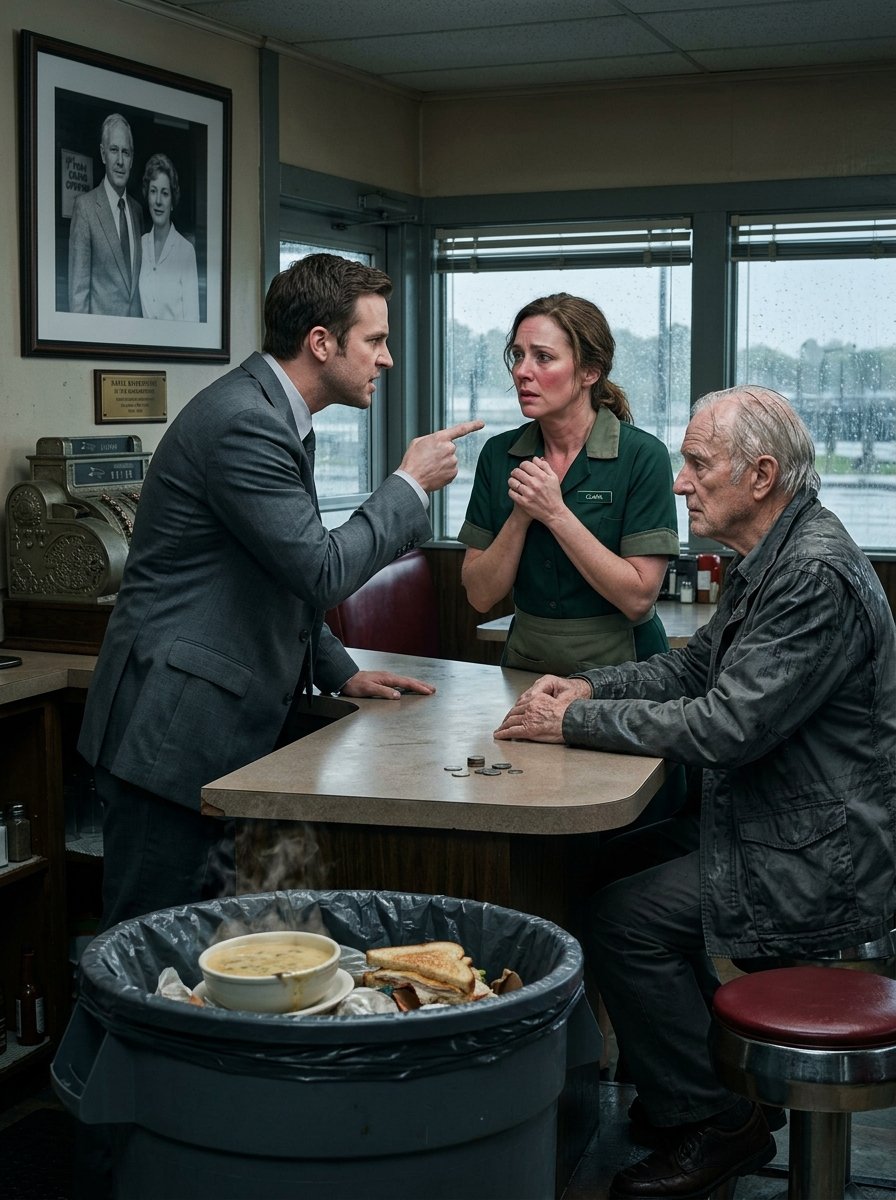
Without another word, Greg reached out with his long, thin fingers, grabbed the plate with the turkey melt, grabbed the stoneware bowl of hot soup, and dumped them both straight into the tall gray trash can behind the register. The ceramic plate made a sickening, sharp crash against the metal rim, shattering into three pieces at the bottom of the bin. The entire dining room went dead silent. The two truckers in booth four stopped chewing their eggs, and the rattle of silverware from the kitchen died out instantly. If he wants charity, he can go down to the shelter on Fourth Street, Greg said, pointing a stiff finger right between my eyes. This is a commercial dining establishment. We don’t host vagrants, and we don’t let servers give away inventory. You step out of line again, Clara, and your shift ends right then and there. Pack your apron and leave the building.
My face burned like I’d touched a hot stove, and my chest felt so tight I could barely draw a breath. I thought about the overdue electric notice sitting in the glove box of my Chevy, and I thought about Julian’s winter coat that was already two inches too short at the wrists. I had taken Greg’s petty cruelty for fourteen months because I couldn’t afford to lose my reference or my weekly paycheck, watching him dock our tips every Sunday for a mandatory one-hundred-and-forty-dollar register reserve that none of us had ever agreed to in writing.
I stood there, humiliated and shaking, ready to drop my eyes and swallow the insult the way I always did when Greg started flexing his miserable little authority. Then the old man spoke up from the end of the counter. Young man, he said, his voice remarkably steady despite the shivering in his shoulders. You shouldn’t have done that. Greg spun around on his heel, his face twisting into an open sneer as he glared down at the stool. Get out before I call the police and have you removed for trespassing, you old beggar. The old man didn’t flinch an inch. He slowly reached deep into the inside pocket of his soaked canvas coat, his fingers moving with a deliberate, unhurried grace that felt entirely out of place in our noisy diner. He didn’t pull out a worn leather wallet, and he didn’t pull out a modern cell phone with a cracked screen like the ones we all carried. Instead, he set a heavy, tarnished brass key down on the laminate counter with a solid, metallic click that echoed through the quiet room.
The key was unlike any modern key used in our building or anywhere else I’d ever seen. It was thick, solid brass with deep, intricate notches cut into the bit and a round head stamped with a faded number 1 right in the center. Greg barely glanced at it, letting out a short, harsh laugh that sounded like dry leaves scraping across concrete. What is that supposed to be? Put your junk away and walk out the door, old man, or I’m pressing charges for disturbing the business. I looked down at the brass key, then looked up at the old man’s face, really looked at him for the first time since he walked in out of the rain. There was a large, framed black-and-white photograph hanging right beside our vintage register on the cherry wood paneling, a picture that had been there since my first day on the job six years ago.
The photograph showed the grand opening of the Hayes Riverfront Diner in September of 1984, back when things were built to last. In the exact center of the photo stood a tall, smiling man in his mid-thirties wearing a clean white apron, standing proudly beside his young wife right in front of the brand-new laminate counter. Underneath the glass frame, a small brass plaque read: Arthur Hayes, Founder and Builder, September 12, 1984.
I stared from the photograph down to the old man sitting on the stool. The hair was thin and snow-white now, and the face had deep, carved lines around the eyes and mouth from forty years of weather, but the strong, straight bridge of that nose and the clear blue color of those eyes were identical to the young man in the glass frame. My heart began to pound against my ribs like a trapped bird. Greg, I whispered, stepping closer to the counter and pointing toward the wall. Look at the photo. Shut up, Clara, Greg snapped, his eyes fixed with pure venom on the old man. I told you to clear table three. Don’t speak to me again unless it’s to clock out at the register. The old man ignored Greg entirely, sliding off the stool with slow, deliberate steps and picking up the heavy brass key by its round head. He walked past the counter without a word, heading straight down the narrow hallway toward the back office where Greg kept his paperwork and his stash of extra register rolls.
Hey! Greg yelled, his voice cracking with sudden, rising panic. You can’t go back there! That’s a restricted private office! Stop right now or I’m calling the county sheriff! Greg lunged down the hall after him, his shoes squeaking on the linoleum, but Arthur Hayes did not hurry his pace by a single second. He stopped right in front of the heavy solid-oak door of the manager’s office, the same door the rest of us were forbidden to enter even to grab a spare roll of paper towels. When the regional management group had taken over operations fourteen months ago, they had installed electronic keypads and new security hardware on all the back delivery doors to keep us out of the administrative records, but the original private office door still had its historic 1984 heavy Yale deadbolt. Greg had tried to replace it three months ago to install an electronic latch with a digital keypad, but the corporate facility office had refused the request because the historic property lease terms forbade altering the original hardware.
Arthur inserted the tarnished brass master cylinder key into the ancient Yale lock without a moment of hesitation. It slipped into the keyway without catching, sliding home with a smooth, oiled precision that only a custom-fitted lock possessed. With a crisp, heavy clunk that echoed down the short hallway like a gunshot, the deadbolt retracted into the wood. Arthur turned the solid brass knob and pushed the heavy door wide open into the dim office. Greg froze mid-stride in the doorway, his face suddenly losing all its smug arrogance, turning a pale, sickly gray under the hallway light. How did you… where did you get that key? he stammered, his hands twitching at his sides. I built this room forty years ago, Arthur said plainly, his voice carrying an absolute stillness that stopped Greg dead in his tracks. He walked right inside the office, reached across Greg’s cluttered mahogany desk, and picked up the black landline telephone receiver as if he owned the place. Which, of course, he did.
Greg hurried into the doorway, his hands balling into tight fists as he watched Arthur pick up the phone. Get off that office phone right now! Greg shouted, his voice rising in pitch. I don’t care who you think you are, you don’t have the right to touch company property! Company property? Arthur Hayes looked up from the desk, his gaze sharp and calm like cold water on a winter morning. The operating company leases this physical plant from my family trust. Under Section 8 of the master commercial lease agreement, the property owner retains unilateral inspection rights and immediate lease revocation authority for gross mismanagement, unauthorized structural damage, or moral breach of premises. Arthur dialed a ten-digit number from memory with steady fingers, never taking his eyes off Greg, and pressed the speakerphone button on the desk base.
The line rang twice in the quiet office, sounding loud and harsh against the drumming of the rain outside. A brisk, professional voice answered on the other end before the third ring. Richard Vance, Regional Operations. Greg’s jaw dropped so low I thought it might unhinge, his eyes darting frantically between the phone and the old man. Richard Vance was the regional vice president of the operating company, and he was also Greg’s older cousin, the man who had placed Greg in this general manager position in the first place and covered for his poor numbers every single quarter. Richard, Arthur Hayes said into the speaker, his voice cutting through the office air like a razor. This is Arthur Hayes. There was an immediate, sharp pause on the other end of the line, the kind of absolute dead air that only happens when someone realizes they’ve just walked off a high cliff in the dark.
Mr. Hayes? Richard’s voice changed completely in a fraction of a second, dropping every trace of executive briskness into an instant, trembling panic. Sir, I didn’t know you were in the state. We had your annual property inspection scheduled for next month in November, and everything down at the Hayes Riverfront location is fully compliant with, I decided to come a month early, Arthur interrupted quietly. And I decided to come through the front door instead of the loading dock. The silence in the office was so heavy you could hear the rain drumming against the back metal gutters and the hum of the old refrigerator out in the kitchen. Greg stood frozen in the doorway, his hands trembling at his sides as the realization of what he had just done began to settle over him like wet concrete.
I’m standing in my original office right now, Arthur continued into the phone, his tone even and merciless. Twenty minutes ago, I watched your general manager rip an eight-dollar-and-fifty-cent sandwich out of a hungry patron’s hands and dump it straight into the trash can. That meal had been purchased with a hardworking server’s earned shift allowance. Mr. Hayes, please, let me explain, Richard’s voice pleaded through the small speaker, sounding small and desperate. Greg runs a tight margin for the district, but he’s, I am not finished, Richard, Arthur said, his voice dropping an octave with cold authority. While standing in this hallway, I also took a look at the monthly maintenance board. I see cracked floor tiles that were reported eight months ago, grease traps that haven’t been professionally cleared since spring, and a roster of loyal employees being threatened with termination for basic human kindness.
Arthur looked up from the desk and locked his eyes directly onto me as I stood just outside the office door in the narrow hallway. Clara, Arthur said gently, his tone softening completely. Come inside. I took a deep breath, my boots feeling heavy on the linoleum, and stepped past Greg without looking at him. For fourteen months, I had stayed quiet because I was terrified of what would happen if I couldn’t bring home my paycheck on Friday to pay for Julian’s asthma inhalers. I had watched Greg verbally abuse young dishwashers until they cried and quit. I had watched him take cash out of our shared tip envelope every Sunday evening, claiming it was for register balancing and administrative fees. Tell Mr. Vance on the phone what happens to your wages every week, Arthur instructed, leaning back in the leather chair. Greg glared at me, his eyes full of silent, murderous threats. Clara, be very careful what you say right now, he hissed through his teeth. You want to keep your job or not?
I looked at Greg, then down at the heavy brass key lying on the desk, and finally at the small black speakerphone box. The fear that had kept my mouth shut for over a year simply vanished like smoke in the wind. Every week, Greg takes one hundred and forty dollars from the server tip pool, I said clearly into the microphone, my voice steady and loud enough to fill the small room. He calls it a mandatory register reserve. Over the last twelve months, he has taken over fourteen thousand dollars from the floor staff. When we asked to see the accounting ledger, he threatened to cut our hours to zero and blacklist us from every diner in the county. That is an outright lie! Greg shouted, stepping forward into the room with his fists clenched. She’s an insubordinate, bitter employee trying to cover for her own health violations and inventory theft!
Shut up, Greg! Richard Vance yelled through the speakerphone so loud the plastic housing crackled. The anger in the regional director’s voice was unmistakable and absolute. Mr. Hayes, I swear to you on my career, corporate headquarters did not authorize any tip retention or deferred maintenance funds. We sent maintenance disbursements every single quarter for this location. Then your manager pocketed the money and logged false cuts to pad his store performance bonus, Arthur said, picking up the heavy 1984 commercial covenant from the filing cabinet drawer. I have the original commercial operating lease in my hand right here, Richard. Clause twelve allows me to terminate your group’s operating lease within twenty-four hours for criminal conversion and gross negligence on the premises. If your company wants to keep this location open under your brand, you will clean your house right this second.
Consider it done, Richard said without a single second of hesitation, his voice flat with defeat. Greg, step away from the desk right now. You are relieved of duty immediately. Pack your personal belongings and leave the property this minute. If you touch any paperwork or register cash on your way out, I will have the county sheriff meet you in the parking lot with a warrant. Greg looked around the small room, breathing hard through his nose like a cornered animal. He looked at Arthur, then down at the speakerphone, and finally at me with a look of pure hatred. For the first time since he had taken over the diner fourteen months ago, he had nothing left to say. He grabbed his cheap raincoat from the coat rack by the door, shoved past us into the dining room without another word, and walked out the front door into the pouring rain, his car keys jingling in his trembling hand.
Two hours later, an independent internal auditor from the regional office arrived with the company’s master district accounts ledger and three thick ring binders. By four o’clock that afternoon, the preliminary review confirmed exactly what we had lived through day after day: over the previous twelve months, Greg had improperly diverted fourteen thousand two hundred dollars from staff tip pools and local maintenance funds to make his store profitability numbers look artificially high for his quarterly review. Richard Vance arrived in person before the evening dinner rush, looking exhausted and pale in his expensive overcoat. In front of the entire evening staff gathered near the counter, he issued a formal corporate apology on behalf of the operating group and cut immediate reimbursement checks to every server and cook who had been shorted during Greg’s tenure. My back-tip check came to two thousand one hundred and eighty dollars, enough to clear every past-due utility notice in my glove box and buy Julian a brand-new winter coat with room to spare.
Then Arthur Hayes walked out from the back office, wearing a dry flannel shirt that our head line cook, Eddie, had brought him from his locker in the back. This place was built on the idea that good food and decent treatment belong to everybody who walks through that door, Arthur said, looking around at the staff gathered near the counter with hot mugs of coffee in their hands. Richard, if your company wants to renew this commercial lease at the end of the term next month, I want Clara running floor operations as the general manager of this diner. I looked at Arthur, my eyes stinging with hot tears that I didn’t bother to wipe away. Arthur, I’ve only ever been a floor server, I said, my voice catching in my throat. I don’t know the first thing about business management or corporate accounting software. You know how to treat people with dignity and respect, Clara, Arthur said with a quiet, knowing smile that crinkled the corners of his eyes. You can learn the inventory software in a week of shadowing. The other part can’t be taught in a seminar.
By six that evening, the rain had finally stopped, leaving the river outside calm and reflective under the yellow streetlights as the evening shift settled into a steady, peaceful rhythm. Before Arthur left to catch his ride back into the city, he walked over to the cash register and picked up the tarnished 1984 brass master key from where it lay on the counter. Instead of putting it back into his pocket, he took a small picture nail from the back office drawer and drove it into the oak paneling directly beneath the opening-day photograph with two firm taps of a heavy screwdriver. He hung the heavy brass key right beside his younger self’s smiling face in the glass frame, letting it catch the warm light of the diner interior. Leave it right there, Arthur told me as he buttoned up his canvas jacket against the evening chill. Just to remind whoever stands behind this counter why these doors are open in the first place.
I walked back behind the register and clocked in for the evening shift with a steady hand, feeling the brass key gleaming just inches from where my fingers rested on the keys. For the first time in six years, I wasn’t worried about whether I could pay my bills on Friday, and I didn’t have to look over my shoulder when I poured a hot cup of coffee for someone who needed it.