How I Found My Eight-Year-Old Daughter Working as a Maid in Our Villa and Met My Wife’s Bank Ledger

The last normal thing my daughter Isabella said to me that morning before my taxi arrived was that she wanted a tin of those soft graphite pencils with the rubber animals on top, the ones they sold in the airport shop down by Gate 14. I told her I would find them in Dubai and bring back enough to fill a coffee mug. She was standing on the bottom step of our entryway in her yellow socks with the rubber grips on the bottom, holding a half-eaten piece of toast she had forgotten to finish because the school bus honked twice down at the corner.
I kissed the top of her head, grabbed my heavy leather duffel, and told her to mind her mother. That was four months ago, and honestly I thought about those pencils every single time I had to check the grade of a concrete pour under forty-degree desert sun, figuring out how many days were left until I could get back to the coast.
When the foundation schedule broke wide open because the supplier delivered three days early, I did not call Beatriz. I wanted to see the look on Isabella’s face when I walked through the heavy wooden front gates with nothing in my hands except my passport and a small box of chocolates wrapped in blue paper. The taxi let me down at the tarmac turnabout outside Marbella at two in the afternoon, right when the heat was heavy enough to make the asphalt smell like old tires. I did not use the main remote clicker because the batteries had been dying anyway, so I just slipped through the side pedestrian gate near the olive trees.
The gravel path was quiet except for the cicadas screaming in the hedges. Then I heard that wet, dragging sound coming around the corner of the guest wing, like someone was pulling a sack of wet laundry across loose stones.
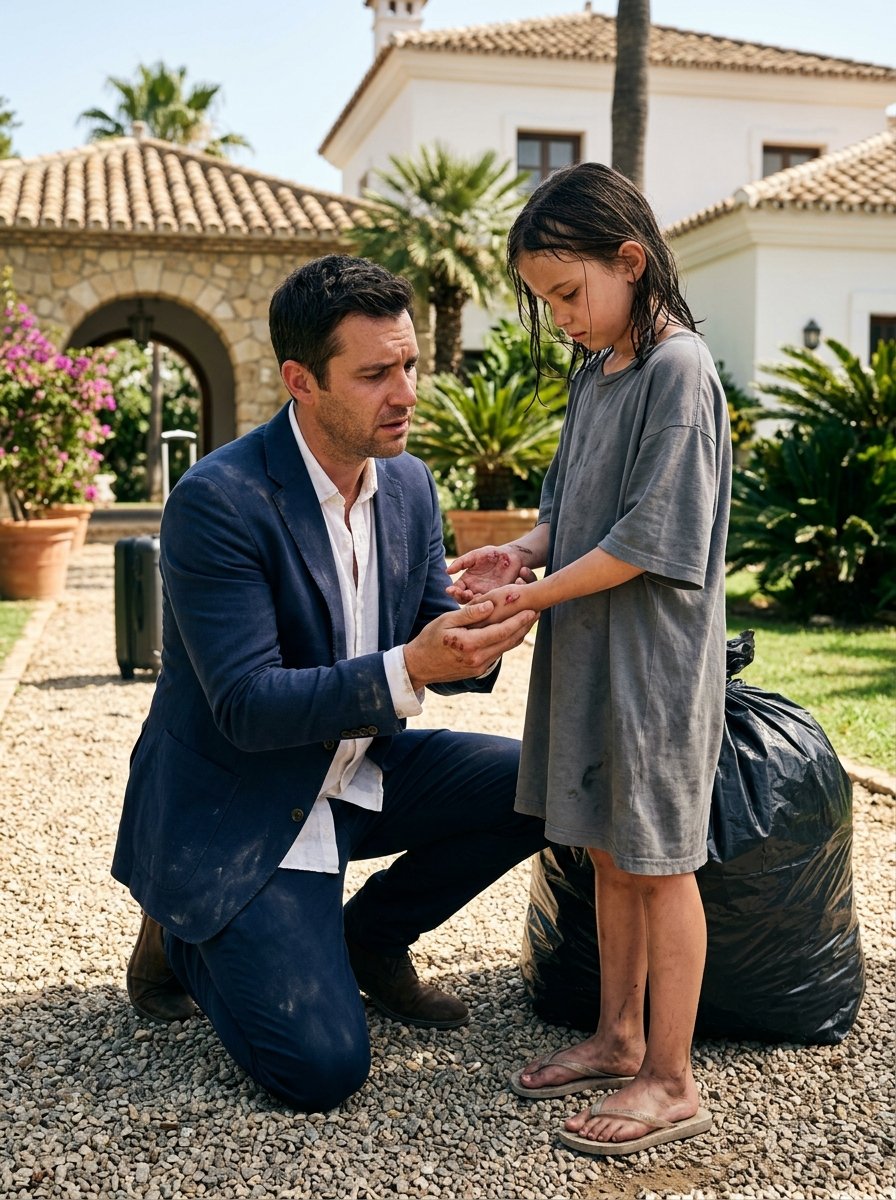
It was Isabella, and she looked like a little ghost. She was wearing one of my old gray cotton work t-shirts that hung down past her knees like a sackcloth, and her feet were jammed into a pair of plastic flip-flops that were caked white with dry clay and garden mulch. She was hauling a black heavy-duty construction trash bag that looked like it weighed thirty pounds if it weighed an ounce, her small shoulder hitched up high and her teeth bitten hard into her bottom lip just to keep her balance. When I dropped my bag and called her name, she jumped so hard she fell backward against the gravel, the big plastic bag tearing slightly at the bottom and spilling out a heap of dead bougainvillea cuttings and dirty paper plates.
She did not run to me like she used to when I came home from weekend jobs in Madrid. Her shoulders went stiff, her chin dropped right down to her chest, and she shoved both her hands straight behind her back like she was hiding a broken dish.
She whispered daddy in that tiny, raspy voice that sounded like she had been screaming into a pillow or hadn’t spoken to another human being since breakfast. I walked over and knelt down on the hot gravel, ignoring the way my knees popped, and reached out to pull her away from the mess. The sun was beating down on the back of my neck like a flat iron, but she was shivering underneath that oversized shirt as if she had the ague. When I gently took her wrists to pull her hands out from behind her back, she let out a sharp little hiss through her teeth and tried to pull away.
I did not let go. I just turned her small palms upward so the sunlight hit them squarely, and my stomach simply dropped out through the soles of my shoes.
Both of her palms were a raw mess of torn friction blisters and open red skin where the wet dirt had gotten inside the cracks. Her right thumb had a deep, jagged scrape across the knuckle that looked like it had been there for weeks, swollen yellow around the edges with old fluid and dust. These were not the kind of scrapes you get from climbing on a jungle gym or skinning your knee playing tag behind the schoolhouse. These were the calluses and tears of someone who had been hauling twenty-pound bags and scrubbing flagstones every single day for months, her skin rubbed thin until it gave up entirely. I could not even look at her face for a second because my own throat felt like it was full of dry sand.
When I asked her what she was doing with the trash, she kept her eyes glued to the dust on my work boots. She told me she had to finish the terrace before the lunch dishes were cleared from the sink, and she whispered that she was sorry for stopping because she didn’t want to get locked in the pantry again. That last word hit me so hard I actually reached out and grabbed her by the shoulders to make sure she was real. Before I could ask what she meant by the pantry, a heavy burst of laughter drifted over the green boxwood hedges from the main pool terrace, followed by the sharp, metallic clink of ice cubes in a crystal pitcher and the sound of someone turning up the portable stereo. It was Sofia’s voice, loud and easy, complaining about the price of French wine in the province.
I picked Isabella up in my arms, and she felt like a bundle of dry sticks compared to the solid little girl I had left behind in March. Her ribs pressed right against my forearm through her shirt, sharp and thin as a birdcage. I carried her around the side of the house toward the bright blue water of the pool, my boots heavy on the stone. The scene waiting for us was something out of a bad magazine spread. The long teak dining table was buried under empty tapas plates, greasy napkins, and five or six half-empty bottles of expensive Rioja. Sofia and her husband Manuel were stretched out on our lounge chairs under the big striped umbrellas with their eyes closed against the glare, while Beatriz stood near the sliding glass doors in a white silk cover-up, holding a tall glass and laughing into her mobile phone.
The entire household staff I paid for every single month was gone. There was no sign of Rosa, no sign of the older man who used to come in on Thursdays to prune the roses, no sign of the housekeeper who folded Isabella’s clothes with lavender sachets. When Sofia finally opened her eyes and saw me standing by the archway with my daughter in my arms like an invalid, her laugh died right in her throat. She kicked Manuel’s shin with her bare foot, and he sat up so fast he tipped his plastic cup over onto the pavers. Beatriz turned around slowly, lowering the phone from her ear, and for about three seconds her face went entirely slack with a look of pure, animal panic that she had never shown me in six years of marriage.
Then she caught herself, plastered that wide, artificial smile right back onto her mouth, and walked across the tiles with her arms stretched out as if we were meeting in the arrivals lounge at Barajas. She told me I was supposed to be in Dubai until next Friday, asking why I didn’t wire ahead so she could have the driver meet me at the station. When she reached out to kiss my cheek, I simply took one step back onto the gravel, holding Isabella tighter against my chest so her bandaged hands wouldn’t brush against Beatriz’s silk dress. I asked her why our eight-year-old daughter was hauling construction trash across the property in ninety-degree heat with her hands torn to raw meat. Beatriz stopped dead in her tracks, her smile turning thin and hard around the edges like dried glue.
She told me not to be so dramatic, waving her wine glass toward the table as if Isabella was just a stray dog we had taken in for the afternoon. She said kids needed to learn the value of work, and that I spoiled her rotten every time I came home with those expensive German toys and silk dresses from the city. When I asked where Rosa and the maintenance crew were, Beatriz didn’t even blink an eye. She told me Rosa had left weeks ago to take care of a sick aunt in Seville, and that the rest of the staff had been stealing from our pantry behind my back, so she let them all go to save us money. She said Sofia and Manuel had kindly moved into the guest wing to help her manage the property while I was away making a fool of myself in the desert.
I looked at Manuel, who wouldn’t look back at me, and then down at Isabella’s face, where she was staring at the tips of my shoes as if she expected me to start hitting her too. I told Beatriz we were leaving right then, and that she could explain her theories about character-building to someone else. Beatriz crossed her arms over her chest, her voice rising until it sounded like tin foil tearing against a brick. She asked where the hell we were supposed to go, reminding me that we had guests for the weekend and that I was making a scene over nothing. I told her I was taking my daughter to a proper doctor in town, and that when I came back through those gates, she and her freeloading family were going to pack every single bag they brought into my house.
The drive down the winding coastal road into town was so quiet you could hear the grit under the brake pads every time we took a corner. Isabella sat in the back seat with her hands tucked firmly between her knees, staring out the window at the olive groves sliding past in the afternoon heat. When we stopped at the red light near the old municipal theater, I looked back in the mirror and asked her what she meant about the pantry. She didn’t look up from her lap for a long time, but then she said in that small, flat voice that Beatriz told her if she complained about the chores or cried when I called on Sundays, I would get tired of the drama and just stay in Dubai forever. That was the moment something inside my ribs simply snapped, and I had to squeeze the steering wheel until my thumbs turned white just to keep the car from drifting into the ditch.
Dr. Alvarez was an old-school pediatrician whose office smelled of old paper and peppermint lozenges, and he didn’t care about my money or Beatriz’s social club friends. He took Isabella into the back room for twenty minutes while I sat on a yellow vinyl chair that squeaked every time I shifted my weight. When he finally opened the door and called me in, he closed it carefully behind me, his face looking like carved granite under the fluorescent lights. He told me the friction burns on her palms were the result of weeks of heavy manual labor, pointing out the fresh blisters forming right underneath the scabs where the skin hadn’t been given a single day to heal. He also weighed her on the scale near the door, and she had dropped nearly four pounds since the last time I took her in before flying out to the Gulf.
He told me he was legally required to log this as a case of severe domestic neglect, and that if I wanted to protect my child, I needed to have the official report stamped and filed with the local authorities before the sun went down. While he went back to his desk to print out the copies on heavy cream-colored paper, I pulled out my phone and opened the banking application for our joint household account. I didn’t look at the recent purchases; I just went straight to the monthly ledgers for the last four months while I was working on the high-rise in Dubai. Every single month, like clockwork, I had wired four thousand two hundred euros directly into that account to pay for Rosa’s salary, the gardeners, the pool service, and Isabella’s private tutor.
What I found was enough to make me want to throw up right there on the linoleum floor. Rosa’s payroll had stopped on the exact Tuesday I boarded my flight out of Malaga, replaced by a series of four identical transfers moving four thousand two hundred euros straight out of the household pool and into Beatriz’s private checking account. She had fired the entire staff within forty-eight hours of my departure, pocketed nearly seventeen thousand euros in maintenance money, moved her sister and her lazy husband into my guest wing rent-free, and turned my little girl into a household drudge. I took screenshots of every single ledger entry, downloaded the PDF statements, and had the clinic desk printer spit out three clean copies of the doctor’s report with the red wax seal at the bottom.
I folded the papers up, tucked them inside the breast pocket of my linen jacket, and walked back to where Isabella was sitting on the exam table swinging her bandaged legs. I knelt down until my eyes were level with hers, took her small, hurt hands very carefully in mine, and told her the truth for the first time since I walked through the gate. I told her I was never going back to Dubai, that I had handed my resignation to the regional director over the phone from the car park, and that nobody in this world was ever going to make her scrub another floor while I was breathing air. She looked at me with those big, dark eyes that looked too big for her face, and then she let out one long, ragged breath and leaned her forehead right against my collarbone.
When we pulled back up to the villa at five o’clock, the sun was casting long yellow shadows across the gravel drive. Sofia and Manuel were still sitting on the patio with their wine glasses, listening to some local radio station play old flamenco guitar tracks while they shelled salted almonds into a silver bowl. Beatriz came out through the sliding doors holding an espresso cup, looking completely cool and collected as if I had just taken Isabella out for an ice cream cone. She asked if the doctor had laughed me out of the office for being an overprotective father who couldn’t handle a little country air. I didn’t say a single word to her. I led Isabella up the wide marble stairs, tucked her into her own bed with a fresh glass of water, and told her to sleep while I sorted out the terrace.
When I came back down the stairs, my boots made a hard, dry sound against the stone that made Sofia look up from her book. I walked straight over to the portable stereo sitting on the stone wall and pulled the power cord right out of the outdoor socket, killing the music instantly. Manuel sat up, his face turning red under his expensive sunglasses, and told me to watch myself. I told them both to get their luggage packed and out of my house inside of thirty minutes, or I would call the local Guardia Civil and have them dragged off the property for criminal trespassing. Sofia gasped as if I had slapped her across the face with a wet towel, turning to Beatriz and asking if she was just going to stand there and let her husband act like a madman.
Beatriz stepped forward with her espresso cup in her hand, her face flushing a dark, ugly red that matched her lipstick. She told me I had lost my damn mind, reminding me that her name was on the marriage certificate and that I couldn’t just throw her family out into the street like stray dogs. I pulled the papers out of my jacket pocket and tossed them onto the glass table right on top of their half-eaten bowl of almonds. The top document was Dr. Alvarez’s clinic report with the red seal, and right beneath it were the bank ledgers showing every single euro she had stolen from the household account while Isabella was bleeding on the stones. Beatriz stared down at the black-and-white figures for a long second, and I could watch the color drain out of her face until she looked like she had seen a ghost in broad daylight.
She tried to stammer something about unexpected expenses and how she was just saving for a rainy day, reaching out a hand to touch my sleeve as if we were still having a quiet discussion over breakfast. I told her to keep her hands to herself and reminded her that I had already sent copies of those exact bank statements and medical records to my solicitor in town. Sofia and Manuel were already scrambling out of their lounge chairs, avoiding my eyes as they hurried toward the guest wing to grab their designer bags from the closets. I told Beatriz she had twenty minutes to pack one single suitcase and get off my land before the private security guards I hired from the estate entrance came up the drive to help her along. She started crying then, real ugly tears that smeared her mascara down her cheeks, begging me to talk it over like civilized people, but I just turned my back and walked over to the stone balustrade.
Twenty minutes later, the two security guards were standing by the front gates like a pair of iron statues as Beatriz, Sofia, and Manuel loaded their suitcases into the back of a beaten-up gray taxi that smelled of diesel fuel. Beatriz tried to look back at me through the rear window as the car rolled down the gravel drive, but I didn’t wave back. I simply watched the heavy iron gates swing shut with a dull, final thud and threw the manual deadbolt into place. The house was so quiet when they were gone that I could hear the refrigerator humming in the kitchen from three rooms away. I spent the next two hours walking through every single room with a large black trash bag, throwing away every magazine Sofia had left on the tables, stripping the guest beds down to the bare mattresses, and scrubbing the kitchen counters until they squeaked under my fingers.
At seven o’clock, I called my director in Madrid, told him I was finished with the international rotation, and accepted a permanent position overseeing local structural builds along the coast so I could sleep under my own roof every single night of the week. Then I went back upstairs to Isabella’s room. She was sitting on her pink wool rug, trying to use a yellow crayon with her bandaged fingers, but she kept dropping it because the gauze was too thick. When she saw me standing in the doorway, she froze like she expected me to change my mind and tell her she had to finish sweeping the patio. I sat down cross-legged on the floor right beside her, took the crayon out of her stiff fingers, and told her that her aunt and her mother were gone for good and that I wasn’t ever going back to the desert.
She stared at me for a long time, her lower lip trembling just a little bit, before she dropped her head onto my shoulder and started to cry. It wasn’t the hard, desperate crying she had been doing earlier in the car; it was just the slow, heavy release of a little girl who finally realized she didn’t have to carry twenty-pound trash bags anymore. I held her until the sun went down behind the hills, turning the sky the color of a bruised plum. Later, we sat out on the small kitchen patio eating bowls of plain noodles with butter and salt, the evening breeze coming off the Mediterranean cool and clean against our skin. Isabella looked across the table at me, picked up her fork with her good fingers, and gave me a small, crooked smile that reached all the way up to her eyes.