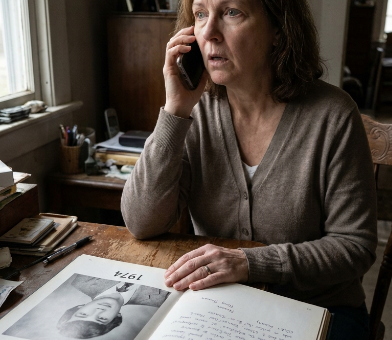
Ninety days. That was how long I watched my daughter push her dinner away across our oak table and pretend she was just dealing with normal freshman stress. Three months of empty plates, oversized knit sweaters, and dark shadows forming under warm brown eyes while I told myself she was just going through a regular teenage phase. I worked forty hours a week as a paralegal in our small river town, running on caffeine and court filings, and I honestly thought I was just too tired to notice her growing up.
Then came that Tuesday morning in mid-November, raining hard enough to pelt the windowpanes against the glass. Sofia had already caught the 7:15 bus, and I had a late start at the firm, so I went upstairs to strip her bed linens. When I pulled the fitted sheet loose from the corner, my hand caught on something stiff tucked deep between the mattress and the heavy wooden box spring.
It was a standard black-and-white composition notebook, its paper cover worn soft at the edges from being held too tight. A folded scrap of loose-leaf paper fluttered out of the pages as I picked it up, landing quietly on the hardwood floorboards.
I picked it up. Written across the top line in Sofia’s neat, careful cursive were words that made the room tilt right off its foundation: Day one of not eating. If I become small and invisible enough, maybe he will stop looking at me.
Maybe if I do not stand out in his class, he will leave me alone.
My heart hammered against my ribs like a trapped bird. My hands shook so badly I could barely turn the pages of the notebook, sitting right down on the edge of her unmade twin bed because my knees kind of stopped working. Line after line of frantic, tear-stained handwriting spanned the previous three months, detailing systematic harassment by Marcus Sterling, the forty-eight-year-old Vice Principal and head of the Westbridge High honors program.
October 12: He called me into the guidance annex after seventh period again. He locked the inner door. He told me that if I want my college recommendation letter for the state honors grant to stay clean, I need to keep our special meetings quiet.
The name jumped out at me from every single page. Sterling. A man the school board treated like a saint for bringing in Ivy League scholarship money.
I did not grab my purse. I did not fix my hair. I grabbed that notebook, ran out to my sedan, and drove to Westbridge High School with my knuckles locked white around the steering wheel. When I pushed through the front double doors, the receptionist looked up from her desk and blinked at me.
Ma’am? Visitors need to sign in at the front counter.
I need to see Principal Vance right now, I said, my voice vibrating with a quiet that made the woman freeze in her chair.
I did not wait for her permission. I walked down the carpeted hallway and threw open the door to the principal’s corner office without even knocking. Arthur Vance, a broad-shouldered man in a grey suit, dropped his pen and looked up from his desk with a frown.
Mrs. Torres? What is going on? You cannot just storm in here.
Something is happening to my daughter in this building, I snapped, stepping right up to his heavy oak desk. Something terrible, and it stops today.
Vance adjusted his wire-rimmed glasses and took a slow breath, putting on his polished administrator voice. Mrs. Torres, please take a seat and calm down. Sofia is our top freshman student. She has a 4.0 GPA, and her teachers adore her. I assure you, nothing is wrong.
She has lost twenty pounds in three months because she is terrified to walk through your hallways, I shouted, the tears finally breaking over my lower lashes.
Mrs. Torres, high school transition stress is very common, Vance said, holding up his hands like he was managing a difficult client. Academic pressure affects appetite. We have wonderful counselors who can talk to her about managing anxiety.
I reached forward and slammed that black-and-white composition notebook flat onto the glass blotter right under his nose. Read page fourteen, I told him, my voice shaking. Read what your staff is doing to my fourteen-year-old child.
Vance frowned, clearly annoyed by my hostility, but he leaned forward and looked down at the paper. His eyes scanned the top paragraph. Then he paused. He adjusted his glasses, leaned closer, and read the handwritten dates, the specific room codes, and the transcript of threats logged in my daughter’s handwriting.
As his eyes reached the bottom of the page where Marcus Sterling’s private office extensions were documented, the diplomatic composure completely vanished from Principal Vance’s face. The color drained from his cheeks until he looked almost gray. His mouth opened slightly, his eyes wide with horror.
He slowly looked up at me, his hands trembling so hard the paper rattled against the wood. Without saying a single word, Vance reached for his black desk phone, hit a direct line button, and lifted the receiver to his ear.
This is Principal Vance, he said, his voice flat and hollow. I need an emergency police dispatch to Westbridge High School immediately. I am reporting a felony criminal offense involving an administrator on campus. Send Detective Reyes directly to my office.
The forty-five minutes that followed passed in a surreal blur. Principal Vance immediately placed the administration building on a soft lockdown, and within ten minutes, two unmarked police cruisers pulled onto the concrete plaza outside. Detective Sarah Reyes, a sharp woman in a dark blazer, stepped into the principal’s office alongside a uniformed officer.
My first instinct as a mother was to run down the hallway to Sofia’s history class, but Detective Reyes gently caught my elbow in the doorway. Mrs. Torres, I know every fiber of your body wants to grab your daughter right now, she said softly. But if we march into her classroom with uniformed officers, we create a public scene that will traumatize her further and give Marcus Sterling an immediate warning to erase his digital devices. Let us handle this with precision.
I swallowed the lump of fire in my throat and nodded. Vance arranged for the school nurse, Mrs. Gable, to quietly pull Sofia from her class under the guise of an routine health record update. Two minutes later, the side conference room door opened, and Sofia walked in carrying her heavy backpack.
When her eyes landed on me standing beside Detective Reyes, her face went completely pale. She saw the composition notebook resting on the conference table, and her breath hitched in a terrified gasp.
Mom? Sofia whispered, her voice cracking as her backpack slipped from her shoulder. What are you doing here?
I crossed the room in two strides, dropped to my knees in front of my daughter, and wrapped my arms around her frail waist, pulling her small, shaking body against my chest. You are safe, baby, I sobbed into her shoulder. I found the notebook. You do not ever have to go back into that room.
Sofia froze for a single second, and then the heavy dam she had built inside herself for ninety days completely broke. She fell onto her knees beside me on the carpet, burying her face into my neck and letting out deep, agonizing, shuddering sobs.
I am sorry, Mom, she wept, soaking through my sweater. He said he would ruin you. He said he would tell the school board that you falsified our income forms for my tuition grant. He said no one would believe me.
Shh, no, baby, no, I cried, holding her head in my hands and looking directly into her tear-filled eyes. He was lying to you. He is a monster, and he is never going to touch your life again. You did nothing wrong.
Detective Reyes knelt down beside us, her face solemn and completely focused. Sofia, my name is Detective Reyes. Your mother is right. What happened to you is a crime, and Marcus Sterling is never going to hurt you or any other student in this building again. But I need you to help us make sure he can never do this to anyone else.
While a victim advocate sat with Sofia and me in the private conference room, Detective Reyes and her team moved with terrifying, efficient speed. Because Sofia’s diary contained specific dates, times, and exact quotes from text messages Sterling had sent her through a secondary encrypted messaging app, officers secured an emergency search warrant from a county judge within forty minutes.
At 11:15 AM, while students were in fourth period, three plainclothes detectives walked into Vice Principal Marcus Sterling’s corner office at the end of the administrative wing. They served the warrant on the spot, confiscating his personal cell phone, his district computer, and a thumb drive locked inside his desk drawer. Through the glass windows of the conference room, I watched as two uniformed deputies escorted Marcus Sterling out through the rear administrative exit in handcuffs. He wore his sharp grey suit, his head bowed, his face dark with panic as he was loaded into the back of a police cruiser.
Sofia sat at the table, wrapped in a warm fleece blanket Mrs. Gable had brought her, holding a cup of sweet tea. As she watched the police car drive away through the window, the color slowly began to return to her lips.
He is really gone? Sofia whispered, looking up at me with young eyes filled with disbelief and fragile hope.
He is gone, sweetie, I said, taking her cold, thin hands in mine. And now we are going home.
The days following Marcus Sterling’s arrest revealed the true, insidious scope of the illusion he had constructed at Westbridge High School. When police forensic experts audited his confiscated hard drives, they did not just find the encrypted messages he had sent to my daughter. They discovered a pattern of psychological grooming and extortion stretching back over four years, targeting bright girls from single-parent or low-income families who relied heavily on his signature for state scholarships. He had used their academic ambitions and fear of losing their futures as a weapon to keep them silent.
Two days after the arrest, the school district’s legal team attempted to arrange a private meeting at my law firm’s office. A smooth attorney representing the school board sat across the table from me, offering an immediate, private educational trust fund for Sofia, alongside an offer to transfer her to an elite private academy across town with all expenses paid.
We want to ensure Sofia’s academic future is completely protected, Mrs. Torres, the attorney said smoothly, sliding a folder across the mahogany table. In exchange, we would ask for a comprehensive non-disclosure agreement regarding the administrative oversight procedures during the ongoing criminal trial.
I looked at the thick legal folder sitting between us. I thought about the ninety days my daughter had spent suffering in silence, pushing her food away, trying to shrink her body into nothingness just to escape a predator who held a key to her school doors. I picked up the folder and slid it right back across the table without opening it.
My daughter’s dignity and safety are not for sale, I said, my voice cutting through the quiet office like a razor. You will not sweep Marcus Sterling under the rug to protect your district’s reputation. Every single detail of his actions will be presented in open court, and every parent in this county will know exactly what happened inside those walls.
Detective Reyes stood firmly by our side throughout the grand jury proceedings. With Sofia’s meticulous, dated composition notebook acting as the central pillar of evidence, supported by the recovered digital files from Sterling’s phone, the prosecutor filed sixteen felony counts of coercion, child endangerment, and administrative extortion. Deprived of his administrative standing and facing an ironclad mountain of evidence, Sterling’s high-priced defense team collapsed within two months. He pleaded guilty to multiple felony charges, receiving a mandatory fifteen-year sentence in state custody without the possibility of early parole, alongside the permanent revocation of his educator licenses nationwide.
In late January, the school board was forced to execute a complete administrative restructuring, implementing strict new safety protocols, independent oversight channels for student scholarship grants, and mandatory reporting systems that ensured no single administrator would ever hold absolute power over a student’s future again.
The victory in court was absolute, but the real work, the quiet, grueling work of healing my daughter, happened at home one day at a time. For the first two months, Sofia struggled with deep anxiety. She stayed home with me under an approved district home-study program while we worked with an exceptional adolescent trauma therapist named Dr. Aris. We threw away the oversized hoodies. We filled her room with soft light, colorful art supplies, and warm blankets. We did not talk about weight, calorie counts, or meals as a chore; we talked about safety, strength, and rebuilding trust from the ground up.
I took a six-week family medical leave from my paralegal job, spending every morning sitting with Sofia on our back porch, sipping hot cocoa, listening to her talk about her favorite books, and reminding her every single day that her voice was the most powerful thing she possessed.
Six months after that terrifying Tuesday morning in November, the warm, golden light of late spring streamed through our dining room windows. It was a Friday evening, exactly 6:00 PM. The house smelled wonderful, a rich, savory aroma of slow-roasted garlic chicken, warm yellow rice, and freshly baked corn muffins filling the kitchen.
I walked out of the kitchen carrying a large wooden salad bowl and set it in the center of the dining room table. Sofia walked in from the living room. She was wearing a lovely, light-blue fitted sweater that fit her comfortably, her dark hair thick and shiny again, her cheeks carrying a healthy, radiant color. She had gained back fifteen pounds of healthy weight, but more importantly, the heavy, haunted shadow that had clouded her young eyes was completely gone.
She sat down in her usual chair across from me, smiling as she reached for a warm muffin. Smells amazing, Mom, Sofia said, her voice light, clear, and filled with effortless warmth.
Pass your plate, sweetie, I smiled, serving her a generous portion of chicken and rice.
We sat together at our small dining table, eating, laughing, and talking about her plans to rejoin the regional debate team in the fall, this time under a wonderful new female advisor who had reached out to support her. As I watched my daughter laugh at a story about her friend’s stubborn dog, taking a hearty bite of her dinner without a single moment of hesitation or fear, a deep, overwhelming wave of peace settled over my heart.
The black-and-white composition notebook was now safely locked inside an evidence vault at the county courthouse, its pages having served their purpose in bringing a predator to justice. But the lesson it taught me as a mother would remain written on my soul forever. Children do not always have the words to scream when they are trapped in the dark. Sometimes, their cry for help is spoken in silence, in pushed-away plates, in oversized clothes, and in a quiet withdraw from the world they love.
I looked across the table at my brave, resilient fourteen-year-old daughter, reaching across the wood to squeeze her hand tightly. We had fought through the dark together, and now, inside our warm, loud, loving home, my daughter was no longer trying to become invisible. She was standing fully, proudly, and safely in the light.