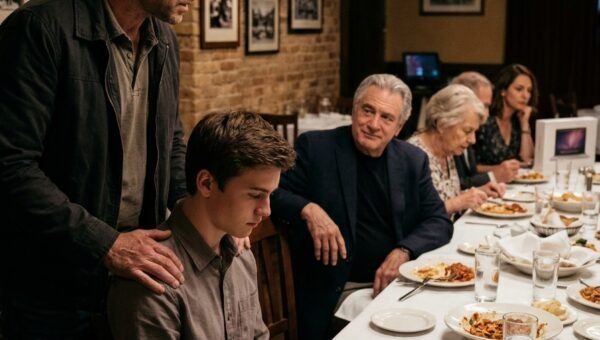
The room went quiet after General Staer asked where the photo came from.
I remember the clink of my fork against my plate. It was a small, stupid sound. My hand had moved before I knew what to do with it.
Dad looked at the screen, then at Bridget, who was still standing by the slideshow controls.
“I found it online,” she said. “I’m sorry. I didn’t know what it was.”
She looked at me, not him. I gave her a small nod.
She hadn’t meant to put me on display. She’d been trying to make the slideshow nice.
Dad lowered his glass. “What is it?”
General Staer didn’t answer him right away. He looked at the photo again.
“Could we find the original source?” he asked Bridget. “The caption matters.”
Bridget’s fingers fumbled with the laptop. For a few seconds, the screen went dark. Then the photo came back, along with a page she’d saved while building the slideshow.
She read the heading under it. “Army feature. It says it’s from the evacuation outside, ” She stopped and glanced at me.
I nodded. “You can read it.”
The page gave the date and the unit, and identified me in the picture. The caption said I was helping coordinate the evacuation of wounded soldiers after the operation’s chain of command was disrupted. It also named the medics and other service members involved.
It didn’t say I did it alone. I didn’t.
General Staer read the caption silently, then set his hand on the back of the nearest chair.
“I remember the report,” he said. “I reviewed it after the operation. The account matched what’s written here.”
Dad was still holding the glass. “You were there?”
“No, sir,” General Staer said. “I reviewed the report. I know what it documented.”
I was glad he said that. He hadn’t known me personally. He wasn’t there to make me into a legend. The report was the report, and the photo showed one part of a much bigger day.
I’d been a major then. There was confusion after the officer directing the movement was hurt. I took over coordination while the medics and the rest of the team got people out. I remember asking for a count twice because the radio kept cutting out. I remember grit in my teeth and a medic named Luis yelling that he needed room.
That’s what the photo caught. Not the whole thing. Just one moment when I was trying to make myself heard.
The ballroom stayed quiet. Not in a grand way. People were simply waiting to see what Dad would do.
I could have explained it all. I could have told the room what those ribbons meant, what twenty years meant, what it felt like to hear my own father call my work paperwork.
I didn’t want to use the general to make my case for me.
Dad cleared his throat. “I didn’t know about that.”
I looked at him. “You didn’t ask.”
His mouth opened, but nothing came out. Marcus shifted in his chair.
I don’t think Dad had planned to hurt me that night. He’d planned to be funny. He wanted the room to like his speech, and he knew that joke would get a laugh. That doesn’t make it harmless.
“I made a joke about work I don’t understand,” he said at last. “That was wrong.”
Nobody clapped. I was relieved. A round of applause would have made it too easy to move on.
Marcus stared down at his napkin. “I shouldn’t have said that either.”
“No,” I said. “You shouldn’t have.”
He looked up, as if he expected me to make it softer. I didn’t.
Dad turned toward the tables. “I’m sorry for making Adele the joke tonight. I was wrong to do that.”
His voice sounded tight. He didn’t add that he’d only meant to tease me. He didn’t say everybody had laughed. I noticed that.
The general stepped back from the screen. He didn’t add anything else about the operation. He didn’t need to.
A few people looked at me. Mrs. Peterson, seated beside me, touched my wrist once. I didn’t know what to do with that, so I put my fork down and stood.
Dad had the microphone. He started to say my name.
I raised my hand. “I can speak for myself.”
He lowered it.
My voice came out steady. “That photo is from an evacuation during a deployment. I was one of the people coordinating it. The medics and the team beside me did the work too.”
I took a breath. I didn’t need to give the ballroom a full report. “I’ve spent twenty years in the Army. I don’t do only paperwork. I’d rather be asked about my job than guessed at.”
That was enough. I sat down.
The dinner went on, though not exactly as planned. Dad finished his remarks. The slideshow continued. People spoke to me afterward, some more awkwardly than others. I kept saying it was a team effort, because it was, and because I didn’t want a single picture to become my whole career.
Bridget came over while the room was thinning out.
“I really didn’t know,” she said.
“I know.”
“I thought it was just some Army photo.”
“It was an Army photo,” I said. “It was okay to include it.”
She looked like she still wanted to apologize. I squeezed her hand. “You didn’t make the joke.”
Her shoulders dropped a little.
Mom found me near the coat tables. She had spent most of the dinner watching Dad, and I knew what she was about to say before she spoke.
“I’m sorry I asked you to protect his weekend,” she said. “I put that on you because I didn’t want a scene.”
“I know.”
“I should’ve asked him to stop.”
I didn’t say it was fine. It wasn’t. But I was tired of reassuring everyone before they had finished apologizing.
Mom nodded and looked down at her purse. “I’m sorry, Adele.”
“I heard you,” I said.
Dad waited until most of the guests had left before he came over. Without the microphone, he looked smaller, though he was still a tall man. He kept turning his glass by the stem.
“I owe you an apology,” he said.
“You already apologized.”
“Not properly.”
He seemed to be looking for the right words. I had spent a long time wishing he’d ask about my work, and now that he was standing there trying, I felt almost annoyed at how much I wanted to help him.
I didn’t.
“The joke tonight wasn’t the whole thing,” I said. “You’ve called my work paperwork for years. You never ask what I do. You don’t know what the ribbons on my uniform mean.”
“I thought you didn’t like talking shop.”
“I told myself that, too,” I said. “It was easier than admitting you weren’t asking.”
He rubbed his thumb along the glass stem. “I should have asked.”
“Yes.”
“I thought if something was important, you’d tell me.”
“I did tell you things. You changed the subject.”
Dad looked at the floor. He didn’t argue. That was different, but it wasn’t the same as fixing anything.
“I wanted the weekend to go well,” he said.
“So did I. That’s why I sat there while people laughed.”
He nodded once. “I’m sorry.”
I wanted to hear it. I also wanted to tell him that one apology couldn’t cover twenty years of not being curious. I did tell him that, but not as sharply as it sounds written down. I was tired and trying not to turn his retirement dinner into a trial.
“I’m not asking you to know everything about my job,” I said. “I’m asking you to ask.”
“I can do that.”
“You can try.”
He glanced toward the ballroom. “Will you let me?”
I had no good answer ready. I’d spent so long wanting him to take an interest that letting him try should have felt like relief. Instead, it felt like handing him something breakable and waiting to see if he dropped it.
“There’s a command ceremony in the spring,” I said. “I’ll be taking command of a battalion.”
“I know you have that coming up.”
“I’m inviting you. But I need to be clear. You’re there as my father. Not to make a joke, not to tell my story for me, and not to turn it into your moment.”
“I understand.”
“I don’t know if you do yet.”
He nodded again. “I’ll come.”
I didn’t promise that everything was all right. I didn’t tell him I forgave him. He didn’t ask me to.
Three weeks later, I got the official program for the ceremony. I sent Dad the date and the address. He replied, “I’ll be there,” and nothing more.
That was fine. I didn’t need a speech over text. I did notice that he didn’t ask what he should wear or whether he’d be expected to talk. He just said he’d come.
The ceremony was in the spring, as planned. Dad arrived early and sat with Mom and Bridget. He didn’t come looking for me before the start. I was grateful for that. I had a job to do, and I didn’t want to spend the morning managing anyone’s feelings.
When it was over, people came up to congratulate me. My new command team was there. I thanked them, shook hands, and said more than once that I was glad to be working with them.
Dad waited until the line had thinned.
“I don’t want to interrupt,” he said.
“You’re not.”
He held the program in both hands. He’d folded it once down the middle, carefully, not into a little square the way he used to fold maps.
“What will your command involve?” he asked.
I could have given him the easy answer. The short version. The version that wouldn’t take long or ask much of him.
Instead, I told him about the people I’d be responsible for, the work ahead, and the things I was still learning. I told him about the leaders I trusted and what I hoped my battalion would be able to do.
He didn’t interrupt to compare it to his career. He didn’t make a joke. He listened, holding the program in his hands.
Then he asked what I wanted to know first.