The voice said, “Mercer, can you hear me?”
Captain Rodriguez came over the cabin speaker a second later. He said the flight deck was relaying a message from the lead fighter, and asked the passenger in 12A to confirm he could hear. I pressed the button on my phone, though I hadn’t answered it yet.
“I hear you,” I said.
The executive beside me had stopped typing. He looked at the window, then at me. He didn’t ask what I’d done again. I could see the question sitting there, though.
The pilot came back through the speaker. “This is Captain Rusk. We’re confirming your identity through the flight deck. Please stay seated.”
I said, “I’m seated.”
It sounded rude. I was trying to keep my voice level, but my mouth had gone dry. The encrypted phone was still ringing in my hand. I answered it.
“Jake?”
“Good,” Jake said. “You picked up.”
“What is happening?”
He didn’t tell me to calm down. That was one reason I trusted him. “There was a communications and identification irregularity with your flight. I’ve been told the fighters are checking the plane as a precaution.”
“By who?”
“The liaison handling your travel. I’m not in the control room, Mercer. I know what they’ve told me.”
“Is there a threat?”
“Nothing I’ve heard says there’s a threat directed at you or the plane. I can’t promise what I don’t know.”
That was a better answer than everything is fine. I asked if the crew had confirmation, and he said they were still waiting for the flight deck to finish its check. I watched Captain Rodriguez move behind the cockpit door. The cabin had gone quiet in the way a room gets quiet when everyone is trying to hear a phone call that isn’t theirs.
The executive finally spoke, low enough that I almost missed it. “Are we in danger?”
“I don’t know yet,” I told him. “The captain’s checking.”
He nodded. He looked embarrassed, too, though he had no reason to be. His eyes dropped to my tattoos again, then he looked away. I’d spent the first two hours letting him wonder what kind of man I was. I couldn’t blame him for being afraid now.
Captain Rodriguez came back over the speaker. He said the aircraft was in contact with air traffic control and the escort was part of a precautionary identification check.
He didn’t give the cause. He said there was no confirmed threat, and asked everyone to remain seated while the checks continued.
The plane kept moving. That was the strangest part. A drink cart was still parked near the front, and somebody behind me had a little bag of pretzels open. I could hear the plastic crinkle every time the plane shifted.
Then Captain Rusk’s voice came through again.
“Mr. Mercer, I served as aircrew on the aircraft your team recovered in Syria.”
I kept the phone against my ear. Jake was still there, breathing quietly on the line.
I didn’t answer right away. I’d been told not to discuss that mission, and I wasn’t going to start because a fighter pilot had found a way to speak through an airline speaker.
Rusk seemed to understand. “I’m not asking you to discuss the operation,” he said. “I wanted to tell you I’m alive.”
That got through.
I looked at the thin line of desert outside the window. “You were the pilot?”
“Yes, sir.”
I didn’t like being called sir. I was retired. I was a man with a bad leg trying to get to a ceremony I’d been told to attend.
Still, I knew the voice now, or I knew the memory attached to it. A man talking while we moved him. My hand on his shoulder. The smell of dust and fuel. Someone telling me not to let go.
Rusk said, “You kept telling me to stay with you.”
I lowered the phone from my ear. Jake said my name once, but I didn’t answer him. I looked down at my left leg, tucked awkwardly under the seat in front of me. The spot that still hurt was quiet for a few seconds, as if it had decided to listen too.
“You got me home,” Rusk said.
I put the phone back to my ear. “Your crew got you home.”
“I know,” he said. “I’m not taking anything away from them.”
I said, “Good.”
It was all I could manage without making the conversation into something it wasn’t. Rusk didn’t ask me to tell him about the mission. He didn’t say I’d saved the day. He just told me he’d learned my surname through the limited official record connected to the rescue and confirmed it through the liaison handling my Pentagon travel. That was how he knew I was on the flight. He’d been assigned to the escort because of the check, not because anyone had arranged a flyby for me.
The whole thing was less mysterious than it had felt. Not less strange. Just less mysterious.
Jake asked, “You all right?”
“I’m on a plane with fighter jets outside the window.”
“That’s not an answer.”
“I know.”
There was a little pause. Then he said, “I’m glad he got to tell you.”
I leaned my head back against the seat. The fabric smelled faintly like detergent and old coffee. I remembered that because it was such a stupid thing to notice at a moment like that.
“Me too,” I said.
I thought about the two men who hadn’t come home. I didn’t say their names. I don’t know why. Maybe because the cabin was full of strangers and I’d already had enough of my life made public for one afternoon. Maybe because I didn’t want to say their names in a place where I couldn’t control what happened next.
Captain Rodriguez returned to the speaker. He told us the identification check was complete and the aircraft was continuing to Washington. The two fighters would remain with us as needed for flight operations. He repeated that there was no confirmed threat.
People began moving again in little ways. Someone took a drink from the cup holder. A child started asking questions, and a parent answered in a whisper. The executive beside me shut his laptop.
“I’m sorry,” he said.
“For what?”
“For looking at you like that earlier. I made assumptions.”
I rubbed my thumb over the edge of the phone. “You were nervous.”
“I was.”
“So was I.”
He looked at me for a moment. “You don’t look nervous.”
I almost laughed. “That’s just my face.”
He gave a small, awkward smile and opened his laptop again. Neither of us made a new friend. That’s not what happened. But he stopped watching my arms, and I stopped pretending I hadn’t noticed him watching.
The escort stayed outside for a while. Rusk didn’t speak again over the cabin speaker. I held the phone until Jake told me he had to go, then asked him to stay on a minute longer.
“Do you know what the ceremony is going to say?” I asked.
“Only the approved citation.”
“And if somebody asks me for details?”
“Don’t give them.”
“That simple?”
“It can be.”
I looked past the window, but the fighters weren’t easy to keep in view. “I don’t want to stand there and act like a medal makes this clean.”
“It doesn’t.”
“Two guys are dead.”
“I know.”
“And I’m supposed to put on a suit and shake hands.”
“You’re supposed to accept an award,” Jake said. “You don’t have to pretend you like it.”
That sounded like him. He had a way of making a hard thing sound like a regular job you could finish one step at a time.
“Don’t let them make me talk about the operation,” I said.
“I won’t.”
“You can’t control everybody.”
“No,” he said. “But I can make sure they know what you will and won’t say.”
I told him I’d call after landing. Then I ended the call and slipped the phone into my bag. It was still warm from my hand.
The rest of the flight was ordinary enough. A flight attendant came by with water. The executive asked if I wanted his extra packet of crackers, and I said no, then took it when he offered again. My leg started aching once we were closer to D.C. I shifted it, tried to get comfortable, and failed. There wasn’t much to do about it.
Rusk’s voice stayed with me, but so did the other two voices I couldn’t hear anymore. I kept thinking that someone had lived. I kept thinking that two men hadn’t. Both things were true. One didn’t cancel the other out.
After we landed, I waited until I was clear of the line of passengers before I called Jake. He answered on the first ring.
“You down?”
“Yeah.”
“How’s the leg?”
“Same as it was before we got on the plane.”
“Fair enough.”
I told him what Rusk had said. Jake didn’t sound surprised, but he didn’t pretend he’d known either. He said the pilot’s identity had come through the liaison after the flight deck confirmed the passenger check. It was a narrow chain of information, not something open to the public. He also said the air-traffic issue had been cleared and there was no report of a threat against the plane.
“So that’s it?” I asked.
“That’s what I’ve got.”
I looked at the airport floor and waited for my brain to come up with another question. It didn’t. The plane had been checked. The pilot had told me he was alive. I was still going to the ceremony the next day.
Jake asked if I was going to skip it.
“I said I’d go.”
“You also said that because an admiral ordered you.”
“I know.”
“So?”
I was quiet for a second. A family with two small kids walked past us, dragging a carry-on that made a soft rattling sound over the floor. “I’ll go because Rusk’s alive,” I said. “And because those two should be there too.”
“They will be.”
“That’s not what I mean.”
“I know.”
I checked into the hotel and slept badly. That part isn’t worth dressing up. My leg hurt. I woke up twice. I watched the clock until I was tired enough to stop watching it.
The next day, I put on the suit I’d packed for the ceremony. It was the only one I owned that still fit right. I stood in front of the mirror longer than I needed to, mostly because my tie was crooked. My left hand didn’t work as well as it used to when I was tired, so it took me three tries.
I nearly called Jake to tell him I wasn’t going. I had the phone in my hand and his name on the screen. Then I thought about Rusk saying he was alive. I thought about the two men who weren’t. I thought about how easy it would be to make the choice for myself by calling it a choice to stay invisible.
I set the phone down and finished tying the tie.
Jake met me before the ceremony. He didn’t hug me. We weren’t people who hugged much, and I didn’t need him to pretend we were. He looked at my tie and said, “You got it straight.”
“Third try.”
“Still counts.”
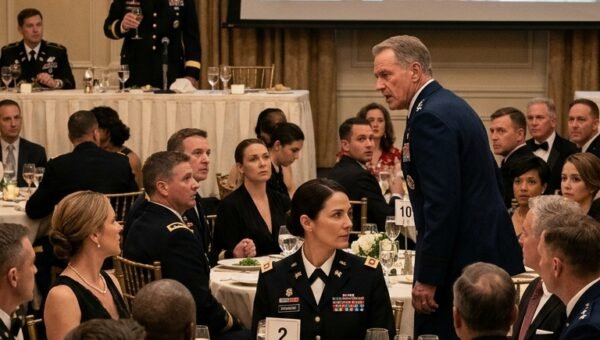
The room was full of people who knew enough to be there and not enough to know the details. That was how it had to be. The citation used the public words they were allowed to use. It described my service and the result without naming the operation or explaining what happened on the ground.
I listened. I kept my hands still. When they called me forward, my left leg hurt on the first step. I took the next one anyway.
The admiral handed me the award and said, “You earned this.”
I said, “Thank you, sir.”
I didn’t feel proud in the way people probably expected. I didn’t feel like refusing it either. The medal was not payment for the men we lost. It wasn’t proof that every decision had gone right. It was a record that the mission had mattered to someone besides the people who had been there.
When they asked if I wanted to say a few words, I’d already decided what I could say without crossing the line.
“I can’t talk about the operation,” I said. “I can say I didn’t do this alone.”
I paused. I could feel the room waiting, but I didn’t have to fill every second.
“Two of my teammates didn’t come home. I want them remembered with me.”
That was it. No names. No story I wasn’t allowed to tell. No claim that the award made anything right.
Afterward, people came up and shook my hand. A few said they were sorry for the loss. I thanked them. It wasn’t a conversation I knew how to have, but I stayed for it instead of slipping out the first chance I got.
Jake waited near the door with my coat. When I reached him, he asked, “Ready?”
“Not really.”
“Want to get something to eat?”
I said yes. We went somewhere quiet enough that I didn’t have to keep turning toward people when they spoke. He ordered coffee. I ordered soup and ate half of it. We talked about ordinary things for a while, which was a kindness, though neither of us called it that.
Before we split up, I told him I’d keep the next check-in we’d planned. Not because I suddenly had a lot to say. Because I knew how easy it was for me to miss one, then another, and make being alone sound like a preference.
“Thursday?” he asked.
“Thursday.”
He nodded and didn’t ask me to promise anything else.
I put the medal in my closed hand instead of pinning it to my coat. My boots sounded the same on the Pentagon corridor floor as they had on the airport tile. I still wanted to disappear some days. I just didn’t have to throw the medal away to do it.