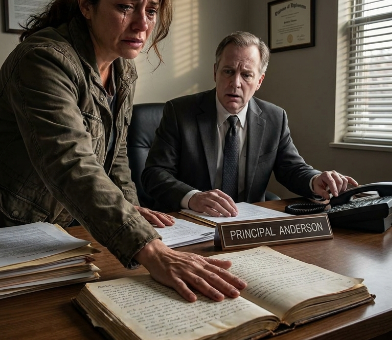
The smell of floor wax and old paper always lingers in the corners of Arthur Vance’s office, but on that Tuesday afternoon in Des Moines, it just smelled like a ledger that finally had to be balanced. I know you will hate me for how it ended, and maybe I deserved every bit of the cold silence that settled between my mother and me after the dust cleared. I sat there in the second chair from the door, my fingers resting on the brass buckle of my briefcase, watching Evelyn wipe a nonexistent crumb off the lap of her floral cardigan.
She had that little churchgoing look on her face, the one she always put on whenever she was about to take something that didn’t belong to her and call it Christian charity.
For twelve years, my world was measured in the specific, dry weight of the grocery bags I hauled up her front steps twice a week and the hum of the electric bill I paid out of my corporate accounting salary so the power wouldn’t get cut off. While Robert, Thomas, and Julian moved away to Omaha and Kansas City and wherever else men go when they want to forget they have a family, I stayed right here. Papa had looked at me with his failing eyes three days before he went into the ground at Graceland Cemetery and whispered those six words that became my entire life. Take care of your mother, David. I took him at his word.
I paid her rent when the fixed income ran dry every November, I replaced the water heater when it rusted through in nineteen-eighteen, and I kept her in hearing aids that cost more than my first used sedan.
I didn’t ask for a parade. I just figured that when the time came, the math would work itself out the way math always does if you give it enough years to compound. I spent one hundred fifty-six thousand dollars of my own savings on her living expenses before the real trouble started. Then came the autumn when Evelyn fell on the ice by the mailbox and fractured her hip, setting off a chain of surgeries, private room fees, and six weeks of physical therapy that nearly cleaned out my checking account in one single stroke. My brothers were too busy with their landscaping businesses and regional sales quotas to send anything more than greeting cards with fifty-dollar bills tucked inside like conscience money.
I wired forty-five thousand dollars directly to Mercy Hospital out of my retirement account so she wouldn’t have to go to the county facility down on Grand Avenue. That brought my total out-of-pocket investment to two hundred thousand and four hundred twelve dollars, down to the last digit on the statement.
When she finally came home with her walker and her little pill organizers lined up on the kitchen counter like toy soldiers, she called a family meeting. I remember walking up her driveway that Sunday morning thinking we were finally going to sit down and figure out how to reimburse the ledger, maybe by signing over a portion of the house title or setting up a repayment schedule from her social security and the remaining equity. I brought three copies of my itemized spreadsheet, neatly printed in Times New Roman with every receipt taped to the back of the corresponding month’s bank printout.
Julian was already there leaning against the kitchen counter, eating a banana and talking about how much he could get for Evelyn’s oak dining set if he put it on Marketplace.
Evelyn didn’t offer us coffee. She just sat in her floral armchair with her hands folded over her walker handles and told us she had been doing a lot of praying about the future. Robert nodded like a deacon at an Ash Wednesday service while Thomas checked his watch for the third time in two minutes. Evelyn cleared her throat and looked right past me toward the hallway mirror. “I’ve decided to make things simple for everybody,” she said, her voice carrying that thin, papery certainty she always used when she had already made up her mind behind closed doors. “The house is appraised at two hundred twenty thousand dollars. When the Lord calls me home, I want it split four ways equally. Fifty-five thousand apiece for my boys. That’s only fair.”
Nobody said anything for a second and honestly that felt worse than the shouting that came later. I looked from Robert to Thomas, then over at Julian who was grinning like he’d just found a twenty on the sidewalk. I set my briefcase on the floor and my foot hit the leg of the coffee table with a dull thud. “Mama,” I said, and my voice sounded smaller than I meant it to, “we talked about this back when I paid the Mercy hospital bills. We agreed the house would cover the money I’ve put into keeping you afloat these last twelve years.”
Evelyn didn’t even blink. She just adjusted her cardigan and gave me that look she used whenever I asked for a pair of shoes that didn’t come from the clearance bin at Sears. “Your brothers are family too, David. Blood is blood. I’m not going to leave them with nothing just because you had a better head for numbers.” Julian bit into the end of his banana and laughed, a dry little sound that bounced off the wallpaper. “Fair is fair, bro,” he said, shaking his head. “You chose to spend your money on Mom. Nobody held a gun to your head.”
That was the exact moment the room went very quiet, the kind of quiet where you can hear the refrigerator motor kick on down the hall. I didn’t yell. I didn’t slam the table. I just reached down to the brass latches of my briefcase and clicked them open one by one. I pulled out a thick manila folder that had been sitting at the bottom under my tax software disks ever since the winter of two thousand eighteen. It wasn’t the spreadsheet. It was the other thing. The thing Evelyn had completely forgotten about because she was so used to everyone around her forgiving her debts with a sigh and a Bible verse.
“You might want to check page three before we talk about fifty-five thousand apiece,” I said, sliding the blue-backed document across the laminate tabletop until it stopped right against Julian’s banana peel. Evelyn went very still, her hands gripping the plastic handles of her walker until her knuckles turned the color of skim milk. In twenty-eighteen, when she first needed that knee replacement and told me she couldn’t afford the deductible, I told her I was done writing blank checks without an anchor. We drove down to Arthur Vance’s office together on a rainy Thursday afternoon. She signed a formal, notarized Promissory Note and a first-position Mortgage Security Instrument pledging her primary residence as collateral for every dollar of past and future care loans up to a ceiling of two hundred thousand dollars. Arthur recorded it with the Polk County recorder before we even went out for lunch at Perkins.
Julian picked up the paper, squinted at the seal, and dropped it back on the table like it was hot. “What is this garbage?” he asked, looking around the room for someone to laugh with him. Robert leaned over his shoulder, his finger tracing the stamped notary seal at the bottom corner where Evelyn’s signature sat in shaky blue ink. Nobody laughed. Evelyn kept staring at the base of the living room lamp like she could wish herself out of the room entirely. “Arthur has the master file,” I told them, my voice steady enough that I almost didn’t recognize it as my own. “We’re going to his office on Tuesday morning to settle the estate papers anyway. We might as well let him read it to us now.”
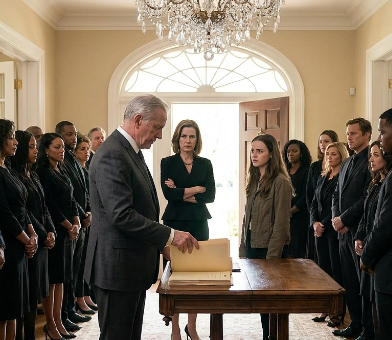
The conference room at Vance and Associates smelled like floor wax and old paper two days later when the five of us squeezed around the cherrywood table. Arthur Vance was sixty-eight then, with gray hair combed straight back and eyes that had seen every kind of greedy family member Polk County could produce since the Carter administration. He didn’t look up when we walked in. He just adjusted his half-moon reading glasses and tapped a yellow legal pad with the blunt end of a wooden pencil. Evelyn sat in the center chair, her purse clutched in her lap like she was waiting for a bus in a bad neighborhood. Julian stood by the window with his arms crossed over his chest, scowling at the parking lot while Robert and Thomas sat on either side of him looking like they wished they had stayed in Kansas City.
Arthur cleared his throat and slid a certified copy of the two-thousand-eighteen deed across the middle of the table. “I drafted this instrument myself six years ago,” Arthur said, his voice flat and professional as a grain scale. He looked directly at Evelyn, and the kindness in his face went cold. “Mrs. Miller, this is a legally binding, first-position mortgage lien recorded against the title of your property at twelve-fourteen Maple Street. Because it was filed properly with the county clerk, it constitutes a primary encumbrance on the real estate. The house cannot be sold, gifted, or transferred to heirs until the principal debt of two hundred thousand dollars is satisfied in full to the lienholder.”
Julian slammed his hand down on the cherrywood so hard the stapler jumped an inch. “That’s bullshit!” he shouted, his face turning the color of a bruised plum. “She’s our mother! You can’t just steal the house out from under us with some backroom paperwork!” Robert chimed in right behind him, his voice shaking with that righteous indignation people only get when they realize they aren’t going to inherit something for free. “We’re her sons! We have rights to that property! You manipulated an old woman, David. You’re a sick bastard.”
I didn’t yell back. I just opened my leather folder and laid out twelve years of bank statements, hospital wire receipts, and canceled checks in a long, neat row from one end of the conference table to the other. “You three paid zero dollars,” I said, looking right at Robert’s belt buckle. “You spent twelve years ignoring her phone calls unless you needed gas money or a place to crash during the state fair. I paid two hundred thousand dollars of my own money to keep a roof over her head and a surgeon’s hands on her spine. You aren’t losing an inheritance today. You’re just not getting mine.”
Arthur Vance didn’t blink at the shouting. He picked up his calculator, tapped three keys, and looked up over his glasses at the room. “The current market appraisal for twelve-fourteen Maple Street is two hundred twenty thousand dollars,” Arthur said, his tone dropping the temperature in the room by ten degrees. “After administrative fees, closing costs, and title transfer taxes, the net proceeds from an immediate estate sale will be approximately two hundred twenty thousand. Since Mr. David Miller’s first-position lien is for the principal sum of two hundred thousand dollars, that amount must be paid directly to him from the escrow account before any other distribution can occur.” He paused, letting the numbers sink into the carpet. “That leaves exactly twenty thousand dollars remaining in the estate. Divided four ways among the heirs, that comes out to five thousand dollars per person, less legal fees.”
Evelyn finally broke her silence. She dropped her purse on the floor, reached across the table, and grabbed my sleeve with fingers that felt like dry twigs. “David, please,” she whispered, her voice cracking right down the middle the way it used to when I was ten years old and crying over a scraped knee. “Don’t do this to your brothers. They have families to feed. Just tear the paper up. Let them have their share like your father wanted.” I looked down at her hand on my sleeve, at the little gold wedding band she’d worn since nineteen-seventy-two, and for half a second I almost did it. I almost let twelve years of resentment go for the sake of a quiet dinner and a clean conscience. Then I remembered the three years I spent sleeping on a fold-out cot in her sunroom while my brothers were out buying boats and building decks on their suburban homes.
“No, Mama,” I said, pulling my arm away gently and buttoning my suit jacket. “I’m not tearing it up. I want the house sold.” Arthur Vance looked at me over his glasses, his pen poised above the signature line. “Execute the debt settlement terms and list the property immediately,” I told him. “Send my portion to my credit union account, and let the boys have their five thousand dollars each when the closing goes through.”
Julian cursed and kicked the leg of the conference table on his way out the door, slamming the frosted glass office door so hard the frame rattled in the drywall. Robert and Thomas followed him without looking back, their coats flapping behind them like a pair of crows taking off from a carcass. Evelyn stayed in her chair for a long time, staring at the empty table where the receipts had been, before Arthur’s secretary came in with a wheelchair to take her out to the Buick. I didn’t walk her to the car. I just packed my folder, shook Arthur’s hand, and walked out into the bright Des Moines afternoon by myself.
That was six weeks ago. Today the house on Maple Street belongs to a young couple with a baby carriage on the front lawn, and the escrow check has already cleared my credit union’s electronic clearinghouse. I sit here alone at my kitchen table under the warm morning sun coming through the gingham curtains. On the laminate surface right next to my coffee mug sits the official bank confirmation statement showing the two hundred thousand dollar deposit cleared in full, resting right beside my late father’s silver pocket watch. The second hand is ticking steadily forward, the little brass arm jumping from one second to the next without pausing for anybody, and for the first time in twelve years, the room is completely, perfectly quiet.