The first thing I noticed was the absolute stillness in the air. It was 6:12 AM, and the guest lodge at the estate was usually filled with the distant sounds of groundskeepers or the early morning birds. But the house was dead quiet. I sat up in bed, my head feeling unusually light, almost drafty. I reached up to push back my hair, the way I had done every morning for sixty-eight years, and my hand just slid over bare, stubbly skin.
I sat there for a long time. The room looked like it always did, the sunlight just beginning to crawl across the expensive duvet, but my world had tilted on its axis. I slid out of bed and went to the vanity mirror. I didn’t recognize the woman looking back. My hair, the thick silver-gray waves I had cultivated with pride for decades, was gone. It lay in ragged, uneven tufts on the floor and over my pillow. It wasn’t an accident. It was a harvest.
Then I saw the note. It was resting on the marble nightstand, written in a cheap, cherry-red lipstick that had smudged against the glass. It said: “Now you look on the outside like the decrepit old hag you are on the inside. Stay in your room and don’t ruin our photos.”
I didn’t scream. I didn’t even cry. I just picked up the two tea cups from the nightstand.
Natalie had brought me chamomile the night before, telling me she wanted me to sleep well so I would be refreshed for the ceremony. I looked at the dark, dried dregs at the bottom of the cups. My hands were shaking, but not from fear. It was a cold, sharp anger, the kind that burns through everything else until only the truth is left.
I locked the door and pulled up the security app on my phone. The audit trail for the electronic door lock was clear as day. At 3:15 AM, someone had swiped a master key card to enter my suite. The card was registered to the bridal dressing suite. Natalie hadn’t just been planning a wedding. She had been planning a funeral for my independence.
I didn’t stay in the room. I put on a wide-brimmed hat and a silk Hermes scarf, wrapping it tight until I looked like a woman who had simply chosen a modest style for the morning.
I made my way to the clubhouse. I heard the voices before I reached the door. Natalie was in the dressing room with her bridesmaids, and she was laughing, a high, thin sound that cut through the wood like a blade.
I stood there, pressed against the door frame. I didn’t need to be invited in. “She’s out for the count,” Natalie was saying, her voice brimming with a kind of jagged excitement. “I gave her enough of the powder to keep her dead to the world until noon. By the time she wakes up, we’ll be signing the transfer papers, and Jackson will have the keys to the kingdom.”
There was more. A lot more. She talked about the $120 million trust as if it were already sitting in her offshore accounts. She laughed about how she had told the florist that I was losing my mind, that I was prone to “episodes” where I might try to interfere with the wedding, and that I would need to be escorted out if I caused a scene. She called it a preventative measure for my own safety.
“We’ll put her in the Willow Creek unit by Monday,” she said. “The one with the locked doors. She’ll be so confused she won’t even know who she is, let alone where the money went.”
I didn’t wait to hear the rest. I turned around and walked back to my car. My mind wasn’t a whirlwind; it was a calculator. I called Arthur Abernathy. Arthur had been my husband’s attorney for thirty years, and he was the only person left in this world who understood what the Vance Heritage Trust was actually built on.
“Arthur, bring the original documents,” I said. My voice was steady, a tone that made him pause and ask what was wrong. “And bring the amendment rider we discussed last winter. The one for emergency breach of fiduciary intent.”
“Eleanor, it’s the wedding morning,” he started, but I cut him off.
“The wedding is not the concern, Arthur. The survival of the legacy is.”
I went back to the portrait room, my head held high under the silk scarf. I found Jackson in the parlor, checking his cufflinks in the mirror. He looked like his father, and for a moment, the ache in my chest was so sharp I almost collapsed. But then he turned to me, his face tight with annoyance.
“Where have you been, Mom? Natalie says you’ve been acting weird since you woke up.”
I reached into my handbag and pulled out the lipstick-smeared note. I held it out to him, my hand steady. “Read this, Jackson.”
He glanced at it, his eyes skimming the words, and then he scoffed, dropping the note onto the coffee table as if it were trash. “Are you really doing this right now? You’re jealous, aren’t you? You can’t stand that I’m starting my own life with someone who actually wants me.”
“She shaved my head while I was drugged, Jackson.”
He laughed, a harsh, dismissive sound that confirmed everything Natalie had spent months whispering in his ear. “You probably had a nightmare or you did it yourself and you’re just trying to make her look bad because you’re terrified of losing control of the money. Don’t be pathetic. Keep your scarf on, get through the ceremony, and stay in the background.”
He walked away, not even looking back to see if I was following. That was the moment the door closed in my mind. I didn’t have a son anymore. I had a stranger who was so blinded by greed that he would watch his own mother be dismantled to get a better view of the loot.
The wedding ceremony was a blur of white lace and hollow promises. I sat in the front row, a ghost in silk, watching the man I had raised pledge his life to a girl who was already counting the days until she could throw me in a memory ward. Every time they looked at each other, I saw the same calculation. It wasn’t love. It was a heist.
Then came the reception. The ballroom was filled with flowers that cost more than most people make in a year. The champagne was flowing, and the mood was electric, everyone waiting for the toast that would officially hand over the stewardship of the legacy. Natalie stepped up to the microphone, her face glowing with a predatory kind of triumph.
“I just want to say how much we love Eleanor,” she said, her voice dripping with artificial sweetness. “But as many of you know, it’s been a hard year for her. Her memory has been slipping, and we’re all so concerned about her stability. We’re going to be helping her transition into full-time care after the honeymoon.”
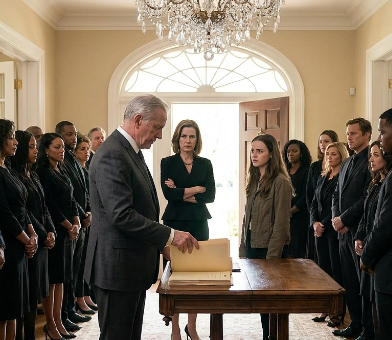
The room went quiet. People looked at me, some with pity, some with that nervous curiosity people have when they see a wreck they can’t look away from. I stood up. The silence grew heavier as I walked toward the stage. My legs felt like steel. I didn’t look at Jackson. I didn’t look at the crowd. I walked straight to the podium.
Natalie blinked, her smile faltering. “Eleanor, sit down. You’re confusing everyone.”
I took the microphone from her hand. It felt cool and heavy. I didn’t look at her. I turned to the two hundred people in the room, my heart beating with a slow, deliberate rhythm. I reached up and pulled the silk scarf from my head.
The gasp from the crowd was almost like a physical gust of wind. I stood there, my scalp bare and jagged, the harsh reality of the vanity mirror exposed under the ballroom chandeliers.
“My daughter-in-law mentioned my stability,” I said into the microphone. My voice was calm, clear, and projected across the entire room. “But I think we should talk about hers.”
I pulled my phone from my pocket and hit play. Natalie’s voice flooded the ballroom, crisp and unmistakable. The laughter, the bragging about the sleeping powder, the cold, clinical plan to put me in a home and drain the $120 million for her father’s debts. It echoed against the high ceilings, bouncing off the walls, inescapable.
Natalie stood frozen, her mouth hanging open, the color draining from her face until she looked like a statue. Her father, Marcus, started toward the stage, his face purple with rage, but two men in suits, the security team Arthur had hired, stepped in his way. He didn’t move any further.
Jackson stood by the cake, his phone in his hand, his eyes wide as he heard his bride describing how she had played him like a fiddle. The silence in the room was absolute. You could hear the hum of the air conditioning.
I didn’t stop the audio. I waited until the very end, until Natalie’s voice promised that by Monday, I would be a footnote in the history of the Vance family. Then I clicked it off.
“Arthur?” I said, not turning around.
Arthur Abernathy walked onto the stage, the leather-bound portfolio in his hands. He opened it on the podium, his expression professional and grave.
“This is the formal amendment to the Vance Heritage Trust,” I announced, my voice ringing out. “As of this moment, the entirety of the $120 million fund is being reallocated. It is no longer a family inheritance. It has been transferred into the Vance Medical Foundation, to be used exclusively for the support of victims of elder abuse and the investigation of fraudulent guardianship. Jackson Vance is no longer a beneficiary of this estate. He has been removed, permanently.”
Jackson started to walk toward the stage, his hands out, his face a mask of panic. “Mom, wait, we can talk about this! You don’t understand, she just, “
“I understand exactly what this is,” I said. I looked at him then, really looked at him, and he stopped in his tracks. “You were going to let them do it, Jackson. You didn’t care about the truth. You only cared about the price tag.”
Security moved in. It was efficient. They didn’t make a scene; they just did their jobs. They escorted Natalie and her father toward the exit. Jackson tried to follow, looking back at me with a mixture of rage and fear, but the guards kept him moving. The doors closed behind them, and the room was finally empty of their presence.
The guests didn’t know what to do. Some of them started to leave. Others just stood there, shell-shocked. Arthur stayed by my side, closing the portfolio and securing the locks.
“Are you all right, Eleanor?” he asked softly.
“I’m tired, Arthur,” I said. And I was. I was bone-deep tired, the kind of exhaustion that comes when you’ve been holding a wall up for years and you finally let it go.
The rest of the night was a blur of police statements and legal paperwork. The guests trickled out, the lights were dimmed, and the grand ballroom, which had been set for a celebration, became the site of a very different kind of ending.
Now, the house is quiet again. It’s late, and the wind is coming off the pond, cold and smelling of damp leaves. I’m standing on the balcony of the main house, looking out over the dark lawn. My head feels cold, but it also feels free.
The gates to the estate are locked. I can see the headlights of Jackson’s car at the bottom of the drive, the beams cutting through the mist. He’s been there for an hour, pressing the intercom button over and over. I can hear the faint, rhythmic buzzing of it, a pathetic little sound in the vast dark. I don’t answer. I don’t think I ever will.
Arthur is inside, finishing the final filings for the foundation. He came out once to ask if I wanted anything, and I told him no. I just want to stand here and breathe the air that doesn’t have the smell of those people in it.
The money is gone. The family name is permanently altered. My son is a stranger standing in the rain. I know what people will say. They’ll say I was cold, that I should have forgiven him, that a mother shouldn’t do this to her own child. They don’t know the sound of a key card sliding into a lock at 3:15 in the morning. They don’t know the feeling of a razor blade pulling hair from a scalp while you lie there, helpless and drugged.
I look down at my reflection in the glass of the balcony door. The woman staring back is bald and tired, but her eyes are clear. I’m not a martyr. I’m not a hero. I’m just a woman who finally woke up.
The buzzing at the gate stops for a second, then starts again. It’s a rhythmic, mechanical sound. I turn away from the railing and walk back into the house, leaving the door open just wide enough for the wind to come in. The inheritance wasn’t just money. It was the weight of a legacy that had been rotting from the inside out for years. Now, it’s just a house. And for the first time in a long time, the house is mine.
I sit down at the desk in the study and pick up the pen. There are more papers to sign, more details to settle. The foundation needs to be organized. There is so much work to be done. I don’t know what tomorrow looks like. I don’t know if I’ll ever speak to Jackson again. I don’t know if the anger will ever really leave me, or if it’s just become part of who I am now.
I look at the last document, the one that seals the transfer. I sign it, my hand firm, the ink black and permanent against the white page. The silence in the room is heavy, but it’s a good kind of heavy. It’s the silence of a debt paid. I put the pen down and listen to the wind outside, waiting for the sun to come up.