The deadbolt didn’t even click when I turned the key. It just slid back, easy and soft, like it had been waiting for someone to finally come home. I pushed the heavy oak door open and stepped into the dim entryway of my father’s house in Scranton. The air hit me first. It wasn’t the smell of cedar or the sharp, clean scent of the cleaning supplies my father, Thomas, usually obsessively kept stocked. It smelled like stale, trapped air and something else, something metallic and sharp that made my throat tighten.
“Dad?” I called out. My voice sounded thin, swallowed up by the heavy velvet drapes that had been pulled shut for weeks.
I walked through the foyer, my heels clicking too loudly against the hardwood. I was seventeen, full of the kind of arrogance only a teenager who just got a taste of real money can have. I had been living with my mother, Veronica, in Philadelphia for ten weeks. I’d spent that time telling anyone who would listen that my father was a bitter, small-minded man who had chosen his four dead-end jobs over his own daughter. I believed it, too. I believed the story Veronica fed me every morning over breakfast in her marble-countered kitchen, the one where he was too proud to call and too stubborn to apologize for the life he couldn’t provide.
I reached the living room and stopped dead. My brain didn’t want to process what I was seeing.
It felt like the air had been sucked out of the room.
Thomas was lying on the floor beside the worn beige sofa. He was wrapped in a thin, faded quilt, his right side completely rigid. His eyes tracked me the second I walked in, and they were filled with a kind of profound, shattered relief that made my knees hit the floor before I even realized I was moving. He tried to speak, but it was just a low, slurred sound, a jagged noise that didn’t form any words. A plastic water bottle lay just inches from his left hand, tipped over, the last few drops soaking into the rug.
“Oh my God,” I whispered, scrambling toward him. “Dad?”
He looked at me, his eyes wet, and he squeezed my left hand with his left hand. His grip was weak, but it was there. My phone was in my pocket, and for the first time in ten weeks, I actually used it for something other than checking my social media.
I called 911, my voice shaking so hard I could barely give the dispatcher the address. I didn’t let go of his hand, not for a single second. I just sat there on the floor, watching him, watching the way his chest moved in shallow, uneven breaths.
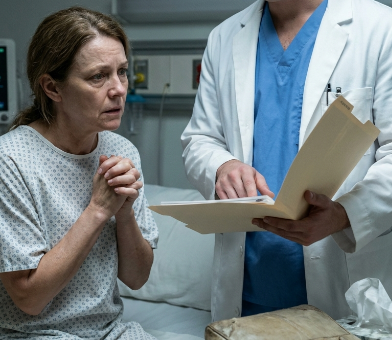
The ambulance ride was a blur of flashing lights and the smell of sterile plastic. By the time we reached Valley General, I was a wreck, but Thomas was stable. That was when I saw Dr. Aris Thorne. He was an old friend of my father, someone who had come over for coffee back when things were still normal, before Veronica left and came back and destroyed everything.
“Maya,” Aris said, his face tight with concern as he pulled me aside in the hallway. “You need to know something. This wasn’t a sudden fall. It was a stroke.”
“A stroke?” I asked, my voice barely a whisper. “He’s forty-eight, Aris.”
“He was working eighty-four hours a week, Maya,” he said, and the way he said it made it sound like an indictment. “He was working four jobs.
Custodial, the paper route, the shop, and security on the weekends. His blood pressure was a ticking time bomb. He had a massive hemorrhagic stroke ten days after you left. He’s been in rehab for eight weeks. He refused to stay in a long-term facility. He insisted on coming home because he didn’t want to miss your eighteenth birthday.”
The hallway seemed to spin. “But why didn’t he call? Why didn’t anyone call me?”
Aris looked at me, his eyes hard and sad. “He asked the social worker to call you every single day, Maya. Every day.”
I pulled out my phone. My hands were shaking so bad I almost dropped it. I went into my settings, the same settings Veronica had ‘helped’ me configure on the drive to Philadelphia to ‘keep the bad influences out.’ I opened the blocked contacts list. My heart hit the floor. There it was. My father’s number. And under it, thirty-two missed calls from the hospital network, all logged during the time I was supposedly ‘too busy’ to be contacted.
I didn’t scream. I didn’t cry, not then. I just felt a cold, hard stone of realization settle in my gut. Veronica hadn’t saved me from a life of poverty. She had kidnapped me from a life of love, and she had done it by deleting the only person who had ever truly looked after me.
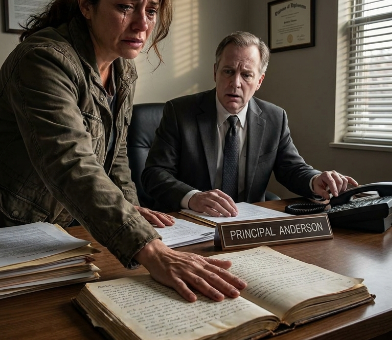
Two days later, I went back to the house. I needed his records for the insurance, for the hospital, for the lawyers. I found the steel box in his nightstand, tucked deep under a pile of old receipts. I didn’t need a key. The lock was rusted and gave way with a sharp metallic snap when I pried it with a kitchen knife. Inside was a worn, leather-bound ledger. It was filled with columns of numbers, meticulous and small, tracked over twelve years.
I flipped through the pages. Every single entry was a wage payment. The paper route. The shop. The cleaning shift. The security gig. Every entry was balanced against a deposit into an account named the “Maya Elizabeth Miller Educational & Life Trust.” The total was $210,000. It wasn’t money he had inherited. It wasn’t money he had skimmed. It was his sweat, his sleep, and his health, distilled into numbers on a page.
I turned to the very last entry. It was dated the day before he suffered the stroke. The handwriting was shaky, barely legible, but I could read it. *”All four shifts complete. Maya is free. She can be whatever she wants.”*
I sat there in the silence of his kitchen, the ledger open on the table, and I felt the weight of it. Every pair of shoes I’d ever wanted, every dinner I’d complained about, every moment I’d spent resenting him for being ‘absent’, it had all been to ensure I never had to live like he did.
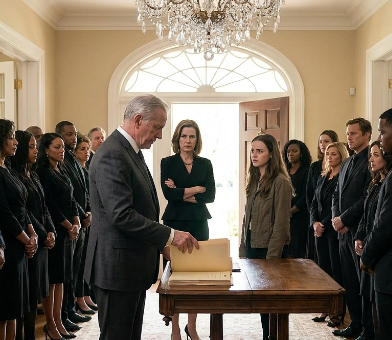
The confrontation happened two days later in the hospital. Veronica and Julian walked in, all silk and expensive cologne, acting like they were there to pick up a wayward daughter from a minor mishap. Veronica didn’t even look at Thomas. She just went straight for me.
“Maya, darling, we’re leaving,” she said, her voice smooth and polished. “This place is unsanitary, and we have the flight back to Philadelphia booked.”
I didn’t move. I just looked at her, and for the first time, I saw her for what she was: a woman who didn’t know how to love anything that didn’t have a price tag.
“I’m not going anywhere, Mother,” I said.
She laughed, a sharp, brittle sound. “Don’t be dramatic. Your father is a broken man who dragged you down for years. We’re doing you a favor.”
I pulled the ledger out of my bag and laid it on the conference table. Then I slid my phone across the wood, the screen showing the list of blocked numbers.
“He wasn’t broken,” I said, my voice steady, no longer the teenager who needed her approval. “He was working. He worked four jobs so I could have a future, and you worked one long con to make sure I’d never see it.”
The look on her face was worth more than every luxury item she’d ever bought me. It wasn’t shock. It was the realization that she’d lost. She didn’t have a counter to the truth. She didn’t have a way to spin $210,000 in documented sacrifice. Julian tried to say something, but I just looked at him and said, “If you don’t leave this room right now, I’m calling the police. I have the logs of how you manipulated my phone settings. I think the lawyers would love to see that evidence.”
They left. They didn’t even look back.
I turned eighteen a week later, sitting in a hospital room, and I signed the papers to become my father’s legal healthcare proxy. I moved back into the house in Scranton. It took me a month to fix the ramp for his wheelchair, and another two weeks to clear out the living room so he could sleep on the main floor. I used a portion of the trust, with Aris’s help and Thomas’s blinking ‘yes’, to hire a night nurse so I could finish high school and start my college courses locally.
Six months later, the house is finally quiet, but it’s a different kind of quiet. It’s the quiet of a home that’s being put back together. I sit on the front porch with him in the late afternoon sun, the kind of light that turns everything a soft, golden color. He’s doing better. He can move his left arm now, and he’s starting to manage short sentences in physical therapy.
Across the street, the auto shop where he used to work has hung a banner. It’s simple, just white fabric with black letters, but it says *Honoring Thomas Miller: The Best Mechanic We Ever Had.*
Thomas watches it, his eyes squinted against the glare. He reaches out, his left hand finding mine on the porch railing. He squeezes, a slow, deliberate pressure. I don’t look at the house anymore and wish it were a mansion. I don’t look at the car in the driveway and wish it were a luxury import. I just hold his hand, feeling the callouses on his skin, knowing exactly what it cost for me to be sitting here. It was a hell of a price to pay, and some days, when the weight of the medical bills or the rehab schedules hits me, I think about how much I still have to learn. But I’m here. And for the first time in my life, I know exactly who I am. I’m Maya Miller, and I’m finally home.