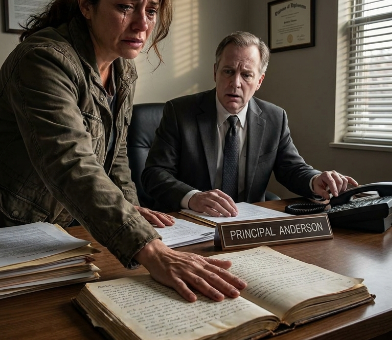
The leather of the 1998 Founding Registry felt dry and brittle under my fingertips, like I was touching something that had been dead for a very long time. I sat in the dim, cramped air of the B-2 archive room, the only light coming from a flickering fluorescent tube that hummed with a low, annoying buzz. This wasn’t just a record. It was the only thing standing between my mother’s legacy and the industrial-strength paper shredder Victoria Sterling had been running for twenty-four months.
I checked my watch. 10:42 PM. The Solmere anniversary gala was in full swing upstairs, two floors of laughter and clinking champagne flutes and people who had no idea the hotel was being sold out from under them in a midnight vote. Victoria liked big, noisy crowds. She liked the way they masked the sound of a company being hollowed out.
My mother, Eleanor, had built the Solmere to last a century. When she died, they told the press I had moved to Europe and signed away my inheritance in a fit of grief. They said I wanted nothing to do with the business. Victoria Sterling, who had been my mother’s closest attorney, had been the one to hold the press conference. I remembered her standing there in a charcoal suit, looking somber, looking like she cared. I was twenty-two then, and honestly, I was too broken to even argue. I just wanted to disappear.
But I didn’t disappear. I just took a different job. I took a job in the basement, stocking linens and sorting old inventory, wearing a faded polo shirt that made me invisible to the people who used to walk by our house every Sunday. It’s funny how much you learn when people think you are just the help. I knew every time Victoria met with an offshore buyer. I knew the exact day they planned to move the liquid assets to a shell company in the Caymans.
“Hey, Charlotte. You almost done with those manifests?”
I jumped, nearly dropping the ledger. It was Julian, the head auditor. He was fifty-eight, with heavy eyes and a habit of checking his pulse against his wrist every time he got nervous. He was the only person in the building who knew who I really was. He hadn’t said a word to anyone for two years.
“Almost, Julian,” I said, my voice sounding thin in the silence. “I just need ten more minutes.”
He looked at the ledger on my lap and his face went tight. “If you go up there, they won’t let you come back down. You know that, right?”
“I’m not coming back down, Julian,” I said, closing the heavy book. “I’m not a clerk anymore.”
He didn’t argue. He just handed me a manila envelope. “The bank audit trails. It’s all here. Victoria diverted three million in dividend payments just this quarter. It’s enough to hold them.”
I took the envelope. My hands weren’t shaking, which surprised me. I felt cold, like the air in the archives had finally soaked into my bones. I stood up and smoothed my uniform. I didn’t look back at the stacks of paper I had spent two years organizing. I just walked toward the service elevator.
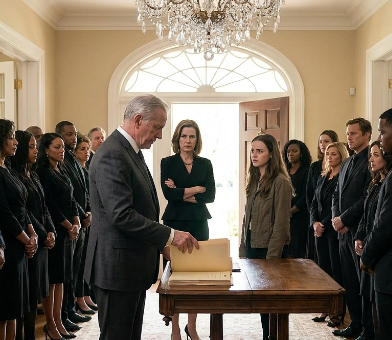
The lobby was a wall of sound. The gala was crowded, a sea of black ties and silk gowns shimmering under the massive crystal chandeliers. I walked through the side service door, my plain navy clerk uniform standing out like a stain on a white tablecloth. People glanced at me, then looked away, their eyes sliding right over me as if I were part of the architecture. That was my favorite part of the disguise. Nobody looks at the person cleaning the spills.
I saw them by the registration desk. Victoria was laughing, a bright, rehearsed sound, with her arm hooked through her son Marcus. Marcus was the general manager, a man who had never done a day of real work in his life. He was busy gesturing toward the board members who were gathered near the boardroom entrance. They were waiting for midnight.
I walked straight toward them. My heart wasn’t beating fast. It was just steady. Like a metronome.
Victoria noticed me when I was ten feet away. She didn’t recognize me at first. She just saw someone standing in the way of her path. Her brow furrowed, a tiny line appearing between her perfectly groomed eyebrows.
“Excuse me,” she said, her voice sharp. “You’re in the way of the guests.”
I kept walking until I was right in front of her. I opened the ledger. It was heavy, a dead weight in my hands.
“I think you’re in the way, Victoria,” I said.
She blinked. Her eyes traveled from my face to the ledger, then back up to my eyes. The color didn’t leave her face, but her entire posture shifted. She stiffened, her chin lifting in that way she had when she was about to dismiss a problem.
“Charlotte?” she whispered, her voice barely audible over the music. “How did you get in here?”
“I never left,” I said.
Marcus stepped closer, his face turning an ugly shade of red. “Mom? Who is this?”
“She’s nobody, Marcus,” Victoria snapped. “Security! Get this woman out of here. Now!”
Two security guards appeared, their faces grim. One of them grabbed my arm, his grip hard enough to bruise. I didn’t pull away. I just held the ledger out.
“Don’t touch me,” I said, my voice loud enough that a few people nearby stopped talking. “Victoria, read page forty-two. Look at the seal.”
“Throw her out,” Victoria shrieked, losing her cool. “She’s a fraud! She’s been stalking the hotel for months. Get her out!”
The guard started dragging me back, but Julian stepped out from behind a pillar. He didn’t look like a nervous old man anymore. He looked like a man who had finally finished a long, exhausting race. He walked up to the guards and held up the manila envelope.
“Wait,” Julian said. His voice was steady. “Don’t touch her. She owns the company.”
The lobby went quiet. It was that kind of silence that feels heavy, like the air has been sucked out of the room. A few reporters near the bar turned their cameras toward us.
“Julian, shut up,” Victoria hissed. “You’re fired. Get out.”
“I was never working for you, Victoria,” Julian said, his voice calm. “I was waiting for the heir.”
Victoria grabbed my arm, her nails digging into my skin. “You think you can just walk in here with a book and claim a billion-dollar empire? You’re nothing. You’re a clerk.”
“I am the trustee,” I said. I pulled my arm away. I slammed the ledger down on the marble desk, the sound echoing like a gunshot. “Look at the crest, Victoria. You forgot that my mother filed the founding papers under landmark law. You didn’t just strip my name from the digital files. You tried to rewrite the charter. But this?” I tapped the wax seal. “This says you haven’t had the authority to move a single dime since I turned twenty-four at midnight.”
Victoria looked down at the page. I watched her eyes track the calligraphy. My mother’s handwriting. It was distinctive. It was unmistakable. I saw the realization hit her, the way the blood drained out of her face, leaving her looking old and small.
“That’s a forgery,” Marcus stammered, his voice cracking. “That’s not legal.”
“The auditors are outside,” I said. I looked at the board members, who were hovering like vultures. “The federal investigators are waiting at the front door. They’ve been reviewing Julian’s files for an hour. Would you like to go explain the offshore accounts to them, or would you like to hand over your keys?”
Victoria looked around the room. Her allies weren’t moving. They were looking at the ledger, at the seals, at the reporters who were closing in. They were calculating their own survival. Nobody wanted to be standing next to her when the handcuffs came out.
“I’m done,” I said. My voice felt final. “You’re terminated, Victoria. Marcus, get your things out of the office by morning.”
“You can’t do this,” Victoria whispered. She looked at me, her eyes desperate, searching for a crack in my composure. She didn’t find one.
“I already did,” I said.
The security guards let go of my arms. They looked at each other, then looked at me, then stepped back. They knew who signed their paychecks.
Victoria didn’t fight. She didn’t scream. She just slumped, the air going out of her like a punctured tire. She looked at the floor, then at Marcus. I didn’t care where they went. I didn’t care about their excuses. I had spent two years in the dark. I wanted to see the light.
The federal agents came in through the main doors, their suits dark and efficient. I saw Julian point toward Victoria. I turned away. I didn’t want to watch the arrest. I had already seen enough.
I walked to the elevator. I didn’t use the service entrance. I pressed the button for the penthouse.
The penthouse was silent. It smelled like cedar and floor wax, the exact same way it smelled the day my mother died. I walked over to her desk, the massive mahogany slab that had been the center of our lives for so long. There was a photo of us in a silver frame, sitting exactly where it had been for years.
I sat down in the leather chair. It felt big, but it fit.
I didn’t feel a rush of victory. I didn’t feel like celebrating. I just felt… quiet. Like the world had finally stopped spinning off its axis and settled into a track. I picked up the photograph and adjusted it by an inch, squaring it with the edge of the desk.
Below, I could hear the sounds of the hotel lobby. They were already starting to take down the anniversary banners. I knew that by morning, they would be pulling the nameplate off the wall. They would be replacing Victoria’s name with the crest.
I looked out the window at the Chicago skyline. The city lights were bright, stretching out to the horizon. For two years, I had been looking at these lights from the basement, wondering if I would ever be here.
It was a strange, uncomfortable peace. It was heavy, like the ledger. But it was mine.
I realized then that I didn’t miss the hotel. I missed the time I had lost. I missed the years I spent being invisible. I looked at my hands, still marked with the faint red lines from where the guard had grabbed me. I didn’t regret it. I would have done it ten times over.
I pulled the ledger closer, resting my hand on the leather. I wasn’t the clerk anymore. I was the owner. I was the heir. I was the person who had survived.
The door behind me opened, and I heard footsteps. I didn’t turn around. I knew it was Julian.
“The board is waiting for you in the conference room,” he said softly. “They want to know what the plans are for the quarter.”
“Tell them to wait,” I said. “I’m not done looking at this book.”
He stood there for a moment, and I could tell he was worried I was going to crack. I didn’t. I just kept looking at the seal, at the name of my mother, and the space right next to it where my name had been waiting all along.
“Okay,” he said, and closed the door.
I was alone. The room was cold, but I didn’t mind. I had two years of catching up to do, and I had all the time in the world. I opened the ledger to page forty-two again. I ran my thumb over the ink, feeling the indentations of the pen.
Everything was where it was supposed to be. The fraud, the lies, the two years of silence, it was all just paper. And paper, I had learned, could be broken. You just had to know which page to turn to.
I leaned back in the chair and closed my eyes. The hotel was mine again. The empire was mine. But as I sat there in the dark, all I could think about was the way the basement used to smell at 3:00 AM. It smelled like dust and old promises. And for the first time in two years, the smell was finally gone.
I didn’t feel happy. I just felt steady. And honestly, that was enough.
The sun started to peek over the horizon, turning the sky a pale, bruised purple. It was a new day. A day where I didn’t have to look over my shoulder. I stood up and walked to the window, watching the sunrise hit the glass of the neighboring towers.
I looked down at the main entrance. A crew of workers was already out there, climbing up on a ladder with a wrench. They were unscrewing the brass plate that said Victoria Sterling. It was the best thing I had ever seen.
I watched them finish. I watched them hold up the new plate, the one with the Vale family crest. It was heavy, and it was solid, and it was going to stay there for a long, long time.
I turned away from the window and sat back down at the desk. I had a lot of work to do. I had to audit the auditors. I had to fire the managers who had turned a blind eye. I had to rebuild a billion-dollar company from the rubble of a two-year lie.
I picked up a pen. I looked at the signature line on the bottom of the page. It was blank.
I put the tip of the pen to the paper. I didn’t hesitate. I signed my name.
It looked good. It looked like it belonged there.
I closed the ledger and tucked it into the drawer. I locked it. I put the key in my pocket.
I was ready.