The electrical fire that took my house on the night of November 14th didn’t just burn through the walls. It stripped the insulation off my entire life. I stood on the frozen grass in my bathrobe, clutching my dog while the volunteer fire department sprayed water into the guts of my home, and for a moment, I didn’t feel anything. I just watched the roof sag. It was a cold, efficient kind of destruction. By the time the sun came up, there wasn’t enough left to identify what had been a kitchen and what had been a bedroom.
Brenda Holloway was the first person to reach me. We had been best friends since our kids were in diapers, nearly twenty-eight years of carpools and Sunday services and secrets shared over lukewarm coffee. She arrived in her SUV before the fire trucks had even cleared the hose lines. She wrapped a heavy wool blanket around my shoulders and held me while I shook. She was the one who called the insurance adjusters. She was the one who set up the temporary housing in that drafty trailer on the edge of the woods.
Two days later, Brenda came to the trailer with a ledger and a grim expression. She told me she had organized a recovery committee through Grace Community Church. She said the town wanted to help, that people were already dropping off envelopes at the local businesses where she’d placed donation jars. She was the event planner for the county, the woman who knew how to pull strings and move crowds.
I trusted her with my life. I honestly thought that was her only motive.
For three weeks, I lived in a haze of paperwork and dry-heaving from the smell of smoke that seemed to follow me everywhere. Brenda stopped by every evening. She’d bring me takeout and tell me about the donations. She’d say things like, “People are stretched thin, Evie, but they are trying.” I didn’t ask for numbers. I was just trying to keep my head above water. When she finally handed me the white envelope at the church potluck in December, I cried. It felt like a tether to the world I had lost.
There was exactly $1,200 inside. It was a mix of cash and a few personal checks from local shop owners. Brenda stood next to me, her hand firm on my shoulder, and told the room that it was a hard season, but the town had done what it could.
I stood there, humiliated and grateful all at once, while the congregation clapped. I felt like a charity case in my own hometown. I used that money for work clothes, a new pair of boots, and the deposit for a more permanent rental. It lasted me exactly twelve days.
The change in my life didn’t come from a grand revelation. It came from a local newspaper. I was sitting in my new, smaller place on a Tuesday morning, drinking coffee that tasted like grit, when I opened the weekend edition of the Oakhaven Herald. I was looking for funeral notices, mostly out of habit, when my eyes caught the civic news section. There it was, in bold, black ink.
“The Grace Community Church Recovery Committee wishes to thank the generous donors of Oakhaven for their overwhelming support. Through the Mercer Fire Relief Fund, our community raised a total of $19,000 for the rebuilding of the Mercer residence.”
I read that sentence four times. I pulled the envelope out of my desk drawer, the one Brenda had given me. I counted the money again. I checked the back of the checks. I stared at the wall until the numbers burned into my retinas. The difference was $17,800. I didn’t call Brenda. I didn’t scream at the television. I felt a strange, cold clarity wash over me, the kind that makes your hands go steady when they should be shaking.
I drove to the newspaper office that afternoon. I asked to see the original submission form for the thank-you notice. The clerk, a girl I had taught in sophomore English, looked at me with pity. She handed over the carbon copy. It was signed by Brenda Holloway, dated three days before the potluck. It listed the total as $19,000. It was the exact number. My lungs felt like they had filled with the same smoke that took my house.
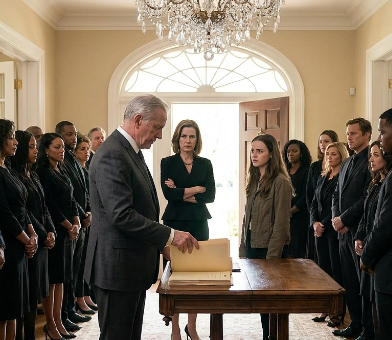
I waited for the monthly community potluck. It was a tradition in Oakhaven, a monthly gathering where the church handed out recognition for civic work. Brenda was on the list to receive a certificate for her leadership during my fire. I wore the only nice dress I had left. I didn’t sleep the night before. I just sat in the dark and mapped out the room.
The hall was packed. The air smelled of pot roast and floor wax. Pastor Thomas Croft stood at the small, wobbly lectern, his voice booming with forced warmth. He started a long speech about the spirit of Oakhaven, about how when one of us falls, the rest of us reach out to lift them up. He called Brenda to the front. She walked up with that modest, practiced smile she’d perfected over two decades of local politics.
She reached for the certificate, her face glowing with the attention. I stood up from the back table. The room was so quiet I could hear the hum of the refrigerator in the kitchen. I walked to the center of the aisle. I didn’t yell. I didn’t throw anything. I just held the newspaper clipping up so the Pastor could see the headline.
“Before everyone claps,” I said, my voice sounding thinner than I expected, “can you tell us where the other seventeen thousand eight hundred dollars went?”
Brenda’s face didn’t go white. It went gray. She blinked, her smile twitching like a dying moth. She started to stutter about “operational overhead” and “insurance processing delays.” She looked around the room, waiting for someone to bail her out, but the faces turned toward her weren’t sympathetic. They were confused.
Pastor Croft stepped down from the lectern. He was a good man, a man who believed in the ledger as much as the gospel. He looked at me, then at Brenda, then at the clipping. He didn’t ask her for an explanation. He asked her for the keys to the church office.
The meeting in his study lasted three hours. The church treasurer brought the bank statements. We sat in hard wooden chairs while the truth was peeled back, layer by layer. Brenda had set up a private account, a sub-ledger she kept hidden from the church board. She had funneled every donation into it. Then, she had moved the money.
It wasn’t a mistake. It wasn’t an administrative error. The bank statements were a map of a slow-motion car crash. She had transferred $17,800 to an online gambling site. She had been losing money for years, chasing a win that never came. She had used my fire as a piggy bank to pay off her credit cards and stop her own foreclosure.
When the sheriff’s deputy arrived at the church, Brenda finally broke. She didn’t cry for forgiveness. She turned on me. She started shouting about how I had always been the lucky one, how she had carried me for twenty-eight years and deserved a cut of the sympathy. She said the money wouldn’t have been raised at all if she hadn’t worked the phones. Her voice was shrill, echoing against the stained-glass windows.
I didn’t argue with her. I handed the deputy the envelope. I handed him the copy of the bank statement. I looked at her, at the woman I had trusted with my children and my grief, and I saw a stranger. I just walked out of the room. I walked past the pot roast and the murmuring neighbors and out into the cold Indiana air.
The legal process was a grind. It was ugly, and it took months. People in town took sides. Some whispered that I should have let it go, that a twenty-eight-year friendship was worth more than the money. They didn’t understand. It wasn’t about the cash. It was about the fact that while I was sleeping in a trailer and counting pennies for bread, my best friend was sitting in her office, clicking buttons on a casino website, watching my house burn all over again.
She pled guilty to avoid a trial. She got a suspended sentence and a mountain of community service, but the real punishment was the court-ordered lien on her assets. The sheriff’s office forced the sale of her house. It was quiet, the way the law works. One day, her lawn was manicured, and the next, there was a bright orange foreclosure sign hammered into the dirt.
The money was returned to me, every cent of it, deposited into a new, dual-signatory escrow account that Pastor Croft personally oversaw. I didn’t spend it on anything but the house. I watched every board go up. I felt the grain of the wood under my hands.
Ten months later, on a crisp autumn afternoon, the work was finally done. I stood on the porch, feeling the solid, heavy weight of the new railing beneath my palms. The air was clean, stripped of the smell of smoke, filled only with the scent of dried leaves and pine. Pastor Croft drove up in his sedan. He climbed out and handed me the final building permits, his smile tired but genuine.
I looked down the street. Across the valley, I could see the silhouette of Brenda’s house. The windows were dark. The lawn was overgrown. There was a fresh sign on the lawn, bold and stark against the dying grass. I didn’t feel a rush of victory. I didn’t feel happy. I just felt a heavy, final kind of relief. The ashes were gone. I was finally home.