The heavy brass key felt cold and familiar as I turned it in the lock of the maintenance closet. It was 2:30 PM on a Friday, the time when the hallways of Oakridge Elementary grew silent and the air tasted faintly of floor wax and industrial pine. For nine years, this little room at the end of the lower wing had been my quiet sanctuary. It smelled of dry mops and the faint, sweet scent of the sandwiches I packed every week.
I pulled out the eight brown paper bags from under the shelf. Each one was identical. A whole wheat sandwich, a crisp apple, two granola bars, and a juice box. I had spent exactly $6,412 of my own money over the last nine years on this. My salary was only $35,200, but I didn’t care about the numbers. I cared about the way the kids looked on Friday afternoon, eyes fixed on the clock, knowing the cafeteria tray they got at lunch was the last full meal they would see until Monday.
I had tried to do this the right way once, back when I first started. Principal Evelyn Vance had listened for exactly three minutes before she pulled out a policy binder. “Liability, Mr. Rivera,” she had said, her voice as stiff as her tailored collar. “If a child gets sick from unverified food, the district is finished. We cannot authorize personal donations.” So, I stopped asking.
I just kept my head down, did my work, and made sure the bags ended up where they needed to be.
Everything changed on a rainy Tuesday. I was slipping a bag into the back of a cubby in Room 104 when the door swung open. Mrs. Gable, a third-grade teacher whose father held a seat on the school board, marched in with a stack of papers. She stopped dead when she saw me. Her eyes locked onto the brown bag in my hand.
“Mr. Rivera?” she said, her voice sharp enough to cut glass. “What are you doing in those cubbies?”
“Just tidying up, Mrs. Gable,” I lied, trying to slide the bag behind my cart.
She didn’t buy it. She stepped forward, her heels clicking like gunfire, and snatched the bag from my grip. She ripped it open, staring at the sandwich as if it were a weapon. “This is unauthorized food distribution. You are putting the district at risk.”
“It’s just lunch for a student who needs it,” I said, my voice barely a whisper.
“It is a policy violation,” she snapped, pulling out her phone. The camera clicked three times, capturing me, the bag, and my cart. “I am reporting this to Administration immediately.”
Two days later, I was sitting in my living room when the certified letter arrived. Suspension without pay. A termination hearing for Friday morning. The charge was repeated, unauthorized distribution of consumable materials. I sat there for a long time, staring at the wall. I thought about the kids. I thought about my wife, Elena, who had passed away three years ago. She was the one who told me that if you have enough to share, you don’t keep it in the pantry.
Friday morning, I walked into the school one last time to clear out my locker.
I felt like a ghost. I was standing near the cafeteria, my heart feeling like a heavy stone, when I saw her. Ten-year-old Maya was standing in the shadows of the archway. She looked terrified, her coat sleeves pulled over her hands.
“Mr. Rivera?” she whispered.
I knelt down, trying to put on a brave face. “Hey, Maya. You should be in class.”
She didn’t move. She reached into her pocket and pulled out a piece of paper, folded into a messy square. She pressed it into my hand. “We heard,” she said, her voice shaking. “We know why you’re leaving.”
I opened the note. It was signed by eight names, all in shaky, colorful crayon. My chest tightened until it was hard to breathe. I read the words she had written, her handwriting slow and careful. *Mr. Rivera, if they fire you, we just want you to know that every Friday, your brown bag is the only reason my little brother and I make it through the weekend.*
I didn’t say anything for a long time. I just looked at the signatures. Maya, Leo, Jamie, Marcus, Sam, Chloe, David, and Anthony. The reality of it hit me harder than the firing ever could. I wasn’t just a custodian. I was the only thing standing between these kids and a hungry, cold weekend. I tucked the card into my shirt pocket, right over my heart, and stood up. I didn’t feel like a ghost anymore. I felt like a man with a mission.
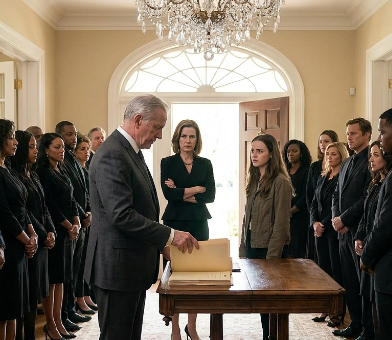
When I walked into the conference room behind Principal Vance’s office, the air was cold. Donald Gable was there, sitting at the head of the table like he owned the building. His daughter was sitting next to him, her face smug.
“Mr. Rivera,” Principal Vance said, pointing to a chair. “Please, sit.”
I stood my ground. “I’m fine standing, thank you.”
Donald Gable leaned forward, his face flushed. “You’ve admitted to the violation, Rivera. You’ve been distributing uninspected food for nine years. We have the photos. We have the reports. We are offering you a chance to resign. You walk away now, you keep your record clean. You refuse, and we terminate you for cause, effective immediately.”
I looked at the resignation form. It was just a piece of paper. It didn’t know about the hollow ache in a child’s stomach on a Sunday morning. It didn’t know about the way Maya’s brother looked at a piece of fruit like it was a gold bar.
“I won’t sign it,” I said.
The room went quiet. Mrs. Gable looked at her father, her eyes wide with shock. Principal Vance started to say something, but the door behind me swung open with a bang.
It was Julian. He was nineteen now, a college student, but I recognized him in a heartbeat. He had been one of the first kids I ever helped. He stood there, flanked by three reporters and a woman I recognized as Councilwoman Marcus.
“What is this?” Donald Gable shouted, standing up. “This is a private meeting!”
“It isn’t private anymore, Mr. Gable,” Julian said, his voice ringing with a calm, sharp authority. He held up his phone, showing the screen to the room. “I posted the story on the town portal an hour ago. There are sixty parents outside on the lawn. They want to know why you’re firing the man who fed their children when the district wouldn’t.”
The room seemed to shrink. Principal Vance looked at the reporters, then at the door, her face turning pale. Mrs. Gable tried to speak, but no sound came out.
“I was one of those kids,” Julian said, looking directly at the board members. “Seven years ago, my mother was working double shifts. We didn’t have food. Mr. Rivera was the only reason I stayed in school. He didn’t care about your liability. He cared about us.”
Councilwoman Marcus stepped forward, her eyes scanning the board members with cold, hard judgment. “We have a municipal audit scheduled for Monday, Donald. If you think this board is going to get away with firing a man for charity while we spend millions on administrative bloat, you are sorely mistaken.”
Donald Gable looked at his daughter, then at the reporters, and finally at me. He looked smaller, somehow. The power he usually wielded like a hammer had vanished. He closed his binder with a heavy thud.
“We will recess,” he muttered.
“No,” I said. I pulled the card from my pocket and laid it on the table. The crayon marks were clear for all of them to see. “I’m not resigning. You fire me, and you tell the town why.”
The board never called the vote. By the next week, the district had issued a public apology, and by the end of the month, they had established the Oakridge Community Weekend Backpack Program. It was an official, insured initiative. Maya, Leo, and the others would never have to worry about a Friday afternoon again.
I stayed on for three more years until I retired. My final day was a blur of handshakes and tears. They held an assembly for me in the gym, and Maya, now a young woman, stood at the podium and spoke about the difference a bag could make. They gave me a bench for the library, and a plaque that still makes me cry when I think about it.
I spend my Fridays on my porch now. Sometimes, kids from the old neighborhood walk by and leave things for me. A loaf of bread, a bunch of grapes, or just a wave and a smile. We don’t talk about policies or liability. We just know that the world is a little bit better when you don’t wait for permission to do the right thing.
I keep the card Maya gave me in a frame on my desk. It’s faded now, and the crayon is starting to peel, but it’s the most valuable thing I own. It reminds me that even when the world feels cold and the rules feel like walls, there is always a way to let a little bit of light in. I didn’t change the world, I know that. But for eight kids, for a few years, I changed their Friday. And honestly, that’s enough for me.