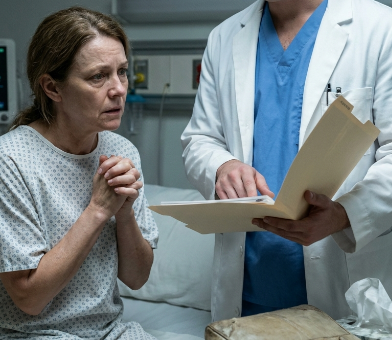
The emergency room at St. Jude’s was loud, bright, and smelled overwhelmingly of industrial disinfectant and wet winter coats. Outside, a bitter January gale was howling across the parking lot, blowing sheets of freezing rain against the tall glass windows. I was sitting on the edge of a high exam bed in Bay 4, cradling my right wrist against my chest. It was swollen, throbbing, and turning an ugly shade of deep purple after an embarrassing slip on a patch of black ice outside the local supermarket.
The blue privacy curtain rustled open, and a paramedic in dark navy trousers and a grey quarter-zip fleece stepped into the bay. His hair was silver at the temples, his face lined with the tired, steady quiet of a veteran first responder. His nametag read D. Miller.
“Evening,” he said gently, pulling a stainless-steel rolling stool toward the bed. “Dr. Aris asked me to double-check your vitals before we take you down to radiology for the X-ray. Let’s get a blood pressure cuff on you.”
I tried to ease my left arm out of my heavy wool sweater. Because my right wrist was stiff and agonizing to move, I had to unbutton the collar and pull the fabric down over my left shoulder to free my arm.
Miller leaned forward, holding a blood pressure cuff in his hands. But as the fabric slid down, revealing my upper shoulder, his hands abruptly stopped.
He didn’t move. He didn’t wrap the cuff. He just stared at the skin right below my collarbone.
High on my left shoulder sat a distinct, raised oval mark about the size of a postage stamp. It was smooth, elevated, and the dark shade of roasted coffee beans. I’ve had it my entire life.
“Ma’am,” Miller said quietly, his tone suddenly dropping its casual clinical warmth. “Where were you born?”
I frowned, shifting slightly on the paper-lined table. “Here in the county, I think. My Aunt Evelyn raised me in Ridgefield, about forty miles north. Why?”
Miller set the blood pressure cuff down on his metal tray. He slowly pulled off his rubber gloves, his knuckles pale, his fingers visibly shaking. He reached into his chest pocket, pulled out a pair of reading glasses, and stepped a few inches closer, inspecting the brown mark without touching it.
“January 1995,” Miller whispered, looking directly into my eyes. “Route 12. The night of the ice storm.”
A cold prickle of uneasiness ran down the back of my neck. “I… I don’t know the exact road. My aunt always said I was born during a bad storm.”
“It was January fourteenth,” Miller said. His voice was thick, brimming with a memory three decades old. “I was twenty-two years old, working as a volunteer EMT out of Station 4. We got a call at two in the morning about an abandoned pickup truck slid into a ditch near the old timber mill on Route 12. Snow was coming down so hard you couldn’t see five feet in front of the rig.”
He took a slow, deep breath, resting his hands on his knees.
“When we pried the truck door open, there was a woman sitting in the cab, wrapped in an old navy blanket. She had just given birth alone in the front seat. No phone, no heat, negative five degrees outside. She was holding a newborn baby girl.”
Miller pointed a trembling finger toward my left shoulder.
“I cleared the baby’s airway right there on the bench seat under a flashlight. When I wrapped the baby in a sterile towel, I saw that mark. Right below her left collarbone. A raised, oval birthmark the exact color of coffee. I’ve been a paramedic for thirty-one years, ma’am. That delivery was my very first. You never forget your first.”
My heart began to thump hard against my ribs. “My aunt told me my mother died that night. She said her heart gave out right after I was born.”
Miller shook his head firmly, his eyes fixed on mine with unwavering certainty.
“Ma’am, I drove your mother to Mercy General myself. I held her hand in the back of the rig while my partner drove. She was exhausted and terrified, but she was entirely stable. When we brought her through the ER doors, she gave the intake clerk a name, Mary Vance. The next morning at six o’clock, before the social worker or the floor nurse could even do rounds, she pulled out her IVs, put her coat on, and walked right out the sliding doors into the snowstorm.”
He leaned closer, his voice dropping to an urgent whisper.
“She left without the baby, Clara. She walked away and left you in the nursery.”
The sounds of the emergency room, the beeping heart monitors, the distant announcements over the intercom, the squeaking rubber soles on linoleum, seemed to mute all at once. My throat felt completely dry.
“She… she abandoned me?” I choked out. “My aunt told me she was buried in the churchyard in St. Mary’s.”
“I don’t know what your aunt told you,” Miller said gently. “But I know what I saw. I followed up with the hospital social worker two days later because I was young and worried about that baby. The police looked for ‘Mary Vance,’ but the address she gave on the intake sheet was a vacant lot. The case was turned over to state child services, and a family member quietly came forward two weeks later to claim custody.”
He reached into his pocket and pulled out a small black pen, sliding his official business card across the metal tray.
“Your aunt didn’t adopt you through a hospital death certificate, Clara. She claimed you through a state abandonment petition.”
I sat frozen on the exam table as Miller stepped back toward the curtain. “I’ll go get the nurse for your X-ray now. But if you ever want to see the old station logbook from that night… I still have a copy of the run sheet.”
He slipped out of the bay, leaving me alone with the quiet humming of the overhead lights.
My left hand was shaking so badly I could barely hold my cell phone. I tapped my contacts, scrolled down to Aunt Evelyn, and pressed call.
Evelyn was seventy-two, a retired high school English teacher who lived alone in the tall, draughty Victorian house where I had been raised. She was a woman of few words, sharp opinions, and absolute discipline. She had given me a home, put me through college, and built my life on a foundation of order and quiet stability.
She picked up on the second ring. “Clara? Did the doctor look at your wrist yet?”
“Aunt Evelyn,” I said, my voice shaking so hard the words tumbled over each other. “I’m sitting in the ER. The paramedic who just checked my vitals… his name is David Miller.”
Silence fell over the line. Complete, heavy silence.
“He was the volunteer EMT on Route 12,” I continued, tears finally burning the corners of my eyes. “In January 1995. He saw my birthmark, Evelyn. He told me my mother didn’t die in that hospital. He said she walked out at six in the morning and left me behind.”
For five agonizing seconds, all I heard was the sound of Evelyn’s slow, deliberate breathing over the phone speaker.
When she finally spoke, her voice wasn’t defensive, angry, or shocked. It was flat, heavy, and loaded with an old, exhausted grief.
“I knew that birthmark would bring the truth back around one day,” Evelyn said softly. “I prayed to God I’d be in the ground before it happened.”
“Why did you lie to me?” I sobbed, pressing the phone tighter against my ear. “Why did you tell me she was dead?”
“Because if you thought she was dead, you wouldn’t spend your life looking for a woman who was running from something that would destroy you,” Evelyn replied quietly. “Get your wrist cast, Clara. Then drive straight to my house. It’s time you open the locked cedar chest in the attic.”
The drive to Aunt Evelyn’s house through the dark, icy country roads was the longest forty minutes of my life. My right arm was encased in a fiberglass cast from my knuckles to my mid-forearm, but I barely felt the dull ache in my bones. All I could see was the reflection of my own face in the rain-slicked windshield, trying to find a trace of a woman I had spent thirty-one years believing was buried under a stone in St. Mary’s cemetery.
When I pulled into the gravel driveway, the old two-story Victorian house was lit up like a beacon against the pitch-black woods. Evelyn was standing on the covered porch, wrapped in a heavy grey cardigan, holding an iron skeleton key in her wrinkled hand.
I stepped out of the car, my boots crunching against the ice. “Evelyn, “
“In the house, Clara,” she said firmly, her face set in deep, familiar lines of determination. “It’s freezing out here.”
She led me inside, past the dark oak sideboard in the entryway, straight up the narrow carpeted stairs to the third-floor attic. The attic smelled of cedar chips, old paper, and dried lavender. In the far corner, beneath a dusty dormer window, sat a heavy, brass-bound cedar trunk that had remained locked for as long as I could remember.
Evelyn knelt down heavily on the floorboards, her knees popping in the quiet room. She slid the iron key into the lock, turned it with a sharp clack, and lifted the heavy lid.
“I didn’t lie to you out of cruelty, Clara,” Evelyn said, her voice steady as she reached into the trunk. “I lied to protect your peace. When a lie keeps a child safe and whole, a mother, or an aunt, will carry the sin of that lie to her grave without flinching.”
She pulled out a yellowed manila folder and set it on her lap. Inside was a stack of official documents, a folded newspaper clipping from 1995, and a silver-framed black-and-white photograph.
She handed me the photograph first.
I took it with my left hand. Staring back at me were two young women in their early twenties, sitting on the front porch of this very house, laughing under the summer sun. One of them was clearly a young Aunt Evelyn. The other woman, standing beside her with dark, wavy hair and a wide, brilliant smile, was her identical twin sister.
My breath hitched. “She… she was your twin?”
“Her name was Sarah,” Evelyn whispered, staring at the photo. “My identical twin sister. We were inseparable until we hit our twenties. I stayed here and became a schoolteacher. Sarah… Sarah wanted adventure. She moved to the city, got involved with the wrong people, and got swept up in a world that was far too big and far too dangerous for her.”
Evelyn reached into the folder and pulled out a newspaper clipping from the State Chronicle, dated November 1994, two months before I was born.
The headline read: Key Witness Disappears Ahead of Grand Jury Testimony in Maritime Fraud Trial.
“Sarah was working as a executive secretary for a high-level private logistics firm in the city,” Evelyn explained, her eyes darkening. “She discovered that her employer was laundering money for a dangerous criminal syndicate. She went to the federal prosecutors, signed a deposition, and agreed to testify. But before the trial could start, someone leaked her identity.”
I swallowed hard, looking from the newspaper clipping to Evelyn. “She ran.”
“She ran for her life,” Evelyn said. “She changed her car, cut off all contact with our family, and lived out of motels across three states. But what the prosecutors didn’t know, what even I didn’t know until the night you were born, was that Sarah was seven months pregnant.”
Evelyn reached deeper into the folder and pulled out an unsealed, handwritten letter written on faded blue stationery, ink smudged at the margins.
“The night of January fourteenth, 1995,” Evelyn continued, her voice trembling slightly for the first time, “Sarah was trying to reach this house. She knew the storm would cover her tracks. But her truck’s alternator failed on Route 12, four miles from here. She went into labor in the cold.”
“The paramedic… Miller,” I whispered. “He said she checked out of Mercy General at six in the morning.”
“She didn’t check out because she didn’t want you, Clara,” Evelyn said, looking up, her dark eyes fierce with emotion. “She checked out because at five-thirty that morning, two men in suit jackets walked into the Mercy General lobby asking the night clerk if a woman named Sarah Vance had been admitted.”
My blood ran instantly cold. “They tracked her to the hospital?”
“The night nurse was an old friend of mine,” Evelyn said. “She recognized Sarah despite the fake name, and she recognized the danger when those men showed up. She snuck Sarah out the emergency exit into the alley, gave her a hundred dollars, and told her to run. Sarah knew that if she took you with her, those men would track an infant with medical needs in a heartbeat. Or worse… they would use you to break her.”
Evelyn handed me the blue letter.
“Sarah came to my window at seven that morning while the snow was still falling,” Evelyn choked out. “She handed me this letter, kissed my cheek, and told me to go to child services the moment the hospital reported an abandoned baby. She made me swear on our mother’s memory that I would claim you, raise you under my name, and tell everyone, including you, that your mother died the night you were born.”
“Why?” I sobbed, tears spilling over my lashes and dripping onto the blue paper. “Why tell me she was dead?”
“Because if the syndicate ever came back to this town,” Evelyn said, “if they ever monitored my house or asked questions, they needed to believe Sarah Vance’s story ended in that hospital bed. And if you knew she was alive, Clara, you would have looked for her. And looking for Sarah Vance was a death sentence.”
I unfolded the blue paper with trembling fingers. The handwriting was slanted, elegant, and frantic.
Evelyn,
If you are reading this, it means you have my little girl in your arms. I am leaving her with the only person on this earth I trust more than myself. I am giving her my life, but I cannot give her my name. Keep her safe. Tell her I love her. Tell her I died, so she never spends a single day waiting by a window for a ghost that can never come home.
Love always, Sarah.
I pressed the letter against my chest, pulling my knees up against the wooden floor of the attic. Thirty-one years of anger, confusion, and abandonment suddenly evaporated, replaced by a devastating, crushing weight of understanding.
“She didn’t leave me because she didn’t love me,” I whispered. “She left me so they wouldn’t find me.”
“She saved your life, Clara,” Evelyn said, reaching out with her worn, calloused hand to cover mine. “And I spent thirty-one years keeping that promise.”
I looked up from the letter, meeting my aunt’s tear-filled eyes. “Where is she now, Evelyn? Is she… is she still out there?”
Evelyn reached back into the bottom of the cedar trunk and pulled out a small, modern white envelope, completely unmarked.
“Three weeks ago,” Evelyn said softly, “an envelope arrived in my mailbox with no return address. Inside was a single photograph of a seaside town in Maine… and a note that said, ‘Tell her it’s safe now.'”
The white envelope felt surprisingly light in my hand, but it carried the weight of thirty-one years of silence.
I pulled out the contents. Inside was a small, glossy photograph of a quiet, rocky coastline in Maine. A small grey-shingled cottage stood near a wooden pier, surrounded by tall pine trees and wild rose bushes. On the back of the photograph, written in that same slanted, elegant handwriting I had just read on the blue stationery, were six words:
The storm has passed. Port Harbor.
“Port Harbor,” I repeated, my voice barely a whisper. “She’s in Maine?”
“Sarah spent twenty-eight years living under assumed names,” Evelyn said, standing up stiffly from the floorboards and leaning against the attic dormer. “Moving every two years, working cash jobs, never staying in one place long enough to let a root take hold. Four years ago, the primary defendant in that federal trial, the man who threatened her life, died in a federal prison hospital.”
“She waited four years to send this?” I asked.
“She waited until she was certain the men who served him were gone or dispersed,” Evelyn replied. “She spent her entire life in the shadows, Clara. Even when the danger faded, the habit of hiding doesn’t just disappear. She was afraid… afraid that if she reached out, you would hate her for leaving you.”
I looked down at the cast on my right wrist, then back at the photograph of the quiet grey cottage on the coast.
For thirty-one years, I had lived a quiet, careful life in this small town, working as an assistant archivist at the county library, moving through predictable days, believing my story began with a tragic loss in a cold hospital room. But my story hadn’t begun with a loss. It had begun with an act of ferocious, sacrificial love.
“I need to go there,” I said, looking up at my aunt.
Evelyn didn’t argue. She didn’t try to reason with me or tell me to wait until my wrist healed. She simply reached into her sweater pocket, pulled out her car keys, and laid them on top of the cedar chest.
“I’m coming with you,” Evelyn said softly. “I haven’t seen my sister in thirty-one years.”
Early the next morning, before the sun had even cleared the tree line, Evelyn and I loaded two small bags into her sedan and pulled out of the driveway. The ice on the roads had begun to melt under a rising winter sun, turning the asphalt black and clear.
We drove north for seven hours, crossing state lines in silence, watching the rolling hills of the interior give way to the rugged, salt-crusted pine forests of the New England coast. Neither of us spoke much. We didn’t need to. The quiet between us was filled with the steady, pulsing anticipation of two women returning to a missing piece of their lives.
By three o’clock in the afternoon, we turned off the main highway onto a narrow gravel road that wound through dense stands of blue spruce toward the water. The air smelled sharp and clean, rich with salt and ozone.
At the very end of the lane, perched on a grassy bluff overlooking a quiet grey bay, sat the cottage from the photograph. Smoke was drifting gently from a red brick chimney into the pale afternoon sky.
Evelyn stopped the car near the wooden mailbox. Her hands gripped the steering wheel so tightly her knuckles were white.
“Are you ready?” I asked softly.
Evelyn looked at me, her eyes filled with a mixture of terror and overwhelming relief. “I’ve been ready for thirty-one years, Clara.”
We stepped out of the car. The wind off the ocean was cold, but it felt refreshing against my face. We walked up the crushed-shell path toward the small wooden porch.
Before we could even reach the top step, the heavy green front door swung open.
A woman stepped out onto the porch. She was sixty-two years old, dressed in a thick cream-colored knit sweater and dark jeans. Her silver-grey hair was pulled back in a loose clip, framing a face lined with time, weather, and quiet endurance.
She stood still, her hands resting near her waist, staring at us.
When her eyes met Evelyn’s, a soft, broken gasp escaped her lips. The two sisters stared at each other across the ten feet of space between them, identical in structure, separated by three decades of enforced silence.
Then, the woman’s eyes shifted slowly from Evelyn to me.
Her gaze traveled down my face, past my dark coat, and rested on my right arm, wrapped in its white fiberglass cast. A faint, tearful smile touched the corners of her mouth.
“You always were prone to rushing through the winter,” she said, her voice low, raspy, and filled with a familiar, melodic cadence that sounded exactly like Evelyn’s.
She took three slow steps across the porch, stopping right in front of me. She reached out with a trembling hand, her fingers stopping an inch from my shoulder, right over the spot where the raised coffee-colored birthmark lay hidden beneath my coat.
“Clara,” she whispered, tears finally overflowing and running down her weathered cheeks. “My sweet, brave Clara.”
We spent the next four days inside that warm, pine-scented cottage by the sea.
There were no explosive confrontations, no theatrical speeches, and no dramatic demands for forgiveness. Instead, there was a quiet, steady unraveling of thirty-one years of kept secrets.
My mother, whose real name was Sarah, showed me boxes of quiet treasures she had kept in her closets across three decades of hiding: every school photograph Evelyn had secretly mailed to a post office box in Vermont, my high school graduation program, my college diploma announcement, and small, handwritten birthday notes she had written to me every January fourteenth and tucked away in a tin box.
She had never missed a year. She had never forgotten a single detail.
We walked along the rocky beach every morning, wrapped in heavy coats, listening to the ocean crash against the granite stones. I listened to her talk about her youth, about the bright summer days she and Evelyn had spent on their porch before the world pulled them apart, and about the terrifying, cold night in the back of a pickup truck on Route 12 where she had held me for forty-five minutes, praying that her sacrifice would give me a peaceful life.
“I used to think leaving you was the only mistake I ever made,” Sarah said on our third evening, as we sat by the stone fireplace watching the dusk settle over the water. “But looking at you now, seeing how strong, how kind, and how whole you are, I know it was the only good choice I had left.”
“You didn’t leave me, Mom,” I said gently, using the word for the very first time. “You protected me.”
When Evelyn and I finally prepared to drive back south, we didn’t say goodbye.
We helped Sarah pack two small leather suitcases and load them into the trunk of our car. For thirty-one years, Sarah had lived as a ghost, hiding from a past that no longer existed. But she was done running.
A month later, Sarah moved into a small, sunlit cottage three miles down the road from Evelyn’s house in Ridgefield.
Today, if you drive past Aunt Evelyn’s Victorian house on a warm Sunday afternoon, you will see two silver-haired women sitting side by side on the front porch, drinking iced tea and talking in low, happy voices. And sitting on the porch steps between them is a thirty-one-year-old woman with a cast-free wrist, watching the afternoon sun light up the garden.
Sometimes, the truth doesn’t arrive in a grand legal battle or a sudden windfall of wealth. Sometimes, it arrives in the quiet cubicle of an emergency room, carried by a veteran paramedic who remembered a coffee-colored birthmark, and the extraordinary sacrifice of a mother who chose her child’s safety over her own heart.