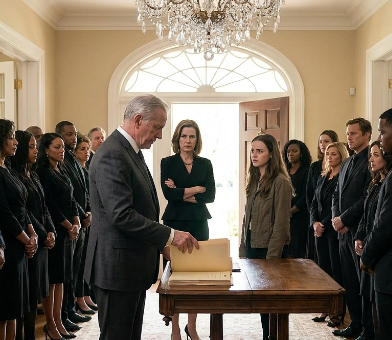
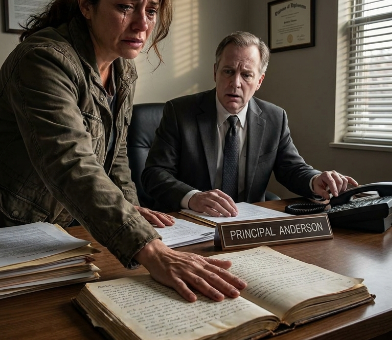
The envelope arrived exactly twenty-eight days after my father’s funeral. It was thin, unassuming, and held a cashier’s check for $138,422. That money was the product of four decades my father spent working at the Miller-Hebert steel fabrication plant in Iberia Parish. He drove a 1996 Ford truck that rattled every time he turned the ignition, and he wore the same work boots until the soles literally detached from the leather. He lived that way so that his youngest daughter and his granddaughter, Chloe, would have a foundation.
I was thirty-six, working as a library assistant in a middle school, and still struggling to pay off the last of my divorce lawyer’s fees. That check wasn’t just savings. It was a lifeline. It was a college fund for Chloe and a way to stop the constant, gnawing anxiety that kept me awake until 3:00 AM every night.
My older sister, Sondra, had been married to Bruce Landry for fourteen years. Bruce was the local success story. He was a senior vice president of regional operations at the St. Martin Parish branch of a massive national bank. He wore expensive suits, belonged to a country club I’d never visited, and always had a loud, booming opinion on how everyone else should manage their finances.
Sondra saw the check on my kitchen counter when she came over to drop off some of my father’s old tools. She called Bruce before she even finished her tea.
Within forty minutes, Bruce pulled into my driveway in his luxury SUV, carrying a slim leather portfolio and a look of profound, patronizing sympathy.
“Hannah, you can’t just leave that money in a standard savings account,” Bruce said, not even waiting for me to ask for his advice. He laid out a series of forms across my scarred pine kitchen table. “The tax bite on a lump sum payout is going to be brutal. If you don’t shield this correctly, you’re looking at a massive hit from the IRS.”
I felt small. I didn’t know the first thing about high-yield investment structures or tax-shielding strategies. I just wanted to do right by my father. “I just need it to be safe for Chloe,” I told him, gripping my mug so hard my knuckles turned white.
“That is exactly why you have me,” Bruce smiled, a smooth, practiced movement. “I handle institutional trust vehicles for high-net-worth commercial clients every single day.
I can move this into a temporary commercial omnibus trust under my branch management portfolio for ninety days. We sweep the interest, shield the principal, and return the funds to you once the fiscal quarter clears. It’s an easy process. I do it for the regional board members all the time.”
Sondra reached out and placed a hand on my wrist. “Hannah, listen to him. Bruce is an expert. Don’t throw away Dad’s money on avoidable taxes just because you’re scared of the paperwork.”
I signed the authorization forms. I trusted them because they were family. That trust was the most expensive mistake I ever made.
For the first two months, I heard nothing. When the ninety-day window hit, I started calling Bruce. He was suddenly always in a meeting, always on a conference call, or always traveling for work. When I finally caught him at Sondra’s house on a Sunday afternoon, he wasn’t the warm, helpful brother-in-law anymore. He was cold, dismissive, and clearly annoyed by my presence.
“Market conditions shifted, Hannah,” he said, staring at his glass of scotch instead of me. “The private equity vehicle encountered a sudden liquidity draw. The capital was absorbed under the risk-mitigation terms of the agreement you signed.”
I felt the blood drain from my face. “Absorbed? Bruce, that was $138,422. That was my father’s life insurance.”
“It was a speculative investment, Hannah,” he snapped, his voice rising just enough to sound aggressive. “You signed the disclosure. The money is gone. There is nothing to audit, and there is nothing to return. If you try to cause trouble, you’ll be suing a multi-billion-dollar bank with a legal department that eats people like you for breakfast.”
Sondra looked at the floor, her face tight. “Hannah, please. Don’t make a scene. Bruce’s career is at a very delicate stage. If the regional board hears about a family dispute, it could ruin his standing.”
I realized then that they weren’t worried about the money. They were worried about their status. I stood up, walked out of their house, and didn’t say a word. I went home and spent the night sitting on my floor in the dark.
The next day, I talked to an attorney. He looked at the one-page waiver Bruce had given me and sighed. “He washed this through an institutional liability waiver,” the lawyer told me. “Without proof of intent or records of the internal diversion, this is a dead end. To subpoena the bank’s internal ledgers, you’ll need a massive retainer I know you don’t have.”
I didn’t have the money. But I had a library assistant’s patience and a burning, singular need for the truth.
Two weeks later, I saw a job posting on the bank’s career site. They needed a records clerk for the basement archives. It was entry-level, mind-numbing work. I applied. I didn’t tell Sondra. I didn’t tell a soul. I put on my best suit, went to the interview, and acted as if I were looking for a simple paycheck.
I got the job.
The basement level of the regional headquarters was a world of dust and flickering fluorescent lights. My clearance was low, but my access to the physical records was almost total. I spent my mornings logging secondary files and my afternoons learning the bank’s operating system. I learned that every internal wire transfer leaves a digital fingerprint, a specific 16-digit routing stamp, a terminal ID, and an operator log that the bank’s system retains for three years, no matter what happens to the account.
I saw Bruce in the elevator once or twice. He would look at me with a mix of pity and arrogance. “How’s the filing, Hannah? Still doing the busy work?”
“It keeps me busy, Bruce,” I’d say, staring at the floor, keeping my face blank. He had no idea that at lunch, I was using his own employee ID to track his terminal activity in the archive server.
By the third month, I found the trail. It wasn’t a market downturn. It was a heist. On the day I signed those papers, Bruce had routed my money into a dormant commercial shell account named *Landry Strategic Holdings.*
Eighteen days later, $42,000 vanished to cover a personal line of credit Bruce held at another branch. Five weeks after that, $55,000 was wired to an offshore escrow account in the Caymans. The remaining $41,422 was funneled into an executive incentive pool that Bruce used to pad his own performance bonuses, netting him an extra $35,000 in personal pay.
It was systematic theft. He had used my father’s legacy to pay for his vacations and his bonuses.
I spent every evening after the rest of the staff left sitting at my terminal in the back corner of the basement. I printed logs, cross-referenced his terminal timestamps with the wire receipts, and mapped out the entire fraud. I built a file that eventually reached 147 pages of pure, documented proof. Every single page had the bank’s official audit stamp.
I didn’t tell Sondra. She had picked her side. I waited for the annual Federal Financial Institutions Examination Council audit, the week when the senior auditors from the federal government took over the building.
On the final day of my employment, I walked into HR and handed in my resignation. Then, I took my leather-bound binder and walked straight to the twelfth-floor executive suite. The board was in session. Bruce was in the middle of a presentation.
I walked into the boardroom, my heart beating so hard it felt like it was hitting my ribs. The room went silent.
“Hannah? What are you doing?” Bruce asked, his voice shaking just a little.
“I’m here to finish our business, Bruce,” I said, placing the binder on the table between the CEO and the federal lead auditor.
I started at page fourteen. I showed them the terminal ID ending in 8-8-2. I showed them the shell account. I showed them the Cayman Islands transfer. The auditor didn’t even look at Bruce once he saw the routing stamps. He just kept flipping pages, his face growing harder with every single section.
Bruce started to shout, but the CEO just held up a hand. “Shut up, Mark. Sit down.”
“It’s not just an error, sir,” I told the auditor, my voice steady, feeling a calm wash over me that I hadn’t felt in a year. “It’s a deliberate, systematic embezzlement of life insurance funds.”
The room was so quiet I could hear the AC hum. The lead auditor looked at the legal counsel and simply said, “Call the feds. This is a criminal matter now.”
I left the building as they were clearing the room. Three days later, Bruce was walked out in handcuffs.
The legal process was long, but because my evidence was flawless, the bank didn’t fight the restitution. They paid me back the full $138,422, plus fees. Sondra called me once after Bruce’s sentencing, crying about how I’d ruined everything. I didn’t argue. I just told her that she’d chosen the wrong person to protect, and then I hung up.
Today, I sit on my own porch in a quiet neighborhood that feels like a sanctuary. Chloe is playing in the backyard with a puppy we picked up from the shelter last month. The money is in an irrevocable trust, untouchable and growing. I don’t work for a bank anymore. I work for a non-profit that helps families stay in their homes. The pay is smaller, but my conscience is clear. My father spent his life working for that money so I could have a future. I didn’t just reclaim his legacy. I protected it. And finally, I can breathe again.