“Just don’t worry about the grocery shopping this month, I have it handled,” Karen told me. It was a week before Christmas, and she sounded busy, like she always did. She was a real estate agent in Lake Worth, and in her head, the world was a series of deals to be closed. I was just a high school English teacher in Stuart, and I suppose she thought I was too distracted by grading essays to notice the world falling apart.
I didn’t think twice about it. For six years, ever since we buried Dad, the arrangement had been simple. Karen managed the finances. She had the head for numbers. I handled the physical presence, the bi-weekly visits to Mom’s mobile home in Fort Pierce. I sent two hundred dollars of my own money every month just to make sure Mom had little things like magazines or extra fruit. I thought we were a team.
The mobile home smelled like lavender and old paper. Mom was a retired librarian, and she still kept her books in perfect alphabetical order, even if she couldn’t remember the plots anymore. When I walked in that Christmas morning, she was sitting in her favorite armchair, wrapped in a faded blue cardigan. She looked thin. Not just frail, but like she was being erased from the inside out.
“Mom, you’re shivering,” I said, reaching out to touch her hand. She felt like a bird. Her skin was paper-dry and cold.
“I’m fine, Laura,” she said, her voice a soft, airy thing. “Just a little drafty today.”
I went to the kitchen to put the kettle on. I opened the fridge because I wanted to make sure she had something decent for lunch. My hand just hovered there. There was a carton of skim milk that had expired two weeks ago. Half a jar of mayonnaise. Two cans of corn. That was it. I opened the pantry. A half-eaten sleeve of saltine crackers.
I turned around, and she was watching me from the living room. She looked so small in that oversized chair. I went into the bathroom and found the scale. When I made her step on it, the number flickered and settled on ninety-two. She had lost eighteen pounds in a year. My throat felt like it was full of glass.
“Mom, why didn’t you tell me?” I asked, trying to keep my voice steady.
“I didn’t want to be a bother,” she whispered. “Karen said the pension was tight lately. She said I had to be careful.”
I didn’t say anything else. I didn’t want to scare her. I just promised to go to the store, but I didn’t go to the store. I went to the First Coastal Bank in Fort Pierce. I had the death certificate and Mom’s ID in my bag. I told the teller I needed to see the account history. I was the eldest daughter. I was supposed to be the one who looked out for the cracks in the foundation.
The teller was a young woman with kind eyes. She looked at the computer screen, and then her face went flat. She clicked a few keys, frowned, and then looked at me. “Is there a problem?” I asked, my heart doing a slow, heavy thud in my chest.
“I’m looking at the automatic sweep,” she said, her voice dropping. “It’s been set up for seventy-two months.
Every time the two-thousand-one-hundred-dollar pension clears on the first, eighteen hundred is immediately wired to an external account.”
I felt the room tilt. “To whom?”
“Karen Vance-Miller,” she said.
I didn’t go home. I sat in the bank parking lot and called Karen. She answered on the second ring, sounding annoyed. “What, Laura? I’m in the middle of a showing.”
“Why are you taking eighteen hundred dollars from Mom’s account every month?” I asked. I wasn’t shouting. I was vibrating with a rage that felt like it was going to burn me up from the inside.
“She doesn’t need that much,” Karen snapped. “She lives in a trailer. The money is just sitting there. I’m building equity for the family. Do you have any idea what my mortgage is in Lake Worth?”
“She is starving, Karen,” I said. “She weighs ninety-two pounds.”
“She’s an old woman, Laura. They lose weight. Don’t be dramatic.”
She hung up on me.
I didn’t call my brother Marcus. He was a trucker, always on the road, always wanting to believe the best of everyone. I didn’t call anyone. I drove straight to the Palm Beach County Department of Children and Families. I walked into that office and I didn’t leave until I had a file number.
Brenda Davis was the investigator. She was a woman who clearly didn’t have time for nonsense. She listened to me, looked at the photos of the empty fridge, and then she looked at me like I was a person who had finally woken up. “We’re going to need a subpoena,” she said.
The next three weeks were a blur of meetings and paperwork. A medical evaluation confirmed the malnutrition. It wasn’t just that Mom wasn’t eating; she was physically wasted. Brenda pushed through the subpoenas. Every day was a new layer of the rot.
Karen didn’t stop. She called Marcus and told him I was having a breakdown. She told him I was trying to seize Mom’s estate to put her in a state-run home. Marcus called me, his voice tight. “Laura, just talk to her. Don’t ruin the family over a misunderstanding.”
“It’s not a misunderstanding, Marcus,” I said. “It’s a balance sheet.”
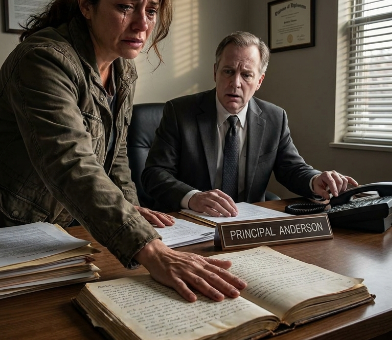
I met Brenda in her office on a Tuesday. She had two thick binders on her desk. She didn’t look at me at first. She was flipping through pages. “It’s worse than the transfers,” she said.
She pointed to a document. It was a secondary line of credit on Karen’s house. Mom’s mobile home title was listed as the collateral. Karen had forged Mom’s signature to gamble on her own property. If Karen’s house went under, Mom would have been homeless.
“She falsified the accounting statements,” Brenda said, sliding a paper toward me. It was a fake quarterly report that Karen had been sending me for years. It looked professional. It looked like a lie.
Brenda called Karen for a meeting. She told her it was just a standard audit. Karen walked into the office looking like she owned the place. She was wearing a designer blazer, her hair perfectly done, the picture of a successful suburban real estate agent. She didn’t see me until she was already inside the room.
“What is she doing here?” Karen asked, her eyes narrowing.
“Sit down, Karen,” Brenda said. Her voice was like iron.
Brenda didn’t waste time. She opened the binders. She laid out the transfer logs, the forged guarantor forms, and the medical diagnosis. It was all there, laid out in black and white. One hundred fifty-one thousand, two hundred dollars.
“This is just administrative reimbursement,” Karen said, but her voice cracked. She was looking at the ledger, not at me.
I stood up. I walked over to the table and dropped the photo of the empty fridge right on top of her bank records. “Is that what you call it?” I asked. “Administrative reimbursement for starving your own mother?”
Karen looked at the photo, and for a second, her mask slipped. She looked terrified. “Laura, please. If this goes to the prosecutor, I lose my license. I lose everything.”
“You already lost everything a long time ago,” I said.
I signed the affidavit. I watched Brenda hand the file over to the state prosecutor’s office. Karen started to cry, but it wasn’t the crying of a person who felt sorry. It was the crying of a person who had finally been caught in a trap of her own making.
The arrest happened two days later. Watching the police lead her out of her suburban home in Lake Worth was the coldest thing I’ve ever seen. The neighbors were watching, and I wondered if they knew the woman they bought houses from had been paying for her granite countertops with her mother’s survival money.
Marcus came to town when the news broke. He looked at the bank records I had printed out for him. He sat at my kitchen table for an hour, just staring at the numbers. He didn’t say a word. When he finally looked up, his eyes were red. He didn’t even ask to see Karen. He just asked how Mom was doing.
It took time to get Mom back to herself. We moved her into an assisted living center near my house. It was bright and clean. It had a porch that caught the morning sun.
Six weeks after the arrest, I went to visit her. She was sitting on the porch, wrapped in a soft, bright blue cardigan I’d picked out for her. She was eating a slice of peach pie, and there was actual color in her cheeks. She looked like the mother I remembered from my childhood.
She saw me coming and smiled. She reached out and took my hand. “It’s so quiet here, sweetie,” she said. “I finally feel safe.”
She didn’t mention Karen. She didn’t mention the mobile home or the hunger. She just looked at the garden, and for the first time in years, she looked like she wasn’t waiting for the other shoe to drop.
I sat there with her, holding her hand, and I thought about the ledger. I thought about the $151,200 that had turned into a prison sentence for one sister and a little bit of peace for the other. I looked at the bank statement in my purse. The balance was clean. It was enough.
I don’t know if she ever truly understood what happened. Sometimes I think she does, and she just chooses to let it go because she’s a better person than I’ll ever be. Other times, I think the memory is just another book she’s decided to stop reading.
The sun started to dip, casting long shadows across the floorboards of the porch. I stayed until the moon came up, just listening to the quiet. It was the best sound I’d heard in six years. My sister is in a cell, and my mother is eating pie, and for now, the ledger is closed.
I don’t know what happens when the court case finishes. I don’t know if Marcus will ever talk to her again. I don’t know if I can ever look at a blue cardigan without thinking of a refrigerator full of nothing but mayonnaise and corn. But that’s for tomorrow. Tonight, the porch is warm, and Mom is still here. That’s the only thing that matters.