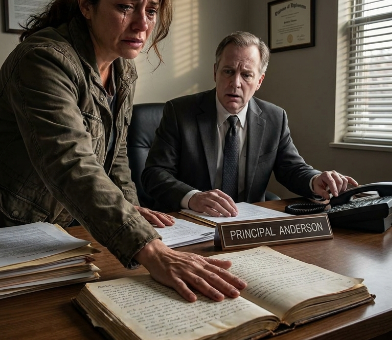
I should have looked closer at the math six years ago instead of just trusting that things were being handled. When you have a sister like Brenda who talks fast and wears expensive blazers in Lake Worth, you tend to let her take the reins just so you do not have to fight about it. I figured out the hard way that trust is a poor substitute for bank statements. My name is Elena Vance, and I spent six years teaching high school English in Orlando while my mother wasted away in a rotting mobile home in Okeechobee.
I told myself Brenda was taking care of things out of the goodness of her heart. I told myself the two-hundred-dollar money orders I sent every month were just extra pocket change for Mom to buy yarn or coffee. I was wrong about pretty much everything from the very first day.
The drive down Florida’s Turnpike always felt the same around the three-hour mark when the landscape flattens out into flat scrub and cattle pastures. That Christmas Eve, the air smelled like damp pond water and woodsmoke as I pulled my sedan onto the gravel lot of the mobile home park. Mom didn’t come to the screen door when I tapped on the aluminum frame. I had to let myself in with the spare key that stuck halfway in the lock. The house hit me first with a damp, bone-chilling cold that felt heavier than the winter air outside. Mom was sitting in her old velvet armchair with a faded green cardigan pulled tight across her thin shoulders, staring blankly at a small television that wasn’t even plugged in.
The kitchen was so quiet I could hear the faint hum of the refrigerator motor struggling to kick on. I opened the fridge hoping to find the ham I had sent money for the week before. The shelves held nothing except a crusted carton of milk that had expired two weeks prior and half a jar of yellow mustard. The pantry had two cans of creamed corn and a box of saltines with stale corners. I touched Mom’s shoulder and felt the sharp ridge of her collarbone right through the wool of her sweater. When I gently coaxed her into the hallway bathroom and stepped her onto the old plastic scale by the door, the needle barely dragged past ninety-four pounds. She had dropped eighteen pounds since July, and I hadn’t even noticed because she wore those same loose sweaters every single time I visited.
“Brenda drops off my three hundred dollar cash envelope on the first of every month, sweetheart,” Mom whispered, her voice dry and paper-thin as she clutched a small, worn spiral notebook against her chest. “Prices have gone up at the Piggly Wiggly, that is all. I just make it stretch.”
I flipped open the notebook she was holding. Every single grocery purchase was written down in her shaky, precise cursive, down to a single loaf of bread or a packet of tea bags. The numbers did not add up in my head no matter how many times I tried to make them fit. Dad’s military pension was twenty-one hundred dollars flat every month, sent straight from the Department of Veterans Affairs. If Brenda was only handing Mom three hundred dollars in cash out of a brown envelope, where was the remaining eighteen hundred dollars going every thirty days?
I didn’t argue with Mom right then because she looked too fragile to handle a fight. I spent the next hour cleaning out the rotting food, driving to the twenty-four-hour store in town, and stocking her tiny cupboards with eggs, chicken soup, and fresh fruit. My hands were shaking so hard I dropped a carton of milk on the linoleum floor, watching it split wide open in a white puddle.
I cleaned it up with a roll of paper towels, my chest feeling tight and hot. When I left her house that evening to sleep in the spare room, I took her battered metal lockbox from the top of the closet.
The bank teller at the local branch in Okeechobee knew me well enough from my high school teaching days to pull the master routing history once I showed my co-signatory papers. She printed out seventy-two pages of transaction ledgers without saying a word, her expression shifting from polite small-town friendliness to something tight and grim. She slid the final summary sheet across the counter and tapped her fingernail against the bottom line. Every single month for six years, the twenty-one hundred dollar deposit hit the primary account, and twenty-four hours later, an automated electronic sweep moved eighteen hundred dollars straight into an escrow account held solely by Brenda Vance-Holloway in Lake Worth. One hundred fifty-one thousand two hundred dollars total.
I sat in my car in the gravel parking lot with the motor running and the heater blasting warm air against my knees. I dialed Brenda’s cell phone before I could talk myself out of it. She picked up on the third ring, the background noise full of shampoo bottles clinking and blow dryers humming in her high-end salon.
“Elena, I’m right in the middle of a foil highlight,” Brenda said, her voice dripping with that smooth real estate agent patience that always made me feel like an idiot. “Can this wait until after the holidays?”
“Where is the rest of Mom’s pension, Brenda?” I asked, my voice shaking so badly I barely recognized it.
“What are you talking about? She gets her envelope every month like clockwork.”
“Don’t lie to me,” I shouted, leaning my forehead against the steering wheel. “I am looking at the bank routing logs right now. You’ve been stripping eighteen hundred dollars out of her account every single month for six years. She is living on thirty-dollar bags of groceries while you’re sitting in Lake Worth.”
There was a sharp pause on the line, the sound of a blow dryer cutting off abruptly. “Mom doesn’t need that money, Elena. She barely goes anywhere. Someone has to maintain the family assets, and her little mobile home isn’t going to pay for itself.”
“She barely eats, Brenda!” I screamed, slamming my palm against the horn before I cut the connection and threw my phone onto the passenger seat.
The local Human Services building smelled like old floor wax and damp raincoats when I walked through the double doors the following morning. Senior Investigator Marcus Thorne didn’t look like a bureaucrat; he had silver hair cropped close to his skull, tired eyes, and a desk piled four feet high with case files. He listened to me for twenty minutes without interrupting, his pen scratching steady notes on a yellow legal pad. When I slid the seventy-two pages of bank statements across his desk, he put his glasses on and traced the automated transfer lines with the tip of his thumb.
“This isn’t just financial mismanagement,” Agent Thorne said, looking up at me over the rims of his glasses. “This is systematic elder exploitation. We see it all the time with family members who think they are entitled to an early inheritance.”
The fallout inside the extended family happened faster than a brushfire in a dry pine forest. By Boxing Day, my phone was blowing up with text messages from Brenda and frantic voice notes from cousins I hadn’t spoken to in five years. Brenda claimed I was dragging the family name through the mud just to feel important, that an APS investigation would ruin her real estate reputation and force her into foreclosure on her three-hundred-and-forty-thousand-dollar Lake Worth house. She even tried to convince our aunt that Mom was losing her mind and making things up. Mom spent the entire afternoon crying into her handkerchief, terrified that both of us would abandon her and leave her in a state-run facility.
“Just leave it alone, honey,” Mom sobbed, reaching out to pat my hand with skin like tissue paper. “Brenda has a lot of responsibilities down south. We don’t need the trouble.”
“We are not leaving it alone, Mom,” I said, keeping my voice as steady as I could while my own throat felt like it was full of sand.
Two days later, Investigator Thorne called me back into his office for the final piece of the puzzle. He pulled a fresh manila folder from the bottom of his stack and opened it up with a slow, deliberate movement. He slid six years of sub-ledgers across the desk and pointed to a single sheet clipped to the back. It was a direct-deposit authorization form dated right after our father died in 2020, bearing Mom’s signature, except the letters were too straight, too firm, too neat for a woman whose hands had been trembling with arthritis for a decade.
“She didn’t just siphon the monthly checks,” Thorne said, his voice low and flat. “She forged your mother’s signature on a power-of-attorney transfer right after the funeral. She used that eighteen hundred a month to cover the exact mortgage payment on her Lake Worth property, and she claimed your mother as a full financial dependent on her state taxes every April to get the deductions.”
The confrontation happened on a Thursday morning under a grey, miserable sky that threatened rain. I drove down to Lake Worth with Agent Thorne and a county sheriff’s deputy named Miller whose belt groaned under the weight of his gear. We pulled up to Brenda’s house, a stucco-and-tile suburban home with a manicured lawn and a shiny white Mercedes parked in the paved driveway. Brenda opened the front door wearing a silk robe and holding a mug of green tea, her face dropping the second she saw the badge on Thorne’s lapel and the uniform beside him.
“What is this about?” Brenda asked, trying to force a bright, professional smile that didn’t reach her eyes. “Elena, what are you doing bringing police to my house?”
I stepped past her into the tiled entryway without waiting for an invitation, holding the bank audit and the forged 2020 authorization form like a shield. “You didn’t manage her estate, Brenda. You starved her to pay your mortgage.”
Agent Thorne stepped inside behind me and served her with an emergency order freezing all linked bank accounts, along with a formal summons for felony elder exploitation. Brenda tried to laugh it off, turning to Deputy Miller with an indignant huff. “This is a private family disagreement over estate planning. My sister is having some kind of emotional breakdown.”
“You forged her signature on a direct-deposit form in 2020, Mrs. Holloway,” Deputy Miller said, his voice entirely devoid of humor as he pulled out his citation book. “That is not a family disagreement. That is grand theft.”
The legal battle didn’t last as long as Brenda had hoped because the paper trail was watertight from top to bottom. The family court in Okeechobee awarded me full legal and financial guardianship over Mom within ten days of the filing. The judge placed an immediate restitution lien of one hundred fifty-one thousand two hundred dollars against Brenda’s Lake Worth property. To avoid facing a mandatory prison sentence under a negotiated plea agreement with the district attorney, Brenda was forced to put her precious house on the market immediately, settling the entire debt into an irrevocable trust designed exclusively for Mom’s ongoing care.
Moving Mom out of that decaying mobile home took two trips in a rental box truck. We packed up her porcelain figurines, her framed photographs of Dad, and the worn spiral notebook where she had kept track of every single cent she never actually spent. We brought her back up to Orlando with us, settling her into the bright, renovated guest suite on the ground floor of my house where the afternoon sun pours straight through the glass doors. We set up visiting nursing care and arranged for fresh, hot meal delivery three times a week using her fully restored twenty-one hundred dollar monthly pension.
On a warm afternoon a few weeks after the dust settled, Mom sat out on the back patio wearing a soft blue cardigan I bought her at the local market, eating fresh strawberries out of a ceramic bowl. She looked out over the lawn where the jasmine was just starting to climb the wooden trellis, her shoulders relaxed for the first time since I could remember. Inside the house, resting quietly inside my leather briefcase on the study desk, was the official court notice confirming the closing sale of Brenda’s Lake Worth home and the full deposit of restitution into Mom’s trust. The kitchen smelled like coffee and warm toast, and for the first time in six years, the house felt entirely quiet in the right kind of way.