Why do we spend decades trying to protect people who are only waiting for the moment they can finally take what is left of us? I ask myself that question every single time I sit on my front porch and watch the mail carrier walk past. For fifteen years, I told myself that my daughter Allison was just ambitious. I told myself that her husband Brandon was simply unlucky with his business ventures, that young families in Charleston need a little help to get their footing in a market that swallows up anyone without a cushion.
I believed my own excuses because the alternative was admitting that I had raised a stranger who measured my worth entirely by square footage and market value.
When my husband Thomas died of a sudden heart attack twenty-two years ago, he left behind a modest pension and a historic two-story commercial building on Broad Street. The building was old, drafty, and required constant maintenance, but its rental income kept food on our table while Allison finished high school. I did not cry in front of my children. I took night shifts auditing inventory at a shipping warehouse on the river, working through high fevers when Allison’s tuition payments were due, keeping the Broad Street roof sound with my own hands and whatever cash I could scrape together from double shifts.
Allison married Brandon when she was twenty-four. He wore expensive suits he could not afford and talked endlessly about venture capital and strategic growth, while his actual job history looked like a trail of abandoned projects.
Whenever their lavish lifestyle hit a wall, I quietly stepped in. When their first suburban home went into pre-foreclosure eight years ago, I wired forty thousand dollars to clear their arrears before the bank could post a notice. When Brandon’s boutique marketing agency defaulted on its commercial lease, I paid their tax liens out of my own savings. Allison never asked how I afforded those rescues. She preferred to believe that she and Brandon were self-made success stories who simply suffered from temporary bad market luck.
Three days before the luncheon at Harbor House, Allison called me. Her voice sounded bright, artificial, and dripping with an eager sweetness I should have recognized immediately. She told me she was being promoted to Regional Director at Bellweather Interiors, a major design firm downtown, and she wanted me there to celebrate at their grand corporate luncheon. She insisted I wear my best dress and told me to bring my driver’s license and official state ID for a quick administrative form required for family corporate records.
I arrived at Harbor House at 12:15 in the afternoon, wearing my favorite blue silk dress, the very one Thomas had bought me for our thirtieth wedding anniversary. The private dining room was decorated with gold arches and white roses, filled with corporate executives, lifestyle reporters, and wealthy clients. But instead of seating me near her at the head table, Allison had tucked me away at the very end of the room, right next to the busy kitchen service station where the bussing staff clattered silver and hauled away dirty trays.
Only my seventeen-year-old granddaughter Sophie greeted me with genuine warmth, slipping away from the main group to give me a fierce hug before Allison pulled her back to pose for the restaurant photographer.
Sitting beside my bread plate was a thick legal folder. I opened it while waiting for the appetizers and found a full warranty deed transferring the Broad Street commercial building, valued at $1.4 million, from my name directly into an LLC controlled exclusively by Allison and Brandon.
When Allison finally walked over to my table between courses, her face was a mask of strained patience. She asked why I hadn’t signed the paperwork yet. I looked up at her and quietly told her that I would never sign away my property at a public restaurant between salad and main courses. Her eyes hardened into ice. She leaned down, murmured that I was embarrassing her in front of her new boss, and told me that I was too old to manage property anyway.
The heat of the soup soaked through my blue silk dress, burning my skin through the fabric. The heavy china bowl tilted with deliberate precision. Allison reached across the crisp white tablecloth, her eyes cold as she knocked a bowl of scalding tomato soup straight into my lap. She gasped for the benefit of her boss and the lifestyle reporter, but as the thick red stain spread across my blue silk dress, she leaned down and whispered that I should just sign the papers before I ruined her career.
Around the long, flower-draped table, conversation snapped shut like an iron gate. Twenty heads turned toward us, but nobody moved. Brandon sat in his crisp linen suit without lifting a single finger to help me, his face completely blank.
“Oh, Mom! I am so sorry!” Allison’s voice flew high and bright, filled with performative horror. She grabbed a cloth napkin and dabbed at the air three inches above my lap, never actually touching the mess she had created.
Beneath the table, out of sight of her boss, her fingers clamped onto my wrist with bruising force. She leaned down, her breath smelling of expensive champagne, her smile fixed and terrifying. She reminded me that the notary was sitting right next to Brandon and told me not to ruin her promotion lunch over my stubbornness.
I looked into the eyes of the child I had carried, raised, and shielded for thirty-four years. I sat in the cold, wet silk, refusing to give her the spectacle of my tears. I was sixty-eight years old, and I had buried too much grief in my life to let my own daughter break my dignity in a dining room over a pile of fraudulent paperwork.
“I need to go to the restroom,” I said, my voice steady and clear despite the shaking in my hands.
“You can’t leave yet, Mom,” Allison said smoothly, her eyes locking onto mine with ruthless intent. “We need your signature on the Broad Street filing before the notary leaves for his two o’clock meeting. Just sign it, and Brandon will drive you home to change.”
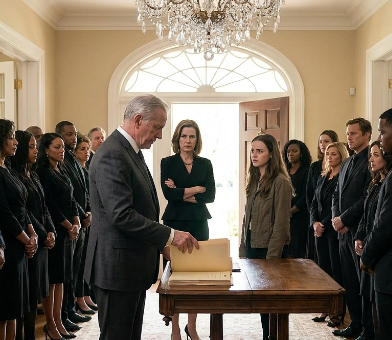
Before I could unclamp her hand from my wrist, a chair scraped loudly against the hardwood floor two tables away. A tall man with silver hair and a tailored charcoal suit stood up. He set his cloth napkin on his table, picked up a thin leather briefcase, and walked deliberately toward our table through the dead silence of the room. It was Arthur Vance, one of Charleston’s most formidable senior estate attorneys, a man whose firm managed the city’s oldest historical trusts.
Arthur stopped directly behind Allison’s chair. He looked down at the ruined front of my dress, his face hardening into an expression of severe disappointment. He asked Allison why she was attempting to force her mother to sign a property transfer on a commercial building she hadn’t personally owned for fifteen years.
Allison’s face went entirely white. The performative concern she had been wearing vanished, replaced by a look of sharp, panicked confusion. She stammered that it was a private family matter and that they were just handling estate planning because I was getting older.
Arthur interrupted her with absolute calm, stating that my estate planning was finalized fifteen years ago in his office and that he had drafted the documentation himself.
Brandon stood up from his seat beside the notary, his face flushing dark red, demanding to know what Arthur was talking about since the public land registry listed Eleanor Vance as the primary title holder of the Broad Street property.
Arthur replied that their consultant had performed only a surface-level search. He pulled a thin document from his briefcase and slid it gently onto the table right over the red soup stain on my napkin. He explained that four years after Thomas passed away, I had come to his office while working sixty hours a week to ensure Allison’s college debts were cleared. I knew that family fortunes wax and wane, and I wanted to ensure that the Broad Street building could never be liquidated, mortgaged, or lost by future generations.
Arthur turned his sharp blue eyes toward seventeen-year-old Sophie, who was watching from the middle of the table with her hands clutched against her chest. He announced that I had executed an irrevocable generational land trust, surrendering my personal right to sell or transfer the property. Under the terms of the trust, I retained a lifetime income interest to pay my living expenses, but the actual ownership of the real estate was permanently transferred to my granddaughter, Sophie Vance.
A collective gasp rippled through the dining room. The lifestyle reporter at the center of the table instantly began scribbling in her notebook, while Bellweather Interiors’ senior vice president slowly set her wineglass down, shifting her gaze from Allison to the legal document on the table.
Allison breathed out Sophie’s name, her voice cracking as she stared at her daughter in disbelief.
Arthur confirmed that Sophie would take full legal possession when she turned twenty-one and that until then, the trust was managed exclusively by his firm as an independent trustee. He warned Allison that neither I nor he could sign that building over to her, and that attempting to record a forged or coerced deed would constitute federal real estate fraud.
My daughter stood frozen beneath her white rose arch, surrounded by the gold decorations celebrating her corporate rise. Her meticulously crafted image was crumbling in front of the very people she had tried so hard to impress. She turned back to me, her voice trembling with desperation, confessing that she and Brandon had taken out a major bridge loan for their new house based on the equity of Broad Street. She admitted the bank had approved the line of credit on the condition that they secured the title today, and that if they didn’t present the recorded deed by five o’clock, the lender would default their construction loan.
The truth finally stepped into the light. The promotion lunch, the white roses, the invited clients, the public press, it was all an elaborate cover for their financial desperation. They had overextended themselves yet again, building a multi-million-dollar suburban mansion they could not afford, relying on my Broad Street property as their secret collateral.
I looked at Arthur, then slowly stood up from my chair. The red stain on my blue dress was cold now, but inside my chest, a warm, unshakable clarity took hold. I called out softly to Sophie, who stood up immediately, ignoring her mother’s sharp gesture to stay seated. She walked around the long table and took my hand, her young face filled with fierce, protective loyalty.
Brandon yelled that I couldn’t just walk out, screaming that if their loan defaulted they would lose their deposit and Allison’s reputation at Bellweather would be destroyed. I stopped and turned my head to look at my son-in-law. I told him quietly that for fifteen years I had quietly fixed their mistakes, paid their back taxes, covered their mortgage arrears, and let them tell everyone they built their life without help, all because I loved my daughter and wanted my granddaughter to have stability.
I looked at Allison, whose eyes were filled with bitter, furious tears. I told her that today she had poured hot soup on my lap to force my hand, seeing a target instead of a mother who sacrificed for her. I told her the trust stayed exactly as it was, that Sophie’s future was secure, and that theirs was up to them.
The silence in Harbor House was absolute as I turned my back on the head table. Supported by my granddaughter on one side and Arthur Vance on the other, I walked out of the private dining room, leaving my ruined dress and fifteen years of silent submission behind me. Behind us, the room exploded into hushed, furious whispers. As we reached the foyer, I heard Katherine Holt’s crisp executive voice announcing that they needed to suspend their discussion regarding Allison’s regional appointment until the board reviewed compliance matters.
Arthur walked us out to his sedan, opening the passenger door for me with quiet courtliness. I thanked him and asked how he knew to be there today. He offered a small, gentle smile and explained that Sophie had called his office yesterday afternoon after overhearing her parents talking about the Broad Street deed on their back patio.
By four o’clock that afternoon, I was bathed, changed into a clean cotton sweater, and sitting on my sunporch with a warm cup of chamomile tea. At 4:30 PM, the front doorbell rang in a continuous, panicked buzzing. Allison and Brandon stood on the porch, Allison’s hair windblown and mascara smudged, Brandon pacing furiously. I opened the door but left the security chain hooked.
Allison begged me to open the door, crying that everything was falling apart, that her promotion was suspended, and that the bank had revoked their construction line. Brandon interjected that I could fix it by talking to Vance to amend the trust or by acting as a guarantor for the construction loan.
I looked at the two of them, two adults demanding that I burn my own granddaughter’s security to save their pride. I told them flatly that I would not co-sign their loans. Allison screamed at me, asking how I could be so cold and how I could stand there and watch them lose everything.
I reminded her that I watched my husband die when I was forty-six years old, that I watched my bank account hit twelve dollars while I paid her college tuition, and that I worked double shifts until my feet bled so she would never know what it felt like to be evicted. I told her that wasn’t coldness, but that coldness was inviting your sixty-eight-year-old mother to a restaurant and dumping hot soup on her dress because she refused to let you steal her estate.
Allison whispered that if I closed the door, I shouldn’t expect to see them again. I replied that I hoped that wasn’t true because my door would always be open when she was ready to come as my daughter rather than a creditor. I stepped back and closed the heavy oak door, sliding the deadbolt into place.
The months that followed brought the slow restructuring of our family’s life. Without the Broad Street property as collateral, Brandon and Allison’s lavish house plans collapsed. They forfeited their initial deposit, sold their luxury sports cars, and downsized into a modest three-bedroom rental property on the outskirts of the city. Allison retained her position at Bellweather Interiors, though her promotion was delayed indefinitely.
Sophie moved into my spare bedroom for her senior year of high school. We spent our evenings cooking dinners together, studying at the kitchen table, and working in the backyard garden. The generational land trust remained entirely untouched under Arthur Vance’s management, growing steadily to ensure Sophie’s future.
On a bright Saturday afternoon in late October, I sat on my front porch holding coffee, watching leaves drift down from the large oak tree. A familiar blue sedan pulled into the driveway, and Allison stepped out wearing simple jeans and a gray sweater, carrying a small tupperware container. She walked up the porch steps slowly, her posture no longer rigid with defensive pride.
She stopped at the top step and looked at me with hesitation, greeting me quietly. She held out the container, saying she had made some vegetable soup from her father’s old recipe and thought I might like some.
I looked at my daughter, seeing for the first time in years a glimpse of the young girl who used to sit on my kitchen counter while I cooked after my night shifts. The pride was gone, replaced by a quiet, fragile humility. I told her to sit down and that I would get us two bowls.
We didn’t pretend the past six months hadn’t happened. The wounds were real, the boundaries were set, and the Broad Street property remained firmly in the trust for Sophie. But as I walked into the kitchen to fetch the spoons, I felt a deep, unshakable peace. I had spent my life making hardship look ordinary, taking the burns and the quiet sacrifices to keep my family safe. But true love doesn’t mean allowing yourself to be consumed so others can live in an illusion. Sometimes, the greatest act of love a mother can offer is to stand firm, hold the line, and force her children to finally stand on their own two feet.