I know you will judge me for walking away from my family and letting them think I was a failure for six years, and maybe I deserved every bit of the cold silence that settled between the Vance household and me. I honestly thought I was doing the right thing by staying away, keeping my head down, and living out my enlistment without asking them for a single dime of their real estate money. I figured distance was the only cure for a father who measures his children by zoning permits and corporate leverage.
But standing outside the heavy mahogany double doors of the estate on a Tuesday evening, holding a fifty-dollar blouse I bought at the Norfolk base exchange, I knew I was walking straight back into a trap I had spent years trying to outrun.
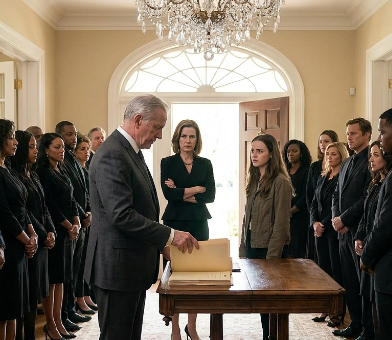
The air inside the grand ballroom smelled of white lilies, melted candle wax, and old money. Two hundred people in black-tie attire were laughing softly, clinking crystal flutes of champagne as if the world outside their gated community didn’t exist. I had only come because our family attorney sent a certified letter stating that Mother’s personal trust required all three surviving children to sign the final disbursement papers in person. My father, Richard Vance, stood near the marble staircase holding court with the city mayor and a couple of local developers. When his eyes caught mine near the entrance, his expression didn’t soften with paternal warmth. It tightened into the cold, transactional disgust I remembered from the morning I walked out.
Six years ago, Richard tried to force me into an arranged corporate marriage with the son of a zoning commissioner to secure a coastal development deal. When I refused his multi-million-dollar buyout and walked straight into a Navy recruiting office instead, he erased me. He pulled every photograph of me off the walls, instructed the domestic staff never to speak my name, and told his country club friends that his youngest daughter had run away to waste her life in the ranks.
“You actually showed up,” a sharp voice sneered from my right.
My older sister, Victoria, stepped directly into my path, holding a flute of vintage champagne. Her tailored three-thousand-dollar silk gown caught the chandelier light, and her diamond earrings glittered with every small movement of her head. Beside her stood my brother Julian, leaning casually against the mahogany bar with a condescending smirk that reminded me too much of our father.
“Look at you, Evelyn,” Victoria laughed, her voice carrying just enough to draw the attention of nearby guests. “Six years out in the world, and you show up to a black-tie gala looking like a bank teller on her lunch break. Did you take the city bus here, or did you have to save up for an Uber?”
“I’m here to sign Mother’s trust release, Victoria,” I said, keeping my voice level and quiet. “Nothing else.”
“Oh, please,” Julian chimed in, taking a slow sip of his scotch. “We all know why you’re really here. You spent six years playing soldier, realized the real world doesn’t care about your stubbornness, and now you’ve come back to beg Dad for a seat at the table. You’re broke, Evelyn.”
Richard separated himself from his business associates and approached us, his polished leather shoes clicking sharply against the marble floor. He didn’t offer a hand or ask how I had been.
He simply looked down his nose at me with that familiar, grating authority.
“You are a disgrace to this family’s name,” Richard said, his voice dropping into the stern register he used to control boardrooms. “You abandoned this family for a uniform. Look at you, unremarkable, unfashionable, and penniless. You will sign the trust papers in my private study at midnight, and then you will leave through the service gate.”
I looked at my father, feeling no urge to argue, no desire to prove myself, and no residual fear of his judgment. They saw a quiet girl in a cheap shirt who had failed according to their narrow financial scorecard. They had no idea that sixteen months ago, eighty feet beneath the surface of the South China Sea, the engine compartment of an Arleigh Burke-class destroyer had suffered an explosive fuel-line rupture following an operational accident.
They didn’t know about the screaming alarms, the pitch-black darkness filled with superheated steam, or the heavy steel emergency hatch that had warped under structural pressure, threatening to trap six junior enlisted sailors inside a burning machinery space. They didn’t know that as the chief engineer officer on duty, I had braced my shoulders against the scorching metal bulkhead, taking the full intensity of the blistering heat across my back, holding that collapsing hatch open by sheer physical force until every single sailor had scrambled through the hatch to safety.
I didn’t tell them about the four months I spent in the naval burn unit, learning to move my arms again while the skin grafted and healed into permanent, thick silver tissue. I didn’t mention the accommodations or the commendations. To them, my silence was proof of defeat.
“I don’t need your allowance, Richard,” I said softly. “And I don’t care about your social status.”
Victoria let out a loud, dramatic scoff that drew more eyes toward us. “Listen to her! Still pretending she’s superior! You think you’re tough because you wore boots for a few years? Look at your shirt, it’s stiff, cheap, and hiding whatever ugly, desperate life you’ve been living!”
Before I could step back, Victoria’s face twisted with a mix of cruel entitlement and alcohol-fueled arrogance. She reached out, caught the collar of my blouse in her hands, and yanked it violently downward, attempting to humiliate me in front of the gathering crowd.
The fabric gave way with a sharp, tearing sound. Victoria had intended to pull my shirt down just enough to expose a cheap undershirt, but the force of her tug ripped the seam completely down my left shoulder and across my upper back, exposing my skin to the bright, uncompromising glare of the ballroom chandeliers.
The laughter in the room died instantly. A collective, sharp intake of breath echoed through two hundred guests as the piano player’s hands froze over the keys.
My back was not smooth. From the base of my neck down to my right hip, my skin was covered in a thick, silver-and-crimson expanse of raised, corrugated burn tissue, jagged, severe, and undeniable. It was the permanent map of three hundred degree steel searing through cotton and skin, a violent testament to a night of absolute survival.
Victoria stumbled backward, dropping her champagne glass, which shattered against the marble floor. She stared at my back with wide, horrified eyes, her mouth open in shock. Julian’s smug smile vanished, his glass halting halfway to his lips as he stared at the severe, brutal texture of the scars.
Richard’s face flushed a deep, ugly red. But instead of horror or concern, his reaction was pure, narcissistic shame. He took a fast step forward, his voice rising in furious embarrassment.
“My God, Evelyn!” Richard hissed, looking around at the hushed, staring crowd of city elites. “What have you done to yourself?! What kind of low-class, reckless squalor have you been living in?! You look like a horror story! Cover that disgusting mess up right now!”
I didn’t reach for the torn fabric. I didn’t turn away, and I didn’t drop my head. I stood in the center of the silent ballroom, my spine straight, my feet set shoulder-width apart in a proper military stance. I let the high-society crowd stare at the scars I had earned protecting six young men and women whose families still had their children alive because I refused to let go of a door.
“I won’t cover it, Richard,” I said, my voice echoing clearly through the vaulted hall, cold and steady as naval steel. “Because unlike everything in this room, those scars weren’t bought with someone else’s money.”
“You insolent brat!” Richard growled, reaching out to grab my arm. “I will have security escort you out to the street where you belong, “
“Touch her, Mr. Vance, and you will be answering to the Department of the Navy before midnight.”
The voice came from the elevated VIP terrace near the rear archway, a voice accustomed to commanding entire fleets across oceans. The crowd parted instantly as a tall, imposing man in a pristine, dark navy service dress uniform stepped down the marble steps. Gold braid gleamed on his sleeves, and four silver stars caught the light on his shoulder boards. Behind him walked two junior officers and the mayor of the city, who looked thoroughly rattled.
It was Admiral Thomas Reed, Commander of U.S. Pacific Fleet operations.
Richard froze, his hand dropping to his side. His arrogant posture melted into a nervous, eager smile as he recognized the high-ranking officer. Richard had been trying to secure a commercial naval supply contract for his port development project for three years, and Admiral Reed was the ultimate decision-maker.
“Admiral Reed!” Richard stammered, adjusting his bow tie as he took a step toward the officer. “I… I apologize for this dramatic family disturbance. My youngest daughter has always been unruly. I am having security handle the situation, “
Admiral Reed completely ignored Richard. He didn’t even glance at my father. The four-star Admiral walked straight past Richard, straight past my sister Victoria, and stopped exactly three feet in front of me.
The silence in the ballroom was absolute. You could hear the faint hum of the air conditioning and the rustle of silk gowns as two hundred wealthy guests strained to watch. Admiral Reed looked at the torn shirt, his eyes briefly registering the extensive burn scars across my back and shoulder. His face didn’t show disgust; it showed a profound, solemn reverence.
He brought his feet together with a crisp, audible click of his heels. He raised his right hand to the temple of his cover, snapping into a flawless, textbook military salute. The two junior officers behind him immediately brought their hands up in unison, holding the salute alongside their fleet commander.
My father’s crystal glass slipped from his numb fingers, crashing onto the marble floor, spraying scotch across his expensive shoes. Victoria gasped, grabbing Julian’s arm as his mouth hung open in total, uncomprehending shock.
“Lieutenant Commander Evelyn Vance,” Admiral Reed’s voice boomed across the silent room, rich with unyielding authority. “On behalf of the United States Navy and a grateful nation, it is my highest honor to finally meet you in person.”
I brought my own hand up, executing a sharp, precise return salute. “Admiral.”
“At zero two hundred hours on November fourteenth,” Admiral Reed spoke loudly, addressing not just me, but every silent, staring member of my family and their high-society guests, “Lieutenant Commander Vance held a warped, superheated bulkhead hatch open with her own physical frame inside a burning engine space. She held that door for four minutes while steam temperatures exceeded three hundred degrees, ensuring all six members of her engineering crew evacuated safely.”
A heavy hush fell over the crowd. Several women in the audience pressed their hands to their mouths as the reality of my scars hit them.
“She spent four months in intensive recovery,” the Admiral continued, looking directly at my father, whose face was now ashen grey. “And three weeks ago, the President of the United States officially approved her nomination. Lieutenant Commander Vance has been awarded the Navy Cross for extraordinary heroism in action.”
Richard took a shaking step forward, his voice cracking. “The… the Navy Cross? Admiral, there must be a mistake… she was just a disgruntled runaway… she never told us, “
“She didn’t tell you, Mr. Vance,” Admiral Reed turned his head, his gaze locking onto my father with the cold precision of a gun director, “because heroes do not boast to people who measure human worth in real estate zoning permits.”
The Admiral reached into his dress jacket and pulled out a small, velvet-lined mahogany box. He stepped forward and handed it to me with both hands.
“I came to this event tonight specifically to deliver this to you, Commander,” Admiral Reed said softly, his tone dropping into a warm, genuine respect. “The Secretary of the Navy requested a formal ceremony at the Pentagon next month, but I knew you were in town for family matters. Your crew, all six of them, are standing outside in the foyer right now. They drove six hours to see you.”
I held the heavy wooden box in my hands, feeling a swell of pride that had nothing to do with the gold chandeliers or the estate I had walked away from.
“Thank you, Admiral,” I said quietly.
Richard stepped into the space between us, his face pale, his posture completely humbled as he tried to repair his shattered standing in front of the city officials. “Evelyn… my god, baby… we had no idea. Why didn’t you tell us? You’re a hero! Admiral, please, let us set up a proper head table for you and my daughter! This is a monumental honor for the Vance family!”
I looked at my father. I looked at my sister Victoria, who was cowering behind Julian, her hands shaking. I looked at the crowd of people who had spent the last hour treating me like an unwanted ghost.
“The Vance family didn’t earn this medal, Richard,” I said, my voice carrying clear and untrembling through the hall. “A team of brave sailors earned it. And my family is standing out in the foyer.”
I turned my back on my father, my sister, and the two hundred guests who stood frozen in silent humiliation. I walked side-by-side with Admiral Reed down the grand hallway toward the front entrance of the estate.
As the heavy oak doors opened into the crisp night air, six young men and women in dark navy dress uniforms stood in a neat line on the paved driveway. The second they saw me step onto the porch, their faces broke into broad, emotional smiles, and they snapped into six perfect salutes.
“Chief!” Petty Officer Miller called out, his eyes shining with tears. “You look sharp!”
I smiled, a real, genuine smile for the first time all evening, and pulled my torn collar together as I walked down the stone steps to embrace the people who had become my true family. The fallout from that evening was swift and unyielding. The story of Admiral Reed saluting a decorated hero while her real estate developer father attempted to throw her out leaked to the local press within forty-eight hours. The public backlash against Richard Vance’s firm was catastrophic. City council members hastily canceled their commercial port meetings, and the naval logistics supply contract Richard had spent three years chasing was permanently denied due to character and ethical compliance failures.
Victoria’s high-society standing vanished overnight, her cruelty at the gala becoming the primary gossip among the city’s elite. Julian’s engagement was quietly called off two months later as his fiancé’s family distanced themselves from the Vance name. I didn’t stay to watch their empire crumble.
Three weeks later, I stood in the sunlit courtyard of the Pentagon in Washington, D.C., wearing my crisp, tailored officer’s service dress white uniform. The heavy, gold-and-blue Navy Cross was pinned to my chest by the Secretary of the Navy, surrounded by my six crew members, my close friends, and a community of people who understood the true definition of sacrifice.
I had returned to my family’s house expecting nothing, and I walked away with something money could never buy: my dignity, my purpose, and an unshakeable pride in the scars I carried. They had tried to erase their daughter to protect an illusion of wealth, only to realize too late that the daughter they cast aside had forged a legacy that no fortune could ever break.