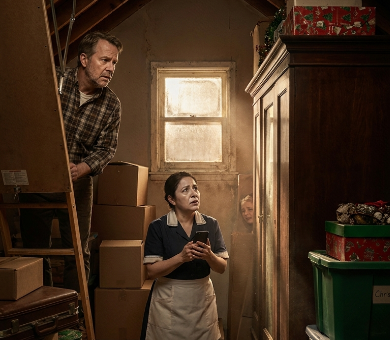
The smell of cold iron and damp wool coats always stays with me whenever the winter wind starts rattling the back porch screen. I remember the exact chill of that Tuesday afternoon in Oakridge when the radiator in my downtown auditing cubicle gave off its usual metallic ping, right before the phone on my desk rang with a number I didn’t recognize.
Mark had only been my husband for eight months. Back then, I honestly believed I had finally managed to build a safe harbor for my five-year-old daughter, Maya, after years of eating cold dinners alone over tax returns and ledger sheets.
Mark was a licensed physical therapist with soft hands and a quiet, patient way of speaking that made both of us feel protected. He loved stepping into the role of the stepfather who always took over the bedtime routine.
While I sat at the kitchen table late into the evening double-checking corporate balance sheets, Mark would carry Maya up the carpeted stairs, humming old folk tunes under his breath. I used to look at the shadow they cast against the hallway wall and thank God for giving us a second chance at a normal family. Maya was always a sweet, affectionate little girl who loved drawing pictures of horses with purple manes, but over the previous two months, she had grown increasingly pale and quiet.
I had blamed the shift on the usual kindergarten exhaustion, telling myself she was just adjusting to long days away from home. I didn’t want to see the small, bruised shadows under her eyes, or the way she started leaning against the living room sofa instead of running across the rug.
I was too busy being grateful for a quiet house to notice that my daughter was slowly fading right under our roof.
The call from Oakridge Elementary changed the shape of my entire life in about thirty seconds. Principal Vance said my name twice before I even answered, her voice tight with the kind of professional panic that makes your blood run sideways. She told me I needed to leave my desk immediately and come to the administrative office because Maya had said something very concerning during morning circle time.
I didn’t even pack up my leather bag; I just dropped my pen and ran out to my sedan, my heart hammering against my ribs like a trapped bird. The drive across town usually took twenty minutes, but that afternoon the traffic lights seemed stuck on an endless loop of red, and my hands shook so hard on the steering wheel I could barely keep the car in its lane.
When I finally pushed open the heavy glass doors of the school office, the silence inside felt heavy and wrong. Maya was sitting in a low vinyl chair in the corner, clutching a worn-out plush bear with a missing ear, her small shoulders hunched forward. Two police officers in dark uniforms stood near the window, and Detective Ray Mercer was leaning down to speak softly to my little girl.
As soon as Maya saw me, she burst into tears and ran across the linoleum floor, burying her face in my coat while whispering the words that tore my world apart. She told me about the game Mark played with her every night after the bedroom lights went out, pressing hard on her ribs and wrists while she tried not to cry.
I felt the room tilt sideways. I thought I had married a monster who was hurting my little girl in the dark, and the blinding wave of protective rage that hit me was almost enough to make me lose my balance right there on the school floor.
I pulled Maya back against my chest, staring at the officers with a look that probably frightened them as much as it did my daughter.
Detective Mercer stepped between us and the door, his face lined and weathered from years of dealing with things people only whispered about in daylight. He asked me if Maya had been complaining about deep bone aches in her legs at night, or running low-grade fevers that came and went without a cold.
I told him she had been tired, but I didn’t know anything about bones. Detective Mercer looked down at Maya’s small canvas shoes, then back up at me with a heavy, troubled expression in his gray eyes. He didn’t yell or jump to conclusions the way I had, but his voice was completely flat when he gave me the warning.
“Ma’am, based on what your daughter told us, this is far more serious than you realize,” he said quietly, stepping closer so Maya wouldn’t hear.
I didn’t scream or break down in the hallway because auditing teaches you how to compartmentalize panic until you have enough data to fix the numbers. I knew Mark was a physical therapist, and I knew the way he talked about human anatomy with a chilling kind of professional detachment sometimes. I told Detective Mercer to keep Maya at the station with a female officer while I went back home under the excuse of picking up her extra clothes and comfort items.
The house was entirely empty when I pulled into the driveway at 4:15 in the afternoon, the pale autumn sun casting long gray shadows across the front lawn. The kitchen counter still had my coffee mug from that morning sitting right where I left it, half-full and cold, which made the ordinary stillness feel completely surreal.
I walked past the living room and headed straight down the narrow hallway toward Mark’s home office, a room he always kept locked with a heavy brass deadbolt. I had a spare key ring in my coat pocket that he didn’t know I had duplicated three months ago when we first combined our household accounts. My hand was steady as I slipped the key into the lock, though my stomach felt like it was full of broken glass.
The door clicked open, revealing the tidy, wood-paneled room where Mark spent hours reviewing his private clinic notes and physical therapy journals. I didn’t bother looking at the desk or the computer monitor because my eyes went straight to the heavy leather trunk sitting at the foot of his leather reading chair.
I dropped to my knees on the hardwood floor, lifted the brass latches of the trunk, and threw the heavy lid back against the baseboard. Inside, neatly stacked beneath a collection of old college textbooks, lay a stack of black, grid-lined physical therapy ledgers and a cardboard box filled with sealed medical specimen tubes bearing Maya’s name.
I pulled out the topmost ledger and flipped it open to a page dated five months ago, right around the time Maya started limping slightly after playing in the backyard. The neat, precise handwriting belonged to Mark, and every single line was filled with clinical measurements of localized bone tenderness and swollen lymph nodes.
There were entries tracking the expansion rate of a dark, aggressive shadow on Maya’s left femur, complete with technical terms and hand-drawn diagrams that looked like they belonged in a surgical textbook. He wasn’t abusing her in the way I had feared at the school, but he was doing something infinitely colder and more calculated behind my back.
He had diagnosed my five-year-old daughter with a rare, aggressive form of pediatric bone cancer or a severe degenerative bone disorder months ago, and instead of taking her to a real doctor, he had kept her in the house to use her body as an ongoing clinical observation project.
The front door clicked open in the hallway, and Mark’s soft footsteps sounded on the hardwood before I even had time to stand up from the floor. He stopped in the doorway of the office, his briefcase slipping from his fingers and hitting the rug with a dull thud when he saw the open leather trunk and the ledgers spread across my lap.
He didn’t run or reach for the door; he just stared down at me with an expression of profound, miserable exhaustion that made him look ten years older than thirty-seven. He fell to his knees right across from me, his hands reaching out to grab the edge of the ledger before I could pull it away.
“Claire, please, just let me explain before you call anyone,” Mark whispered, his voice cracking with a ragged desperation that sounded entirely unfeigned.
I pulled my knees back against my chest and looked at him, feeling a cold, dead weight settle into the center of my being that had nothing to do with fear and everything to do with disgust. I asked him why he didn’t take her to St. Jude or even our family pediatrician down on Main Street if he knew she was sick.
He rubbed his face with both hands, smearing sweat across his forehead as he started talking in a frantic, disjointed stream of words that made my head spin. He reminded me of his bitter, ongoing custody battle for his eight-year-old biological son, Leo, back in Cincinnati, where his ex-wife’s high-priced lawyers had accused Mark’s family of carrying a dangerous genetic taint.
“If a formal oncology record was generated for a child living under my roof, her lawyers would have used it to claim our entire household environment was medically compromised,” Mark stammered, his eyes wide and pleading as he looked for some kind of forgiveness in my face. “They would have stripped me of my parental rights to Leo forever, Claire.”
I just sat there on the floor with the ledger in my lap, looking at the man I had married eight months ago and realizing he cared more about winning a legal paper war against his ex-wife than he did about whether my little girl lived to see her next birthday. He had been quietly administering black-market pain suppressants he stole from his physical therapy clinic to mask Maya’s symptoms while he watched her bones deteriorate in secret.
“You let her suffer for six months so you could keep your custody file clean?” I asked, my voice dropping so low I could barely hear it myself.
He nodded slowly, his shoulders shaking as he tried to justify the unjustifiable by telling me he had everything under control and the tumor growth was still technically within a manageable window. He thought he was smarter than any oncologist in the state, treating a five-year-old child like a science experiment he could manage from a spare bedroom desk.
I didn’t scream at him, and I didn’t throw the ledgers at his head because I knew the data inside those pages was the only thing standing between Maya and a delayed diagnosis that would kill her. I told him to pull up his digital back-up logs on his laptop right now, pretending for a brief, terrible second that I might actually listen to reason.
While Mark fumbled with his password on the desk computer, the front door swung open with a heavy thud, and Detective Mercer stepped into the hallway followed by Dr. Aris Thorne in a dark wool overcoat. Dr. Thorne was a pediatric oncology specialist from St. Jude whom Mercer had managed to reach through an emergency judicial contact within the last hour.
Dr. Thorne walked straight past Mark without even glancing at him, dropped his black medical bag onto the edge of the desk, and picked up the open ledger I had left resting on the floor. He flipped through the detailed daily entries with a growing look of horror and professional disbelief that darkened his features by the second.
“The measurements here are precise down to the millimeter,” Dr. Thorne said, his voice clipped and cold as he stared down at my husband with undisguised contempt. “You tracked an expanding osteosarcoma lesion on a child’s femur for half a year without initiating systemic intervention?”
Mark tried to stand up and stammer something about his clinical credentials, but Detective Mercer stepped into his personal space and cuffed his hands behind his back with a sharp, metallic click that echoed off the wood-paneled walls.
“Mark Halloway, you’re under arrest for felony child endangerment, practicing medicine without a license on a minor, and intentional evidence tampering,” Mercer said, reading him his rights while Mark stared down at the floor in total silence.
They led him out through the front door in handcuffs while the afternoon light faded into a cold, flat gray across the neighborhood lawns. I didn’t watch him leave because my hands were already busy packing Maya’s things into a canvas duffel bag so we could get her to the clinic before the sun went down.
Dr. Thorne stayed with us in the kitchen for ten minutes, reviewing the stolen diagnostic timeline and confirming that because Mark’s logs were so obsessively detailed, the medical team had an exact roadmap of the tumor’s progression without needing to waste precious days on baseline scans.
By six o’clock that evening, Maya was lying in a clean, white-sheeted room at St. Jude Children’s Specialty Clinic, holding my hand while an intravenous line was taped carefully to the back of her small, fragile wrist. Dr. Thorne visited us before his shift ended, confirming that the targeted, non-invasive chemotherapy regimen they were starting tonight would halt the lesion’s growth without any need for amputation.
Three months have passed since that terrible afternoon, and the smell of antiseptic and fresh linen at the clinic has become the background rhythm of our new, quiet life together. Mark’s physical therapy license was permanently revoked by the state board within forty-eight hours of his arrest, and his custody petition for his son in Cincinnati was dismissed with prejudice by a judge who called his actions unconscionable.
Today, the sun is hitting the linoleum floor of the recovery room in bright, clean squares that chase away every shadow from the corners of the space. Maya is sitting up against a pile of pillows, her brown hair starting to grow back in soft, fuzzy curls around her ears after the final round of treatment.
She reaches out from the edge of the narrow hospital bed, her small fingers warm and steady as she touches my wrist, counting my fingers one by one in the bright afternoon light with a bright, ringing laugh. It’s a game of life and healing, stripped forever of the dark secrets that nearly cost us everything, and for the first time in months, I don’t feel the need to look back over my shoulder at what’s waiting in the dark.