How My Fiancée Mocked a Roadside Can Collector Before I Realized It Was My Ex-Wife Holding Our Twins

The rain was coming down hard along the coastal highway outside Charleston, streaming across the windshield of my Range Rover with a heavy, steady hiss that made the tires hum against the wet asphalt. My fiancé, Madison, was sitting in the passenger seat, adjusting her diamond tennis bracelet and checking her phone for notifications about the forty guests waiting at my mother’s oceanfront estate for our formal engagement dinner. We were twenty minutes away, and Madison was already tapping her silver nail against the screen because her phone reception was dipping in and out beneath the heavy canopy of live oaks.
I kept both hands on the steering wheel, watching the red tail lights of a pickup truck smear into long streaks through the glass. The sky had that bruised, slate-gray look it gets right before a full coastal downpour, and the air inside the cabin smelled faintly of Madison’s expensive gardenia perfume mixed with the cold dampness blowing through the vents.
“Look at that, Daniel,” Madison said, pointing out her window with a short, sharp laugh that had no humor in it whatsoever. “Absolute filth. Right on the highway shoulder. It is so pathetic how some people choose to live their lives.” I glanced toward the grassy shoulder of the road where the headlights caught a flash of bright yellow against the dark weeds. A woman in a soaked, oversized raincoat was bending down near a concrete drainage ditch, picking up discarded aluminum cans and placing them into a black plastic trash bag with slow, mechanical movements.
Her shoulders were hunched against the wind, and her boots were caked in thick, reddish-brown mud that clung to her ankles with every step. “She’s just collecting cans, Madison,” I said, keeping my eyes fixed on the wet road ahead and wishing she would just drop the subject. “Leave her alone and let’s get to the house before Mom starts calling.”
“Stop the car,” Madison said, her voice bright with malicious amusement as she leaned closer to the glass. “I want to take a video for my stories. My followers will die when they see what passes for roadside decor near your family’s neighborhood.” I let out an irritated breath and clicked my turn signal, pulling the SUV off onto the gravel shoulder about twenty feet ahead of the woman because arguing with Madison when she got that tone in her voice was simply a waste of breath. The woman in the raincoat straightened up slowly, wringing water from her eyes with the back of a thin, red-chaffed hand that looked like raw meat from the cold.
Under the deep hood of her jacket, her face was gaunt, pale, and hollowed out by a terrifying degree of exhaustion that made her cheekbones jut out like knife edges. Wrapped tightly inside a faded wool blanket tucked securely under her soaked coat, two tiny heads were visible against her chest, shielded from the wind only by the thin fabric she was pressing against them with both arms.
The woman took two steps forward, blinking against the headlights, and looked directly through the windshield of my car. My breath caught in my throat with a sharp, painful jolt, and my hands locked onto the steering wheel so hard my knuckles turned completely white against the leather. I knew those pale blue eyes better than I knew my own reflection in the mirror, and I knew the fine line of that chin, even framed by wet, tangled brown hair and dark rings of starvation that looked like bruises.
It was Emily, my ex-wife, the woman who had supposedly vanished from my life four years ago after leaving a signed note on our kitchen table saying she was moving to Europe with a ski instructor and wanted nothing more to do with me or my family name. “Look at those filthy little babies,” Madison laughed, holding her phone camera steady out the partially rolled window and tapping the screen to focus. “Who brings infant twins out to collect garbage in the pouring rain? Honestly, some people shouldn’t even be allowed to breed.”
I unbuckled my seatbelt, shoved my door open, and stepped out into the mud and pouring rain without even grabbing an umbrella, ignoring Madison’s sharp yell behind me as the wind whipped my suit jacket against my ribs. I walked toward the woman standing by the drainage ditch, the water soaking through my tailored trousers in seconds and chilling my skin to the bone. She froze as I approached, her body stiffening under the yellow coat, and when I stopped three feet from her in the mud, her breath hitched audibly in the damp air. She pulled the wool blanket closer around the two sleeping infants, pressing them deeper against her chest as if she could shield them from the sight of me just by holding them tighter. “Emily?” I asked, my voice cracking under the roar of the rain and the heavy drone of passing traffic on the highway.
She looked up at me, her blue eyes wide with a mixture of terror and overwhelming, soul-crushing shame that made me want to step backward into the ditch. “Daniel,” she whispered, her lips blue and shivering from the raw coastal cold. “Please. Don’t look at me like that. Just go away.” I looked down at the tiny faces resting against her chest, noticing they were no more than three or four weeks old, their skin still pink and wrinkled like newborn kittens. One of them had his mouth slightly open, sleeping deeply despite the howling wind, and across his tiny forehead was a distinct, sweeping lock of fine, light hair, identical to the birthmark I was born with, the exact same mark that ran through three generations of Thorne men on my father’s side. “Emily,” I stammered, my heart hammering wildly against my ribs like a trapped bird. “Whose babies are these? What happened to you after you left?”
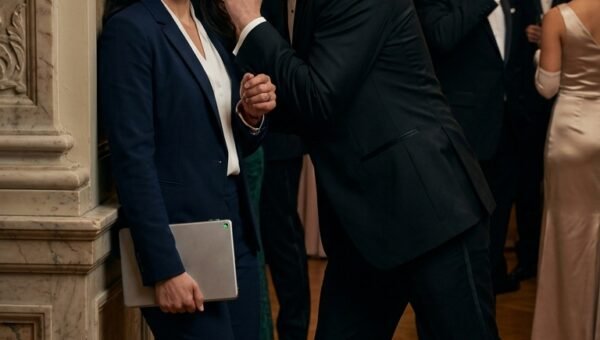
Before she could answer, Madison opened the passenger door of the Range Rover and stepped onto the gravel, holding a black designer umbrella over her head while her silk heels sank an inch into the mud. “Daniel, what on earth are you doing?” Madison snapped, her tone dripping with disgust as she marched toward us with her nose wrinkled against the smell of the damp earth. “Get back in the car right now! You are getting soaked for a homeless panhandler who probably smells like gin!” Emily looked from Madison to me, and a sudden, cold terror swept across her face, stripping away whatever little composure she had managed to hold onto. “Don’t let them see me,” Emily begged softly, her voice breaking as she stepped backward into the tall, wet grass of the ditch. “Daniel, if you ever loved me at all, just drive away. Please, for the kids’ sake, just go.”
She turned with a desperate stumble and hurried down the muddy slope toward a small, rusted sedan parked out of sight behind a thick cluster of pine trees, its primer-gray body blending into the gray fog of the evening. I stood in the mud, completely frozen, as the rain poured over my face and washed the taste of salt into my mouth. Four years ago, my mother and Madison had comforted me while I wept in my empty kitchen, telling me that Emily was a cold, calculating woman who had taken a cash payoff and abandoned our marriage without a second thought because she couldn’t handle the pressures of high society. So why was my ex-wife living out of a rusted car in a South Carolina ditch, holding newborn twins who bore my family’s physical mark while my mother and my new fiancé sat in an oceanfront mansion waiting for me to carve the prime rib?
Madison grabbed my wet arm, trying to yank me back toward the Range Rover with an aggressive pull that left black mud on my sleeve. “Daniel, what is wrong with you?” she yelled over the steady roar of the rain hitting the pine needles. “You look like you’ve seen a ghost, and we are forty minutes late for dinner! Your mother has the caterers set up on the patio, and half the city council is sitting in the sunroom!” I looked down at Madison’s manicured hand on my sleeve, then looked back down the muddy slope where Emily’s rusted sedan was now idling, white smoke puffing in irregular bursts from its broken tailpipe before disappearing into the gloom. “That was Emily,” I said plainly, my voice sounding flat and dead even to my own ears.
Madison stiffened instantly, her fingers digging into my coat before she quickly dropped her hand as if my wet clothes were contaminated. Her eyes flashed with a split second of pure, sharp fear before she forced a harsh, defensive sneer onto her face. “That… that couldn’t have been Emily,” Madison said, her voice rising an octave and cracking slightly on the vowels. “Emily moved to France years ago with that ski instructor! You know that! You signed the papers! That woman down there is just some crazy tramp picking up garbage on the side of the road because she has no self-control. Get in the car right now, Daniel!” “She knew my name, Madison,” I said, and I pulled my arm out of her grip with a sharp motion, turned around, walked back to the driver’s side, and got into the car without looking back. Madison scrambled into the passenger side, splashing mud onto her silk blouse as she hastily pulled her oversized umbrella inside and slammed the door shut.
I did not drive to my mother’s estate on the water, and I didn’t turn on the radio to drown out the heavy silence filling the cabin. I threw the SUV into reverse, backed onto the highway, and drove straight to my private office building in downtown Charleston, ignoring the way the tires hummed against the slick pavement. “Where are we going?” Madison demanded, her voice rising in panic as her phone began buzzing repeatedly with texts and missed calls from my mother. “Daniel, answer me right now! Your mother is calling my cell! What is wrong with you?” “Shut up, Madison,” I said quietly, keeping my eyes on the road ahead. It was the first time I had ever spoken to her like that in the three years we had been together, and the suddenness of it seemed to shock her into silence.
She went completely still in the passenger seat, staring at me with dark, furious eyes while her phone continued to buzz against her knee like an angry insect. When we reached my office building, I parked in my assigned underground slot, went straight to my personal legal safe in the back room of the suite, and spun the dial with cold, steady fingers. I pulled out my private family tax files from four years ago, the thick leather-bound folders I had left untouched in the back of the cabinet because looking at them always brought back too much lingering pain and embarrassment. Among the old receipts, quarterly statements, and bank records from the exact month Emily disappeared, my eyes caught a small white business envelope I had never noticed before, tucked neatly inside the pocket of a manila divider. It was an automated annual maintenance billing notice from Palmetto Reproductive Genetics, delivered to my personal tax folder eight months ago when I was too busy with corporate mergers to check the mail myself.
It showed a paid annual storage fee of four hundred and fifty dollars for two frozen embryos, kept in long-term cryogenic storage under the legal names of Michael and Emily Thorne. The account was marked active and paid in full. The payment had been made under Emily’s legal signature just three months before she gave birth to those twins in the ditch. During our five-year marriage, Emily and I had gone through three grueling rounds of fertility treatments, spending long, painful weekends in sterile medical offices while hoping for a family that never seemed to start. Before our marriage fell apart, we had successfully preserved two healthy, viable embryos just in case the treatments finally took hold. I sat at my wooden desk, my hands trembling as I held the billing statement under the harsh fluorescent light, realizing the ground beneath my feet had completely vanished.
When Emily vanished four years ago, my mother had sat by the fireplace with a cup of chamomile tea and told me that Emily had signed a non-contact release and taken a one-million-two-hundred-thousand-dollar cash settlement out of our family marital trust to walk away from the marriage forever. My mother had handled the trust disbursements herself through her private probate attorney, telling me at the time that Emily wanted a clean break and zero contact with anyone bearing the Thorne name. I picked up my office desk phone and dialed my family’s senior trust accountant, Mr. Vance, at his home number without waiting for business hours. “Daniel?” Mr. Vance answered on the third ring, sounding surprised and slightly annoyed. “Aren’t you supposed to be at your engagement dinner? Your mother has called my house twice looking for you.”
“Mr. Vance, I need you to pull the probate audit trail for the one-million-two-hundred-thousand-dollar marital trust settlement disbursed to Emily four years ago,” I said, my voice dropping an octave into a tone that made him stop talking. “I need to know exactly which bank account that money was transferred into.” There was a long, uncomfortable pause on the other end of the line, broken only by the faint sound of a television playing in the background of his study. “Daniel, your mother handled those release waivers personally with Madison’s assistance,” Mr. Vance hesitated, his voice dropping into a nervous murmur. “They instructed me at the time that all records pertaining to that specific disbursement were sealed under a private family confidentiality agreement.”
“I am the primary trustee of the Thorne Estate, Mr. Vance,” I said firmly, leaning forward over the desk until my forehead almost touched the wood. “Pull the wire transfer routing numbers right now, or I will have a federal forensic auditor in your office by eight o’clock tomorrow morning, and we can discuss confidentiality agreements in front of a federal judge.” There was another long silence on the line, followed by the rapid, clicking sound of keys tapping on a computer keyboard. “Alright, Daniel,” Mr. Vance said quietly after two agonizing minutes. “The one-million-two-hundred-thousand-dollar disbursement was drawn from the estate trust on October fourteenth four years ago. But according to the wire logs, it was never transferred into an account under Emily Thorne’s name.”
“Where did it go?” I asked, my knuckles turning white against the plastic receiver. “It was transferred into an offshore holding company called Vance and Associates Management,” Mr. Vance read directly from his screen, his voice thin and strained. “An account owned jointly by Madison Vance and your mother, Eleanor Thorne.” The air in my office felt freezing cold, as if the heating vents had suddenly started pumping winter wind directly from the coast. Four years ago, Emily had not taken a cash settlement and run off to Europe to live a life of luxury. She had been robbed, cornered, and stripped of everything she owned by the two women who claimed to love and protect me.
I stood up from the desk, walked out into the carpeted lobby where Madison was pacing back and forth while pressing her phone to her ear, and stared at her until she stopped moving. “What did you do to Emily?” I asked softly, holding the printed billing statement and the wire logs in my hand like a weapon. Madison stopped pacing completely, her heels sinking into the carpet. She looked at the papers in my hand, then looked up into the cold, dead rage in my eyes, and her face turned the color of old paper. “Daniel, listen to me,” she stammered, taking two quick steps backward until her back hit the office wall. “Your mother and I were only protecting your future! Emily was a nobody! She was a small-town schoolteacher’s daughter from a poor neighborhood who didn’t even know how to hold a fork at a charity dinner! She was going to ruin your social standing and drag down the Thorne family name forever! Your mother knew you belonged with someone from your own social circle!”
“You stole her trust settlement,” I said, every single word coming out like shattered glass grinding against my teeth. “You and my mother forged non-contact releases and stole one point two million dollars meant for her survival.” “She signed the papers willingly!” Madison yelled defensively, her voice turning shrill and desperate as the mask finally slipped away. “Your mother threatened her with endless probate legal battles that would have left her bankrupt and homeless anyway! We gave her fifty thousand dollars in cash under the table in a brown paper bag and told her if she ever contacted you again, we would use our family connections to make sure she was blacklisted from every job in the state! She gave up her legal rights!”
“She didn’t give up her legal rights to our embryos,” I said, holding up the fertility clinic statement so she could see the active storage fees. “She took the only thing you two greedy monsters couldn’t buy from her with stolen money.” I turned on my heel, walked out of the office suite without another word, and got back into my SUV, locking the doors from the inside before Madison could reach the handle. She stood out in the wet downtown street in her expensive high heels, screaming my name and banging her fist against the tinted glass as I put the car in gear and drove away into the dark Charleston night.
I drove straight back to the roadside shoulder where I had seen Emily four hours earlier, my headlights sweeping across the wet weeds and the dark silhouette of the pine trees. The rusted sedan was still parked behind the cluster of trees, its engine completely cold, and a thick layer of frost was beginning to form on the windshield in the dropping night air. I parked my SUV behind her car, walked down the muddy slope, and knocked gently on the driver’s side window with my knuckles. Inside, Emily was sitting in the front seat, wearing her damp yellow jacket and holding the two tiny infants against her body under a thin blanket, her breath turning to visible steam in the freezing dark. She looked up, saw my face through the glass, and broke down in silent, terrible tears that shook her entire frame.
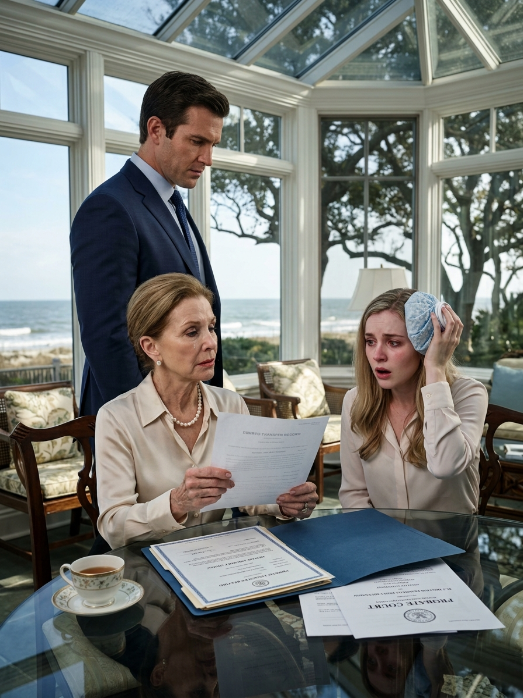
I pulled the door open, took off my dry wool overcoat, and wrapped it carefully around her and the babies, tucking the edges in to keep the wind out. “Come home, Emily,” I whispered, holding her cold, trembling face in my hands for the first time in four years. “Please. Just come home where you belong.” The next morning at exactly ten o’clock, I walked through the double oak doors of my mother’s oceanfront estate in Charleston, my boots clicking loudly against the marble foyer. My mother, Eleanor Thorne, was sitting in the formal glass sunroom wearing her pearls and sipping her morning tea while Madison sat on the velvet sofa beside her, pale, red-eyed, and holding an ice pack against her temples.
When I entered the room, my mother set her porcelain teacup down on the glass table with a sharp, crisp clink that echoed in the quiet room. “Daniel,” my mother said in her accustomed sharp, commanding tone. “You humiliated this family last night in front of the entire upper crust of the city. Forty people waited for two hours because you ran off after some street beggar. Madison told me everything about your hysterical episode. You are acting completely irrational over an old ghost who took our money and left.” I did not sit down in the vacant armchair. I stepped forward and dropped a heavy blue legal folder onto the glass tea table right in front of their teacups.
Inside was a certified copy of the Embryo Transfer Record from Palmetto Reproductive Genetics, showing the birth of twin infants biologically identified as the children of Michael and Emily Thorne. Alongside it was the certified bank audit trail showing the one-million-two-hundred-thousand-dollar fraudulent trust diversion into Madison’s offshore holding account, accompanied by an emergency petition for civil fraud and criminal conversion prepared by my corporate attorneys early that morning. “Read every page, Mother,” I said calmly. My mother picked up the papers with a look of mild annoyance, but as her eyes scanned the bank routing numbers and the official seal of the probate court, her face drained of color. Her hands began to tremble so violently that the heavy legal papers rattled in the air like dry leaves.
“Daniel… this… this is a family matter,” my mother stammered, her voice losing all of its aristocratic poise as she dropped the papers back onto the table. “We did what was necessary to protect the Thorne legacy from ruin. That girl was never fit to be your wife!” “That girl is the mother of my children,” I said, leaning over the table. “And as of eight o’clock this morning, Madison has been removed as a director from all Thorne Development properties. She has two hours to pack her expensive clothes and vacate the corporate condo downtown before the police enforce a formal trespass order.” Madison let out a sharp gasp of disbelief, looking at my mother for help, but my mother could not even look back at her.
“As for you, Mother,” I continued, looking directly into my mother’s terrified, aging eyes. “You will immediately execute a full, unencumbered transfer of one million two hundred thousand dollars, plus four years of compounded legal interest, back into a private living trust established exclusively for Emily and my children. If you refuse, or if either of you ever steps within one hundred feet of Emily again, I will release these bank audit trails directly to the state prosecutor and let a grand jury handle the grand larceny charges.” “You would ruin your own mother for a penniless stranger?” Eleanor whispered, tears of pure anger finally spilling over her mascara. “You ruined my family four years ago for your pride and your social standing,” I said coldly. “You are lucky I am leaving you with the roof over your head.” I turned around and walked out of the estate without looking back, leaving the two of them sitting in total, shattered silence.
Three days later, the afternoon sun was shining brightly through the floor-to-ceiling windows of my private residence in Mount Pleasant, casting warm amber light across the hardwood floors. The house was warm, quiet, and filled with the soft, faint smell of baby lotion and fresh laundry that had been missing for years. Emily was sitting in a plush armchair in the newly painted nursery, wearing a soft gray cashmere sweater, her hair clean and combed, her pale cheeks finally showing a touch of warm, natural color. She was holding our daughter, Lily, in her arms while our son, James, rested peacefully in the wooden crib beside her, breathing softly in his sleep. A team of home health nurses and pediatric specialists I had hired had already checked over both babies thoroughly, and despite the cold nights spent sleeping in the rusted car, both infants were healthy, strong, and gaining weight every single day.
I walked into the nursery carrying two mugs of warm chamomile tea, setting one down on the small side table next to Emily before sitting on the wooden stool beside her chair. She looked at me, her blue eyes clear, calm, and entirely free of the terrible fear that had haunted her on the roadside three days ago. “I kept the storage fee paid every single year, Daniel,” she whispered softly, looking down at the baby sleeping in her arms. “Even when I had to work three grueling shifts at the diner, even when I had to sleep in my car after my hours got cut and I had nowhere else to go… I couldn’t let them destroy the last piece of us that we had left.” I reached out and gently rested my hand over hers, holding her thin, scarred fingers in mine. “Nobody is ever going to hurt you or take anything from you again, Emily,” I said softly. “None of them will ever touch our lives again.”
The one-million-two-hundred-thousand-dollar trust settlement, along with all the added interest, was fully secured in a court-monitored account under Emily’s exclusive name by noon yesterday. Madison had packed her bags and fled Charleston after her name was completely erased from the development firm and her credit cards were frozen by my legal team, and my mother had retired quietly to her estate in total isolation, completely cut off from the lives of her grandchildren. I looked down at tiny James sleeping in his crib, tracing the fine lock of light hair across his forehead with my thumb. For four years, I had believed that corporate money, social status, and business success were the things that defined my worth in this world, living with a blind heart while allowing arrogant people to dictate who I was supposed to be. I leaned down and kissed the top of my daughter’s warm, soft head, then looked up at Emily, whose hand tightened gently around mine as the afternoon sun warmed the room. I had spent years building luxury houses for other people, but sitting in that quiet nursery with my real family finally restored, I knew I had finally come home.