How an ER Doctor Discovered a Stepmother’s Brutal Lie When a Nine-Year-Old Boy’s Spider Bite X-Ray Revealed a Crushed Jaw and a Metal Belt Buckle Fragment

It was 3:15 in the morning when the triage nurse slammed the chart onto my metal desk in Exam Room 4 and told me to get into Triage 2 immediately. I was six hours into a twelve-hour night shift at our coastal Oregon emergency department, the kind of shift where the rain drums against the glass doors like someone throwing handfuls of gravel, and I was trying to finish my coffee before writing up my last chart. Nurse Sarah looked pale, her fingers tapping against her clipboard with a nervous rhythm that told me something was wrong before she even spoke the words.
She said there was a man demanding immediate oral antibiotics for his nine-year-old stepson, insisting it was just an infected spider bite from the woodpile, but she noted the kid looked terrible and the father was fighting every attempt to do a standard intake physical. I put my cold mug down on the formica counter, picked up my stethoscope from where it hung over the corner of the monitor, and asked if she had managed to get any vital signs out of them yet. She whispered that the boy’s temperature was running at 103.4 and that the man was pacing the hallway like a caged animal, yelling about his cross-country semi-truck route starting at dawn and having no patience for hospital bureaucracy. I pushed open the heavy wooden door to Triage 2, and the air in the small exam space felt thick and heavy with a strange, metallic kind of tension that made the hairs on the back of my neck stand up straight.
A large man with thick shoulders and a heavy canvas work jacket stood directly over the vinyl examination table, leaning in close with his massive, calloused hands planted flat on the mattress. His name was Greg Mercer, and he didn’t waste any breath on greetings or polite introductions when the latch clicked behind me. He barked that we didn’t need a whole production or a bunch of expensive tests, explaining that Leo had gotten bit by some bug in their woodpile four days ago and just needed a shot of strong penicillin so they could drop him off at his aunt’s house before hitting the interstate. I looked past the broad expanse of his shoulders to the child sitting frozen on the table, nine-year-old Leo, who was pulled so far back into the corner of the bed that his spine curved unnaturally against the wall. The right side of the boy’s face was distorted by a massive, angry swelling that stretched from his cheekbone down past his jawline, turning the skin a bruised, translucent purple that glistened with fever sweat under the fluorescents.
His right eye was nearly swollen shut, and he was taking short, shallow breaths that rattled faintly in his chest every time his small ribs expanded. I stepped closer, putting on a pair of sterile purple gloves with a crisp snap that made Greg flinch slightly before he tightened his jaw again. I introduced myself softly, telling the boy my name was Dr. Vance and that I just wanted to gently look at his cheek to see how bad the swelling had gotten.
Leo didn’t answer me, and he didn’t even turn his face toward my voice, keeping his eyes locked straight ahead on a smudge of blue ink on the white wall. Greg cut in before I could take another step, his voice dropping into that flat, hard cadence that parents use when they are trying to script a child’s story in front of a stranger. He told Leo to speak up and tell the doctor about the bug in the woodpile like they had practiced in the truck on the way over.
Leo didn’t say a word, but he slowly rotated his head away from Greg, flinching toward his left side with such sharp, involuntary panic that his shoulder struck the wall. I stepped directly between Greg and the exam table, using my own body to block the man’s line of sight and giving the boy a small, quiet pocket of space where he didn’t have to look at those heavy shoulders hovering over him. I told Mr. Mercer that a fever of 103.4 and facial swelling of that magnitude was not a simple outpatient matter and required a thorough evaluation under our standard emergency protocols. I leaned down, my face inches from the boy’s feverish warmth, and gently laid my gloved fingers against the lower edge of his jawline to check for lymph node involvement and see if the heat was migrating downward into his neck.
As my fingers pressed against the bone beneath the tight, shiny skin, I felt something that made my blood run cold in a way that ten years of trauma work hadn’t prepared me for. Beneath the surface, there was a distinct, gritty crunching sensation, the unmistakable feeling of displaced bone fragments grinding against each other under the lightest touch of human pressure. In medicine we call that crepitus, and it never comes from an insect bite or a simple allergic reaction, belonging exclusively to severe, structural fractures where the bone has been broken clean through and left to shift without support. Leo let out a tiny, stifled gasp that sounded more like a choked breath than a cry of pain, his entire body going rigid as a board while he clamped his lips shut as if he had been conditioned never to make a sound when he was hurt. I pulled my hands back slowly, turned around to face the stepfather, and told him straight out that this wasn’t an insect bite because his jaw structure was unstable and there was already a deep-space infection breeding beneath his tissue.
Greg’s face mottled a dark, angry red, his eyes narrowing into slits as a flash of pure, frantic panic crossed his features before he caught himself and tried to force an aggressive smile. He snapped that it was absolute bull, grabbed the hood of Leo’s sweatshirt, and jerked the boy upright off the table while shouting that he must have fallen off his bicycle last week and that if I wasn’t going to write the prescription they were leaving right now for an urgent care down the road.
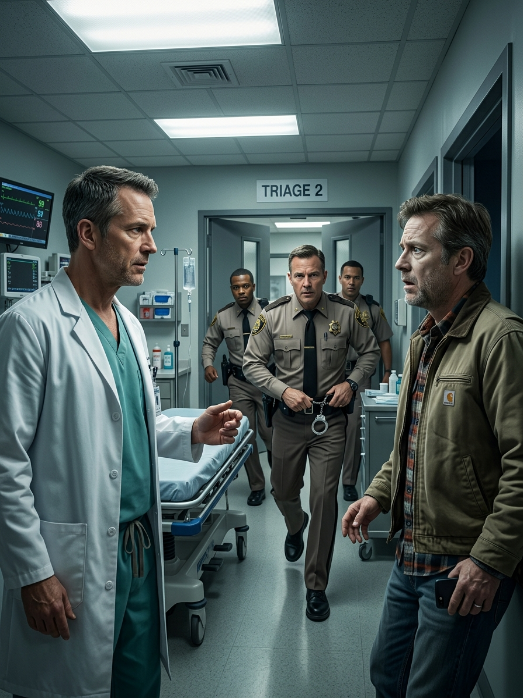
I didn’t move an inch from my spot in front of the exit door, feeling the heavy pulse pounding in my own ears while I told him he wasn’t taking that child anywhere because a compromised airway and an active infection made moving him medically unsafe. Greg stepped forward until his chest was a fraction of an inch from mine, his fingers bunching the fabric of Leo’s sweatshirt so hard the boy’s neck was pulled back at an awkward, painful angle. He told me to get out of his way because he was the parent and nobody was going to tell him what he could do with his kid after a long week of hauling freight. I called over my shoulder for Sarah to initiate a Code Guardian for Triage 2, lock down the hallway doors, and get hospital security down here immediately before Greg could drag the kid out into the rain.
Greg went completely ballistic at the mention of security, demanding to know what the hell I meant by calling people on him just because he wanted to take his boy home to bed. I told him I was placing Leo under an emergency medical protective hold, explaining in a flat, clinical tone that under Oregon law I had the authority to detain any minor patient presenting with life-threatening injuries when parental consent was being withheld or abuse was suspected. He thrust his hand deep into his canvas coat pocket, his face twisting into an ugly sneer as he asked if I was accusing him of something after he worked eighty hours a week to support this family.
The heavy door swung open behind me before he could pull his hand back out, and two uniformed hospital security guards stepped into the small room with their hands resting on their utility belts, followed closely by Sarah with a clipboard pressed to her chest. Greg looked at the guards, then looked at my face, and whatever calculation he was running in his head made him slowly withdraw his hand from his pocket and let go of Leo’s shoulder with a sharp shove that sent the boy tumbling back down onto the mattress. He raised his hands in a fake, theatrical gesture of surrender, muttering that we could run our stupid tests and waste our time proving him wrong, but threatening that his union lawyer would be down here before breakfast if he missed his haul to Seattle. I told Sarah to get a wheel bed immediately, move Leo straight to Trauma Bay 1, call Radiology for a stat maxillofacial CT scan and a full dental series, and start a pediatric IV line with broad-spectrum antibiotics right now.
As the nurses wheeled Leo out down the secure corridor, I kept my hand resting lightly on his cold fingers, feeling the wild, frantic rhythm of his pulse racing at 140 beats per minute as we passed under the bright lights of the trauma suite. Once we got him onto the bed, I asked the boy if he could open his mouth just a little bit so I could see what was happening along the gum line, and he slowly parted his dry, cracked lips for me.
Inside his mouth, the soft tissue along the lower right mandible was dark, necrotic, and torn wide open, oozing a foul-smelling purulent fluid from the spot where a jagged ridge of bone had actually punched through the mucous membrane into the oral cavity. The stench of dead tissue and advanced bone infection was thick and unmistakable, telling me without a shadow of a doubt that this wasn’t some fresh bicycle accident from yesterday afternoon. This was an old, festering, untreated compound fracture that had been rotting inside this little boy’s face for days while someone kept him locked away in a bedroom to hide the evidence. Ten minutes later, the radiology technician pinged the high-resolution CT images directly to my central workstation monitor in Trauma Bay 1, and I stood there in the quiet hum of the equipment with my hands gripping the formica edge so hard my knuckles turned white.
The 3D reconstructed scan of nine-year-old Leo’s skull popped up in sharp, crisp detail, showing his lower right jaw shattered into three distinct, jagged fragments with a massive gap of missing bone matrix right where the angle of the jaw should have been smooth. Right in the center of that fracture site, buried deep within the dark shadow of the dead tissue near the root of his second molar, was a thin, high-density metallic object glowing like a white needle against the gray bone.
It was a broken piece of a heavy brass-and-wire belt buckle, lodged so firmly into the marrow that it looked like it had been driven there by a hammer blow. The mechanics of the injury were suddenly as clear to me as if I had been standing in the room when it happened four days ago, because no bicycle fall on earth creates a linear, high-velocity impact that buries metal deep inside a child’s mandible. Someone had struck this nine-year-old boy across the face with terrifying, vicious force using a heavy leather belt with a metal tongue and frame, hitting him so hard it shattered his bone, tore through his cheek, and left him to suffer in silence. Greg hadn’t brought him in because he cared about the fever or the swelling; he brought him in at three in the morning because the infection had reached a point where the boy might actually die on his watch, and a dead child in the back of a semi cab would mean the end of his license, his freedom, and his life.
He had hoped for a quick bottle of amoxicillin to knock down the fever long enough to get the kid out of state before the rot finished the job for him. I pulled my phone out of my pocket with shaking fingers and dialed the direct line for the state police dispatch and child protective services, keeping my voice cold and steady as I reported an active felony child abuse case with a foreign weapon fragment embedded in a pediatric fracture.
The dispatcher told me officers were three minutes out from the coastal detachment, and I hung up immediately to dial our chief of maxillofacial surgery, Dr. Aris, who answered on the second ring with that raspy, middle-of-the-night voice of a surgeon who lived at the hospital. I told him we had a nine-year-old with a four-day-old compound mandible fracture, a severe facial abscess, early sepsis, and an estimated forty-five thousand dollars worth of emergency reconstruction and ICU care ahead of us, and asked him to meet me in the prep area right now. Aris didn’t hesitate for a second, just grunted that he was pulling on his scrubs and heading down the stairs while telling me to get the boy prepped for immediate debridement. I walked back down the hallway toward Triage 2 with the two security guards flanking me like a pair of bookends, the rubber soles of my shoes squeaking against the polished linoleum.
When I pushed the door open, Greg was pacing a small mud-circle near the window with his phone pressed to his ear, looking up with a hardened scowl that melted into confusion the moment he saw my face. He demanded to know how long this stupid scan was going to take because his rig was idling down at the yard, and I told him flatly that his route to Seattle was canceled permanently.
Greg froze mid-stride, lowering the phone slowly from his ear while asking what the hell I thought I was talking about with a voice that sounded thin and reedy in the small room. I told him Leo didn’t have a spider bite, spelling out every ugly detail of the three-piece fracture and the metal belt buckle fragment sitting right there in the CT scans like a fingerprint of his violence. His face drained of every drop of color until he looked like wet plaster, his jaw working up and down silently like a fish out of water before he managed to choke out that the boy had been talking back to his mother and it was just an accident. Before he could finish stumbling through his excuses, the double doors at the end of the hall flew open and three state troopers rushed into the corridor led by Officer Davis, a veteran investigator I had worked with on half a dozen ugly cases over the years.
Davis called out Greg’s name, pulling his steel cuffs from his belt as he stepped into the room and told him he was under arrest for felony first-degree child abuse, assault with a deadly weapon, and criminal medical neglect. Greg backed away until his shoulders hit the drywall, his eyes darting wild and frantic around the room as he started screaming that he was the boy’s stepfather and had a legal right to discipline his kids however he saw fit.
I watched the troopers force his thick arms behind his back and click the heavy steel cuffs around his wrists with a sharp, metallic snap that echoed off the tile walls. I told him as they dragged him past me toward the exit that nobody has the right to break a child’s jaw and leave him to rot in a dark room for four days just to protect a commercial truck driver’s license. By the time they hauled him out into the rain, shouting threats about his union and his lawyers, the storm outside had started to break into a quiet, gray coastal dawn over the dark timberlines of the mountains. I walked back toward the surgical prep unit where Dr. Aris and his team were already wheeling Leo toward the OR doors under a bright set of overhead lamps. The surgery took nearly four hours in the end, with Aris carefully scraping away the dead, infected bone, pulling the jagged metal fragment out of the tissue with a pair of fine forceps, and securing the shattered mandible with two permanent titanium micro-plates to rebuild the structure of the boy’s face.
The forty-five thousand dollar bill for the reconstruction was a drop in the bucket compared to what it would have cost that little boy if we had let Greg walk out the door with a bottle of useless pills at three in the morning.
When Leo finally came out of the recovery room around noon, his face was wrapped in clean white dressings and his breathing was slow and even under the influence of the IV antibiotics that were already cooling his fever down. I pulled a small wooden chair up beside his bed in the quiet pediatric unit, sitting down to watch the steady drip of the saline bag while the morning light filtered through the blinds in thin, pale stripes. The door clicked open softly, and a state social worker walked in followed by a woman in a dark wool coat who looked so much like Leo around the eyes that I knew instantly she was family. It was his biological aunt, his mother’s sister, who had been tracked down by the state police hours earlier after they discovered the boy’s mother had been stuck in a long-term medical facility in Portland and knew nothing about what was happening in that house.
Leo turned his head slowly on the pillow, and when he saw her standing in the doorway, his pale blue eyes lost that hard, defensive stare he had worn in the ER and filled up with a quiet, overwhelming relief. His aunt crossed the room in two quick strides, dropping to her knees beside the bed and burying her face gently against his uninjured shoulder while she cried soft, shaking tears into his blanket.
She told him over and over again that she was right there and that nobody was ever going to touch him or hurt him like that again as long as she drew breath. I stood up quietly from my wooden chair to give them some privacy, my knees popping slightly in the quiet room as I reached for the door handle to slip out into the hallway. A tiny, feather-light tug caught the cuff of my white lab coat, and I looked down to see Leo’s small fingers holding onto the cloth with just enough strength to keep me from leaving. He looked up at me through his swollen lids, his breathing completely calm for the first time since I met him, and gave me a tiny, careful smile that didn’t pull at the stitches on his right cheek. He whispered thank you for listening to him when everyone else had pretended not to hear, his voice small and sweet in the quiet corner of the room.
I reached down and covered his little hand with my palm, feeling the steady, healthy warmth of his skin against mine and knowing that we had caught him just in time before the dark took him. I told him he was going to be just fine now, walked out into the bright afternoon sun of the nurses’ station, and laid my stethoscope down on the desk for the last time that week.