The oak kitchen island is where I spent fourteen years of my life. It is where I taught Sofia her multiplication tables, where we did her science fair posters, and where we shared every single dinner since her father left. That island is the foundation of our world. It is sturdy and reliable. Or at least that is what I believed until the foundation started to crumble.
Sofia is my life. She is a straight-A student, the kind of girl who actually enjoys reading biochemistry textbooks for fun.
She has always been the one to keep me grounded, with her quick wit and that infectious laugh of hers. We had this rhythm. I worked as an architectural drafter, which kept me at the desk for long hours, but I was always home by 6:00 p.m. We would cook, we would talk, and I would hear about the track team, the homework, the drama of freshman year. It was a beautiful, predictable life. Then, three months ago, the rhythm broke.
It started small. She began staying later at the track field. Then, she started skipping dinner because she claimed she had eaten lunch with her friends. I figured it was just the intensity of high school, the pressure, the need to fit in with the older girls. But she started changing in other ways. She lost weight, a lot of it. Her skin took on this dull, greyish tint that worried me to my core.
When I asked her about it, she would just shrug and look away, her eyes fixed on the floor. She became a stranger in my own home.
I blamed myself at first. I thought I was working too much. I thought I was being a bad mother. I tried to talk to her, but she became a master of deflection. She would laugh, but it didn’t reach her eyes. She would eat, but it was just pushing food around, making it look like she had finished her plate. I felt like I was watching my daughter fade away, day by day, and I had no idea why.
Then came the morning I decided to change her sheets. I don’t know why I was looking under the mattress, maybe just a mother’s intuition or a desperate attempt to find some clue, but my hand brushed against something hard. It was a small, pink, fabric-bound diary.
I didn’t mean to read it. I swear I didn’t. I thought it was just a normal teenage journal. I opened it to the first page, and the words hit me like a physical blow to the chest.
The handwriting was jagged and frantic. It wasn’t the neat, precise script of my straight-A daughter. It read: Day 1 of not eating. If I’m thin enough, maybe he will stop. The entry went on to detail her calorie counts, which were terrifyingly low, and her desperate, pathetic hope that disappearing would make someone go away. My heart didn’t shatter. It just stopped. My brain couldn’t process the reality of it.
I didn’t think about the consequences. I didn’t think about school policy or proper channels. I grabbed my car keys, left the house in a daze, and drove to Oakridge High School. I walked past the front office, ignored the secretary’s questions, and marched straight into Arthur Vance’s office.
I didn’t knock. I slammed the door behind me so hard the pictures on his wall jumped.
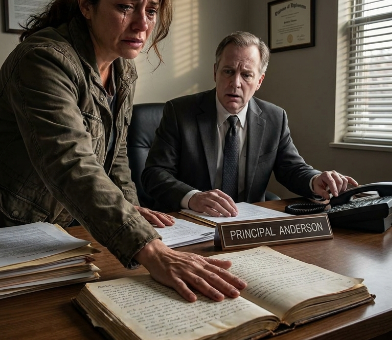
Vance looked up, his face set in that practiced, administrative mask of calm. He was a man who lived for his reputation. He gestured to the chair with a polite, dismissive wave. Mrs. Torres, you really cannot just burst in here, he started, his voice dripping with that infuriating tone of calm authority. I didn’t let him finish. I walked to his desk and slammed that pink book down right in front of him. I told him he needed to read it, right now, or I would call every news station in Virginia.
He looked at the diary like it was a live grenade. He started to protest, but I wasn’t having it. I pointed at the page. Read it, I said, my voice shaking with a rage so cold it felt like liquid nitrogen. He looked at me, then down at the page. He started reading, and I watched the color drain from his face. He went from composed to ash-grey in about five seconds. His jaw dropped, and he didn’t even look at me. He just reached for his phone and started punching buttons.
He didn’t call the police because of a student. He called them because he recognized the handwriting and the name that followed. The man who was doing this to my Sofia wasn’t a classmate. He was the varsity track coach, Marcus Sterling.
The next few hours are a blur of uniforms and hushed voices. Detective Miller took the diary. She was a kind woman, but her eyes were hard as flint. She told me that Sofia had been caught in a trap. Sterling had used his administrative access to mess with her grades, planting false plagiarism reports to hold over her head. He had threatened to end her dreams of college, of her future, if she didn’t pay him off. When she ran out of money, he got meaner. He told her she was taking up space, that she was too visible.
My daughter, in her fourteen-year-old wisdom, decided that if she just stopped existing, if she made herself small enough, he would have nothing left to hold over her. She was starving herself to death to protect me. She thought that if she was too weak to run, she wouldn’t be on the team, and he wouldn’t be able to reach her. It makes me sick even now just to think about it.
We had to be smart. If I had gone public, he would have had his lawyers turn the whole thing into a circus. He would have ruined her reputation, made her seem like a confused, dramatic kid. I had to let the police do their work. I spent the next two days in a state of absolute, controlled panic, waiting for them to get the forensic evidence from the school’s server.
The digital trail was clear. Sterling had been using a back-door code to flag student files for months. He had a whole system set up, a way to squeeze money out of the kids he was supposed to be mentoring. He was a predator in a polo shirt, and he had been doing it right under the principal’s nose for years.
When the time came, I was there. I sat in that conference room, clutching Sofia’s backpack like it was my lifeline. When Sterling walked in, he was still wearing that arrogant, confident smirk, like he owned the place. He looked at me and actually had the audacity to call my daughter unstable. That was the moment I stopped being afraid. I stood up and I walked right to him. I told him he was a coward, and that his little game was over.
The police moved in before he could even try to run. It was fast. It was quiet. It was perfect. They took him out in cuffs, and I watched him go, feeling nothing but a deep, hollow satisfaction. He was finished. The board fired him that same afternoon, and they cleared Sofia’s record before the sun went down.
Three weeks later, the house is finally quiet, but in a good way. The sun is setting behind the trees, casting that long, golden light across the kitchen. Sofia is sitting at the island, finally eating a bowl of soup without me having to beg her. She looks at me, and for the first time in months, I see the light coming back into her eyes. It is slow, but it is real.
The pink diary is sitting on the desk. It is empty. The pages are all clean, waiting for her to write something new, something that belongs to her. I am sitting here, watching her, and I know we are going to be okay. But I am still sitting in that chair, and I am still thinking about the fact that this happened. I keep seeing Sterling’s face. I keep hearing his voice. I am still here, in this house, and I think I will be sitting here for a long time, just watching the door, making sure nothing ever touches her again. The plot is resolved, but the fear is a quiet companion that hasn’t left the room. It sits with us at the dinner table, a ghost of what almost happened, and I don’t think it is going anywhere soon.