I spent my life believing that if I just looked at the data hard enough, I could find the truth in any situation. My work as a quality assurance manager for a medical device company required a certain kind of cold, methodical patience. I lived by the rule that every system, no matter how complex, leaves a footprint. If you knew how to look, you could find exactly where the design failed. I raised my daughter, Maya, with that same belief.
We lived a quiet, predictable life in the foothills of Virginia, just outside the city. It was a good, simple life of tea at the kitchen island, shared sketches, and school days that were supposed to be safe. I reckon I thought I was protecting her by teaching her to be self-reliant and observant, but I never imagined the very system I trusted would turn into a trap.
Maya was twelve, a soft-spoken girl who saw the world in shades of charcoal and graphite. She wasn’t one for the loud, social chaos of seventh grade. She preferred the solitude of her sketchbook. For three months, the light in her eyes just sort of dimmed. I would come home from the plant, and she would be sitting at the island, her posture stiff, her eyes fixed on nothing at all. I asked her about her day, and she would say it was fine.
She was quiet, but she was eating, and she was doing her homework. I figured it was just the heavy weight of turning thirteen. I guess I didn’t want to see the crack in the wall because I was terrified of what I might find if I looked too closely.
The bottom fell out on a Tuesday evening in late October. The air outside was turning sharp and biting. Maya walked through the mudroom, dropped her bag, and sat at the island, not even bothering to take off her heavy wool coat. Her face was ashen. I asked her what happened, and for the first time, she just broke. “Everyone hates me,” she whispered. I tried to tell her that wasn’t possible, that seventh grade was just a hard transition, but she just shook her head. “I eat lunch alone every day, Mom. I walk the halls alone. Nobody speaks to me.” I should have known right then.
I should have seen the signs that this wasn’t just typical middle school cruelty.
The next morning, I did what any parent would do. I called the school. I spoke to the grade-level counselor, a man who sounded calm and professional over the phone, and I spoke to her teachers. Everyone told me the same thing: Maya was fine, she was just shy, she was keeping her grades up. I figured it was just a phase. I thought if I gave her space, it would pass. But that night, the truth started leaking out. I was walking past the hallway charging station when I heard her phone buzz. It didn’t stop. It buzzed again, and again, and again. I picked it up. My hands were shaking, but I told myself I had a right to know. I bypassed the code and opened the messages.
The breath just left my chest. The screen was scrolling through hundreds of messages.
They weren’t just standard taunts. They were cruel, mechanical, and persistent. “The world is better without you,” one said. “Everyone knows you’re the reason no one talks to you,” said another. They were coming from dozens of accounts. I spent the next four hours sitting at my desk, my eyes burning, capturing screenshots of every single one. I was looking for the pattern, the source, the defect in the system. I didn’t sleep. By 4:00 a.m., I had a 400-page dossier of misery. I printed every single one, bound them with a heavy clip, and drove to the school as the sun was just starting to climb over the ridge.
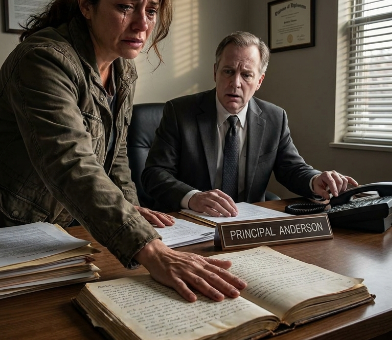
I walked into the principal’s office at 7:30 a.m. I didn’t care about appointments. Principal Joan Vance was sitting there with her coffee. I didn’t say a word. I just walked over and slammed the massive stack of paper onto her mahogany desk. “My daughter has been terrorized for three months,” I said. My voice was steady, the same tone I used when I had to tell a manufacturing team that a batch of heart monitors was failing inspection. “I want these accounts suspended, and I want an immediate investigation into every student and parent involved in this.”
Principal Vance didn’t flinch. She didn’t even look at the pages. She looked at me, and her face held a kind of deep, weary sorrow that I hadn’t expected. She didn’t reach for the paper. “Mrs. Harper, before you say anything, there is something I need to show you,” she said. She turned her monitor toward me. I expected a student file. I expected a list of names. Instead, I saw a screen full of scrolling code and a red line tracing a path through the school’s internal network. “This is where the messages are coming from,” she whispered.
I stared at the screen. I saw the routing. Every single message, every single anonymous profile, was originating from an IP address hardwired into the school’s own administrative wing. It wasn’t a group of girls. It wasn’t parents. It was someone sitting in an office down the hall. Principal Vance pressed a few keys, and a name popped up next to the digital signature. It was Marcus Sterling. The guidance counselor. The man who had sat in my kitchen, the man who had told me Maya was just going through a phase. My vision narrowed. I realized why. Three months ago, I had audited a medical firm for work. I had exposed a fraud ring. The man I had put out of a job was Sterling’s own husband.
I didn’t scream. I didn’t cry. I felt a cold, sharp clarity wash over me. “Call him in,” I said. I stood there, watching the clock on the wall tick away the seconds until he walked in. When Marcus Sterling stepped through the door, he had that same professional smile on his face, that same soft sweater that made him look like he cared about every child in that building. He didn’t even look at me. “What’s the emergency, Joan?” he asked. I didn’t let him finish. I walked over to the desk, slid the 400 pages of screenshots next to the server log on the screen, and pointed at the IP address. “The emergency is your signature, Marcus,” I said. “The audit is complete.”
I saw the light go out in his eyes. He tried to stutter, to pull some excuse out of the air, but the school resource officer was already stepping into the doorway. The game was up. He had used his position, his access, and his technical knowledge to wage a war on a twelve-year-old girl to get revenge on me. He had used the school’s own servers to manufacture a reality that didn’t exist. He had sat there, day after day, clicking buttons on a bot script while he acted like a mentor to the very child he was trying to break.
The police took him out in handcuffs twenty minutes later. I didn’t watch him go. I walked out of that office and into the cool, morning air. It felt like I could finally breathe again. The school board tried to handle it quietly, but I made sure every piece of evidence was in the hands of the district attorneys. They didn’t just fire him. They charged him with everything they could find, from cyber-stalking to data manipulation. It wasn’t just a win for me. It was a win for every kid in that building who had been lied to.
Three weeks later, the world felt different. The house was quiet, but it was a good kind of quiet. I sat at the island, drinking my coffee, and watched Maya sitting at the kitchen table. Her old phone was in the bottom of a locked drawer, turned off, never to buzz again. She was drawing on a big, clean pad of paper, her pencil moving in steady, confident arcs. She looked up at me, and for the first time in months, she just smiled. I didn’t say anything. I just watched the sun come through the windows and hit the paper, feeling the weight of the last three months finally lift off my shoulders. I reckon we had a long way to go, but for the first time in a long time, the path forward was clear.