How My Daughter-in-Law’s Morning Pocket Dial Cost Them My House and Every Legal Right They Had

The morning coffee pot on my kitchen counter had finished its slow, wet sputter about ten minutes before the phone started vibrating against the wood. It was 7:15 in the morning, and the light coming through the small panes above the sink was that pale, watery blue that always shows up right before the frost sets in for good. I was standing there with my favorite ceramic mug half-full of Earl Grey, watching a single gray squirrel scurry along the top of the cedar fence Raymond built back in the summer of ninety-four, when the screen lit up with Alicia’s face.
I thought someone must be in the hospital. I thought maybe my son Mark had been in an accident on his way down the interstate, or one of the girls had broken a bone during gymnastics practice. I swiped the green icon without thinking, pressing the small glass rectangle against my ear, and heard the dull, rhythmic thrum of highway tires against concrete instead of a human voice. I didn’t say hello, and because Alicia never checked to see if the call had actually gone through, she just kept right on talking to her husband over the hum of the engine and the heater fan. For nineteen minutes straight, while my tea slowly went cold beside the butter dish, I sat at that oak table and listened to them carve up the rest of my life like a side of beef at the butcher shop.
It took me a few seconds to realize they weren’t talking about the weather or whether they needed to pick up milk on their way back from the hardware store.
They were driving south on Route 9, about twenty minutes out from my front porch, and they were mapping out how to handle me before the first snow hit the valley floor. Alicia had that sharp, business-like tone in her voice that she always used when she was trying to convince the PTA board to buy expensive catering for the spring banquet, only this time the subject of the transaction was my independence. She told Mark that the memory assessment took less than an hour and that if they could establish a documented pattern of forgetfulness right now, before the winter holidays rolled around, they wouldn’t have to fight my sister Clara on the guardianship later. Mark’s voice came back through the tiny speaker sounding tired, heavy with the dull, greasy fatigue of a man who had spent three years digging a hole for himself and had finally stopped trying to climb out.
He mentioned that Pinecrest was forty miles away and looked more like a county hospital than a retirement home, and that I wouldn’t like the hallways or the institutional food. Alicia didn’t miss a beat. She reminded him that it was all they could afford once the mortgage cleared and the unsecured loans came due, pointing out that my four-bedroom craftsman house was worth at least $620,000 on the open market and entirely unencumbered by debt. Raymond had paid off the note twenty-five years ago with the settlement from the bridge project, leaving us with a clear title and a house full of hand-finished oak trim.
I remember looking down at my thumb resting on the counter, noticing how the skin around the knuckle had gotten thin and paper-like over the years, the blue veins standing out like dry creek beds in August. Alicia was explaining to my only son that if they could get the medical power of attorney transferred into their names before Thanksgiving, they could list the property by the first week of December and have me tucked away in a shared room at Pinecrest before Christmas Eve.
She even had a cousin working in the intake department who could fast-track the paperwork so we didn’t get caught up in the county backlog. Mark gave a long, ragged sigh that sounded like air leaking out of an old tire, and then he gave in the way he always gave in when he was cornered by his own debts. He agreed to the pop-in visit for later that morning, suggesting they bring a box of pastries, look around the kitchen to see if I had left the stove burners on or misplaced my keys, and start building the official file for the doctor. When the line finally clicked dead with a sharp little beep, I didn’t drop my cup or scream at the wall. I just pulled my yellow grocery notepad closer, clicked my ballpoint pen until the brass tip locked into place, and started writing down every single figure they had thrown around like it was nothing more than arithmetic on a blackboard.
My name is Dorothy, and I spent thirty-four years teaching freshman composition at the regional high school down on Elm Street, which means I know how to listen to a sentence and find the part where the speaker is lying to themselves. When Raymond died of a sudden coronary out in the workshop four years ago, I thought the bottom had dropped out of the world entirely, leaving me to rattle around in a house that suddenly felt ten times too big for one pair of slippers. For four years after that funeral, I told myself that Mark’s eleven-minute phone calls every Sunday evening were just the clumsy habits of a busy man trying to keep a tech-consulting firm afloat in the city. I told myself that Alicia’s patronizing way of speaking to me in loud, over-enunciated syllables was just her quirky personality, the kind of modern urban mannerism that rural folks like me were supposed to tolerate in the name of family harmony.
I had convinced myself they were just struggling with the economy, that their frequent hints about downsizing and simple living were borne out of genuine concern for my joints and my winter heating bills. Looking down at the ink bleeding through the second page of my yellow pad, I realized I had been making excuses for a pair of vultures who looked at my tea roses and my front porch and saw nothing more than a six-hundred-thousand-dollar check waiting to be cashed.
I didn’t waste ten seconds on tears because grief is for when you lose someone you love to the cold ground, but this was something entirely different and much colder. I stood up from the table, my knees giving off a small, dry pop that reminded me of my seventy-three years, and walked down the short hallway to Raymond’s study where he kept his heavy green metal file cabinet. Inside the top drawer, tucked behind receipts for lumber and old tractor titles, sat the navy blue binder marked ESTATE AND TRUST that we had put together with Arthur Vance back when Raymond was still walking the property lines with his transit level. I brought the whole binder back to the kitchen, laid it flat beside my handwritten notes, and picked up the heavy rotary-style desk phone we still kept plugged into the wall for emergencies. I dialed Arthur’s direct office line before the clock on the microwave even hit 7:30, knowing he always got to his downtown desk early to read the legal briefs before the junior associates showed up to bother him. He answered on the third ring with that familiar, gravelly warmth in his voice that had reassured half the county through crop failures and probate disputes over the last thirty years.
When I told him what I had just heard through the open speaker of my cell phone, the warmth vanished from his voice and was replaced instantly by the cold, sharp focus of a courtroom lawyer who smelled blood in the water. Arthur didn’t waste time asking if I was sure or if I might have misunderstood the tone of a young couple venting their frustrations over breakfast. He asked me for the names of the debt collectors they were dodging, the name of the cousin at Pinecrest Manor, and the exact dollar amount of the business credit card liability Alicia had named on the highway. I gave him every detail I had jotted down on the notepad, my hand steady as I read back the figures while the morning sun slowly crept across the checkered linoleum floor. Arthur told me to sit tight, that he would draft an immediate revocation of the medical and financial power of attorney Mark had finagled out of me two years ago under the guise of routine estate planning.
He said he would transfer full legal proxy to my sister Clara, who still lived up in the hills near the state line and didn’t take nonsense from anybody, and that he would drive out himself with a notary public by ten o’clock to make sure the ink was dry before my son even parked his car in the drive.
I hung up the phone, walked over to my little computer desk in the corner of the dining alcove, and watched the laser printer hum to life as it pulled three fresh sheets of heavy bond paper from the lower tray. The legal revocation came through cleanly, every clause spelled out in formal legalese that didn’t leave enough room for a mouse to squeeze through, along with a formal notice of representation that warned anyone attempting to access my medical or financial records without my written consent would face immediate civil action. I printed three copies, collated them with a silver binder clip from my desk drawer, and laid them neatly on the kitchen table right beside my yellow notepad and Raymond’s navy binder. At 7:52 AM, exactly as they had planned, I heard the familiar crunch of gravel in the drive as Mark’s gray SUV turned off the lane and rolled to a stop right alongside the cedar fence where the last of the autumn cabbage was still holding on in the garden patches. I parted the white lace curtain with one finger and watched through the glass as Alicia checked her teeth in the passenger-side mirror, smoothing down her wool cardigan and pasting on that practiced, saccharine smile she always wore to funerals and bridal showers.
Mark sat behind the wheel for a long moment with his hands gripping the top of the steering ring, staring down at the dashboard like a man waiting for a sentence to be read out in a county courtroom before he finally killed the ignition. I walked to the counter, pulled two clean china cups from the cupboard, dropped a tea bag into each, and set the heavy iron kettle back on the burner to bring the water up to a rolling boil. I made sure everything on the table looked completely normal, the notepad lying open to page three, the blue binder sitting square in the center, and my reading glasses folded neatly beside the sugar bowl. When the front doorbell gave its high, brassy chime, I took a slow, deep breath of the cool air drifting in from the back hallway, wiped my hands on my apron, and walked over to unlatch the deadbolt. I pulled the heavy oak door open just enough to let the gray morning light fall across the floorboards, and there they were, standing on the braided rug with their little box of bakery goods tied up with red ribbon like they were visiting royalty on a Sunday afternoon.
Alicia let out a little breathy gasp of delight and stepped across the threshold before I had even finished opening the door all the way, her voice dripping with that sticky sweetness that always made my teeth ache. She told me they were just passing through the valley on their way to see a client in the next town and simply couldn’t drive past my lane without stopping to check on their favorite girl and drop off some fresh blueberry scones from the artisanal bakery downtown. Mark followed her in like a dog with its tail tucked between its hind legs, keeping his hands jammed deep into the pockets of his corduroy jacket and refusing to lift his chin high enough to meet my eyes in the hallway mirror. I told them to come on back to the kitchen where the air was warm, stepping aside so they could brush past me into the heart of the house where Raymond and I had raised three children and buried two dogs. Alicia immediately started darting her eyes toward the baseboards and the corner umbrella stand, looking for dust or unopened mail or anything else that might serve as evidence for her little report to the intake nurse at Pinecrest.
She glided into the kitchen with that floating, theatrical grace she liked to put on for company, setting the pastry box down on the counter with a little flourish before turning her attention to the arrangement of the room. She started in with her usual patter about how quiet the place was, how all these empty rooms must feel like a burden for someone of my years, and how she and Mark had been losing sleep worrying about whether I was managing the stairs safely during the damp winter months. I walked over to the table, pulled out the chair at the head where Raymond used to sit to read the daily paper, and sat down without inviting them to take a seat just yet. I told her that the house was built with thick timber and good foundations, and that four bedrooms didn’t feel like much when you knew every nail that held them together. Alicia didn’t seem to notice the shift in my voice, gliding right along as she rested one manicured hand on Mark’s arm and suggested they had been looking at some wonderful, low-maintenance communities just twenty minutes down the interstate where I wouldn’t have to lift a finger or worry about the garden.
Mark finally found his tongue, though he kept his gaze fixed firmly on the floral pattern of the tablecloth between us, mumbling something about how they just wanted to make sure I was supported before the real cold weather set in for good. I let him finish his sentence, let the silence stretch out for a second or two longer than was comfortable, and then asked him very quietly if he meant before Christmas, since that was the timeline they had discussed on the highway an hour earlier. Alicia blinked three times in rapid succession, her smile hitching on her face like a window blind that had caught on a frayed cord, and asked me what on earth I meant by the holidays. I didn’t yell or raise my voice to match her sudden nervous pitch; I just picked up my silver ballpoint pen from the table and tapped it twice against the top margin of my yellow legal pad. I told them that at 7:15 that morning, Alicia’s phone had pocket-dialed my cell line, and that I had stayed on the connection for nineteen minutes while they mapped out my future over the hum of the car engine.
The color left Alicia’s face so fast it looked like someone had thrown a bucket of white paint over her cheeks, her mouth dropping open in a small, fish-like O that didn’t make any sound at all. Mark’s head snapped up as if he had been struck with a riding crop, his eyes going wide as he stared at me across the oak table, finally realizing why the house felt different the moment he stepped through the front door. I looked right into my son’s eyes and repeated back the exact words he had spoken about Pinecrest looking like a hospital, and then I turned my gaze back to his wife and recited her little speech about the $620,000 market value and her $84,000 in boutique investment debts. I didn’t miss a single figure, didn’t mispronounce a single name, and didn’t leave out their clever little plan to use a fabricated memory assessment as a crowbar to pry my title away before the bank foreclosed on their lifestyle. The kitchen became so quiet you could hear the pilot light on the gas stove clicking softly against the metal burner, a tiny, rhythmic tick that sounded like a bomb timer in the middle of our family.
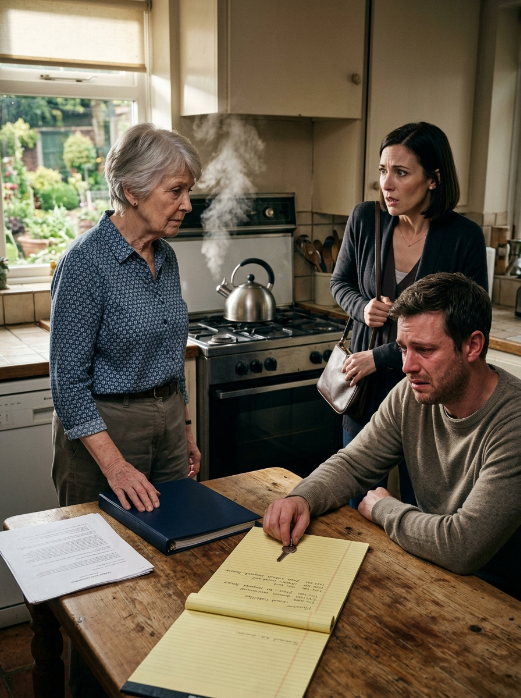
Alicia finally found her voice, but the sweet tea was completely gone now, replaced by a shrill, cracking panic that made her sound like a cornered animal in a shed. She started stammering that I had misunderstood a private conversation, that they were under an incredible amount of stress with the business loans, and that people say all sorts of wild things when they are exhausted from driving early in the morning. I didn’t argue with her or let her talk herself around the corner; I simply slid the yellow notepad across the polished wood until it came to a stop against Mark’s knuckles. He looked down at the paper as if it were a venomous snake coil ready to strike, seeing his own financial ruin and moral bankruptcy set down in my neat, schoolteacher handwriting with timestamps and dollar signs attached to every line. He dropped his chin into his hands and let out a dry, hacking sob that had no pity left in it, muttering that the creditors were threatening to take their family cars and freeze every personal account they had left to their name.
I didn’t offer him a shoulder to cry on or tell him everything was going to work out fine because it wasn’t, and we both knew it as well as we knew our own names. I told him that honorable people sell their own property when they make bad investments, that they take extra shifts or work two jobs until the debt is cleared, but they do not treat their widowed mother like an old milk cow to be sent to the slaughterhouse for quick cash. I reached out and tapped the top of the navy blue binder and the fresh legal papers Arthur had sent over via email that morning, explaining that the power of attorney they thought was their ticket to freedom had been legally dead for the last two hours. I told them that as of eight o’clock that morning, they had zero legal, financial, or medical authority over my person, my property, or my bank accounts, and that my sister Clara was now the primary name on every document that mattered. Alicia tried to step closer, her hands fluttering in the air like wounded birds, begging me to be reasonable and think about what this would do to the family name in the community.
I stood up from my chair, my joints stiff but my back straight, and walked over to the stove where the iron kettle had started to whistle a high, thin note that filled the corners of the room. I didn’t rush to pull it off the ring; I let it sing until the steam billowed up against the copper hood, reminding them both of the time that had passed while they were busy plotting my eviction on Route 9. I turned off the gas, poured myself another splash of hot water into my cooling mug, and walked back to the table to look down at my son one last time before I lowered the boom. I told him that I had given him thirty-five years of unconditional love, paid for his first two years of college out of my own substitute-teaching savings, and welcomed his wife into our home with open arms and a clean slate. And in return, he had given me eleven minutes of distracted chatter every Sunday while calculating how quickly he could dump me in a county facility to pay off his credit card bills.
Mark was shaking now, his shoulders heaving under the corduroy jacket as he wept into his palms, begging me to forgive him, begging me to give him another chance to fix things before the bank locked their doors. I told him I was sure he was sorry, but only because he had forgotten to lock his phone screen before throwing it into the console between the bucket seats. I pointed toward the front hallway and told them both that they had five minutes to get off my property before I picked up the telephone and called the county sheriff to file an official report for elder harassment and financial tampering. I added that if they weren’t gone by the time I finished my tea, I would personally see to it that Arthur Vance mailed a certified copy of my handwritten transcript directly to Alicia’s cousin in the intake department at Pinecrest Manor. Alicia gasped as if she had taken a physical blow to the stomach, grabbed her leather purse off the counter without looking back, and marched out the front door so fast her heels clicked against the porch boards like machine gun fire.
Mark stayed in his chair for three seconds longer, looking up at me with red, swollen eyes that were desperate for a crumb of the mercy I simply no longer had in stock. I told him to hand over his spare key, the one Raymond had cut for him back when he moved into his first apartment in the city, and he didn’t argue or try to stall. He reached into his pocket with trembling fingers, unhooked the small silver key from his ring, and laid it right on top of my yellow legal pad next to the margin where I had written the word Pinecrest. He whispered my name once, a broken little sound that didn’t deserve an answer, and then he stood up and walked out the door without another word. I stood at the window and watched his gray SUV back down the gravel drive, scattering red autumn leaves across the grass before he shifted into gear and disappeared down the lane toward the highway.
The house settled back into that deep, heavy quiet that always follows a storm, a silence that didn’t feel lonely at all, but rather like the feeling you get when you finally bolt a heavy storm door against a November gale. At ten o’clock sharp, Arthur Vance’s dark sedan pulled into the drive, bringing along his young paralegal, Sarah, carrying her metal notary stamp in a leather zipper case. We sat right there at the kitchen table where Mark and Alicia had been weeping half an hour earlier, and I signed every single page of the revocation documents without my hand shaking once. Arthur told me he had already notified the county recorder’s office to place a permanent legal flag on the property title so that no transfer, lien, or deed could ever be filed without a direct signature witnessed in his own office. He closed his briefcase with a sharp snap, smiled across the table at me, and refused to take a single dollar for his trouble, saying Raymond’s retainer from thirty years back still covered a few hours of friendship and common sense.
After they left, I walked through the empty rooms, checking the latches on the double-hung windows and turning off the overhead light in the back hallway where the shadows always gathered first. I picked up the pretty white box of blueberry scones Alicia had left on the counter, walked out to the metal trash can beside the garage, and dropped the whole untasted package right into the bottom among the paper bags and coffee grounds. I came back inside, picked up my warm mug of tea, and stepped out through the back screen door into the late-morning sunlight that was now pouring over the whole backyard. Raymond’s tea roses were standing tall against the cedar fence, deep reds and heavy pinks holding their heads high in the crisp air, refusing to let the coming frost touch their petals before their time. I reached into my apron pocket, pulled out the small silver key Mark had surrendered, and dropped it deep into my old wooden sewing box on the porch table among the spools of thread and spare buttons. The house was mine, the land was mine, and the future was going to be tended by my own hands, exactly the way Raymond would have wanted it done.