How My Family Tried to Move Me to the Garage for My Brother-in-Law and Met My Battalion

Three days after I laid Graham to rest under a slate-grey Colorado sky at Fort Carson, my father picked up my bedside lamp, carried it down the hallway, and set it squarely on the cold concrete floor of my garage. It was 6:40 on a Thursday morning, the kind of biting November dawn where the frost doesn’t leave the windshield until noon, but my skin felt hot with a slow, sick disbelief that had nothing to do with the weather.
I stood in the doorway of the kitchen with both hands resting instinctively against the tight slope of my seven-month pregnant belly, watching him walk back inside as if he owned the foundation under his boots. I had spent ten years in the United States Army managing brigade-level logistics through rotations in places that smelled of diesel and dust, but nothing in my service record had prepared me for the particular brand of casual, paternal contempt that allowed a sixty-two-year-old man to repossess my nightstand while the dirt on my husband’s grave was still settling.
“Dad,” I said, my voice carrying that flat, level tone I used when a supply truck was missing three manifests and a driver was lying about the mileage. “What are you doing with that?”
My father, Richard, did not look at me. He was built like an old fire hydrant, thick through the middle and set in his ways since before I was born, and he had spent decades talking over anyone who had the temerity to interrupt his domestic administrative decrees.
He reached down and picked up my heavy brass alarm clock, the one Graham had bought me at the post exchange in El Paso when we made captain together, and tucked it under his arm alongside my reading lamp. We are streamlining things, Julie, he told me, his tone as breezy and practical as if he were discussing crop rotation or garage sales. You are in no condition to be managing a four-bedroom house right now, he went on, stepping past me toward the hallway storage closet where I kept extra linens. You are grieving, you are exhausted, and in two months you are going to have a baby in your arms with no husband to help you, so we are stepping in to take the administrative burden off your hands.
Before I could draw breath to correct his arithmetic, my younger sister Chloe came out of my master bedroom carrying two of my wool suits still hanging on their dry-cleaning plastic, her face pinched with the self-righteous martyrdom she had perfected during our childhood in Iowa.
Behind her came her husband, Chad, wearing a slate-grey fleece vest stamped with the logo of the tech firm where he had recently managed to secure a remote position after three different layoffs in as many years. Chad was hauling three heavy cardboard wardrobe boxes, the kind you buy in bundles of four at Home Depot, and he dropped them onto my hardwood floor with a dull thud that made the china in the corner cabinet rattle. Chad needs an executive workspace, Chloe announced, slinging my suits over the back of a maple kitchen chair as if she were dropping laundry off at a dry cleaner’s. He just transitioned to full-time remote consulting for that Portland firm, and your master suite has the attached bath, the walk-in closet, the mountain view, and the quiet layout he needs for client calls. We discussed it last night while you were asleep upstairs.
You discussed taking my bedroom while I was sleeping in it? I asked, the words coming out colder than I intended.
Don’t take that tone with us, Julie, my mother called out from the living room, her voice sharp as she marched past with a roll of clear packing tape in her hand. She was already busy boxing up the framed military commendations Graham had earned during his third deployment to the Horn of Africa. We are staying here for the winter to help you through the holidays, but Chad cannot work from a dining table where people are walking by every five minutes to make formula or change diapers. If he loses this contract, none of us can support this family, so you need to be reasonable about the logistics. The room over the finished garage is actually quite cozy, and the main garage bay has central heat if you keep the door shut.
I stood very still in the middle of the kitchen, watching them move through my house like an occupation force that had already decided the treaty terms before crossing the border. My heart was hammering against my ribs, but my posture remained exactly what it had been when the battalion commander at Fort Carson chewed me out for a late fuel report in twenty-twenty: straight spine, shoulders back, chin tucked just enough to keep the blood from rushing to my ears. At thirty-two, they still saw the girl who had cried over a broken violin string in high school or fumbled her checkbook balancing acts during freshman year at Iowa State. They looked at the oversized grey sweater I had pulled on over my maternity leggings, the lack of makeup on my face, and the tea mug I was holding like a lifeline, and they assumed the widowhood had hollowed out whatever backbone the Army had managed to install in me over a decade of service.
They did not know that Graham and I had closed on this house eighteen months ago for four hundred and eighty thousand dollars, putting down a heavy chunk from our combined deployment savings before we even started trying for the baby. They didn’t know that through our principal payments and the steady appreciation of the Colorado Springs market, we had already cleared two hundred and ten thousand dollars in clean equity. Most importantly, they had no earthly idea that the warranty deed sitting in my fireproof box downstairs was filed solely in my name under a special military spouse provision we had used when Graham was still TDY, and that I was currently a Major on active-duty bereavement leave with twenty-eight days of accrued terminal leave waiting behind it if I chose not to return to the motor pool.
Chad carried another stack of plastic bins out of the guest room and marched them straight past me into the master suite, bumping his shoulder against the doorframe without even offering a nod of acknowledgment. I brought my two monitor mounts, Chad called out over his shoulder as he dumped the plastic on my handmade quilt. I’ll need you to clear out the master closet by noon, Julie, because I have a big regional presentation on Monday morning and I need the background to look professional during the Zoom call with the regional vice president. My father dragged my small leather reading armchair out of the corner of the living room, its wooden legs scraping a long grey line across the oak planks as he hauled it toward the interior garage door. You’re ruining Thanksgiving with this attitude, my father muttered over his shoulder, shaking his head in that heavy, disappointed way he had used whenever I missed milking time to study for a board exam. We came all the way out from Des Moines to support you, and you’re standing there like a statue while we do all the heavy lifting to keep this household solvent.
I looked down at the silver face of my watch. The digital numbers read 6:48 AM. I looked at my father’s red, stubborn neck, then at Chloe as she flicked a piece of lint off my winter coat, and finally at Chad, who was already testing the light switch in the master bathroom to see if the vanity bulbs were bright enough for his web camera. I took one long, slow breath through my nose, and down below my ribs, my daughter gave a sudden, sharp little kick that felt like a tiny boot heel finding purchase against my diaphragm. I let the breath out through my teeth, very quiet, and looked my father dead in the eye as he reached for the handle of the garage door.
Okay, I said.
My father paused, his hand gripping the cold metal knob, looking back over his shoulder with a mixture of suspicion and relief. Okay? Good. Glad you finally came to your senses and realized we’re only doing this for your own good.
I am going to make some tea, I said calmly, stepping around him without touching his sleeve.
I turned my back on the three of them, walked over to the electric kettle on the granite counter, and filled it to the max line with filtered water from the tap. My hand was steady, though the skin over my knuckles felt tight as dried hide while I switched the base on and listened to the low hum of the heating element starting its work. While the water climbed toward a boil, I reached into the deep pocket of my leggings, pulled out my encrypted work phone, and tapped the secure messaging app that connected me directly to the fourth infantry division’s rear detachment office. I didn’t need to scroll through contacts; I had spent three years as the battalion logistics executive officer, and Colonel Vance’s direct line was burned into the front lobe of my brain alongside the supply codes for diesel and rations. Vance had been Graham’s company commander back at Fort Hood before we both got our assignment slips for Colorado, and he had come by the house two days after the funeral to make sure my survivor benefits packets were initialed correctly by the rear-detachment JAG officer.
I tapped out a short, precise message using the shorthand we used for morning briefing updates across the secure network. Sir. The family situation we discussed during the casualty assistance visit has escalated significantly. They are currently moving my personal belongings into the garage to clear the master suite for my brother-in-law’s home office. Convoy timing still accurate for 0730 per our staging plan?
My phone vibrated against the cool granite counter almost before the thumb icon had finished spinning. The reply came from Vance himself, no staff sergeant screening the traffic at this hour. 0730 locked and loaded. Three vehicles total. Legal officer Captain Miller and a two-man base security detachment are riding in the lead humvee. Sit tight, Major. We are five minutes out from the staging point down on Interquest Parkway.
I laid the phone face down, the black screen resting against the dark stone like a dropped compass. Behind me, the muffled sound of heavy boots and sliding wardrobe boxes continued down the hall as Chloe carried my jewelry box toward the garage entrance with the casual carelessness of someone tossing trash into a dumpster. Where do you want your winter boots, Julie? Chloe called out, her voice dripping with that thin, artificial patience people reserve for the newly bereaved or the mildly feeble. I put your shoe rack out by the lawnmower near the snowblower. Honestly, you have way too much clutter in this house anyway; Chad needs clear floor space if he’s going to run a regional consultancy from here without tripping over your old gear.
I didn’t answer her. I poured the boiling water into a thick ceramic mug that still had the crest of the third brigade combat team stamped in faded blue ink along the rim, stepped over to the kitchen window, and looked out across the frost-heaved turf of the front lawn. Planted near the cedar porch railing was a young red maple tree that Graham had dug into the frozen ground with his own hands back in August, right before the brigade received their deployment warning orders for the fall training cycle. He had watered it every single morning before dawn PT formation, telling me with that lopsided grin of his that it would be big enough to cast real shade over our daughter’s sandbox by the time she turned three and started running across the grass.
My mother walked into the kitchen, wiping her hands on a linen dish towel she had pulled out of my drawer without asking, her face set in lines of permanent maternal martyrdom. Your father and I decided we will host Thanksgiving dinner for the local cousins at three o’clock this afternoon, she announced, walking straight to the refrigerator and yanking the door open to peer inside with a critical eye. We need to clear out those military storage footlockers in the dining room so we can set up the heavy folding table we borrowed from Aunt Carol. What is actually inside those big green metal boxes anyway? I saw three of them stacked near the radiator when we drove in Tuesday night.
My husband’s service gear and personal effects, I said softly, staring at the bare branches of the maple tree outside.
My mother let out a long, dramatic sigh that fluttered the grey curls around her temples. Julie, Graham is gone, and you cannot keep living in a military museum for the rest of your natural life. It is bad for the baby, it makes Chad uncomfortable to see field jackets and uniform covers hanging in the front coat closet where clients might see them during video calls, and frankly, we all need to move on from this morbid chapter.
Chad is uncomfortable? I asked, turning around slowly with the heavy mug gripped in my right hand.
Yes, she snapped, slamming the milk carton back onto the shelf with enough force to make the plastic handle rattle against the door. He feels like he’s walking on eggshells every time he breathes in this house because you haven’t smiled once since we arrived from the airport on Tuesday evening. We sacrificed our entire holiday to drive out here to Colorado to take care of you after the funeral, and all you’ve done is sit around looking like a storm cloud while we try to give this house some life again.
This is my house, I said, every syllable dropping like a lead weight onto the linoleum.
My mother stopped rearranging the butter dishes and whipped around to glare at me with eyes that were watery and small behind her wire-rimmed glasses. Your house? Julie, you couldn’t even manage a checkbook without your father bailing you out when you were twenty-one years old. Graham bought this place with his Army salary and his sign-on bonus; don’t play high-and-mighty with me about deeds and titles. Without a husband’s income coming in every first and fifteenth, you won’t last six months here on whatever little widow’s stipend the government drops into your account. We are protecting your equity by having Chad work from here so he can help cover the mortgage payments before the bank starts asking questions about your single-income status.
The home value is four hundred and eighty thousand dollars, I said, my voice dropping an octave into that register I used when a supply sergeant tried to tell me twenty crates of rations had simply vanished from the manifest. Our equity is two hundred and ten thousand dollars. The mortgage is paid in full every month through my active military salary and my housing allowance, which exceeds the monthly note by twelve hundred dollars. My name is the only name on the title, and the deed was recorded at the El Paso County clerk’s office on June fourteenth of last year.
My mother waved her hand through the air as if she were swatting away a particularly annoying horsefly. That is just legal paperwork, Julie, and families don’t operate on lawyers’ contracts and government stamps. We operate on common sense and mutual sacrifice. Now go down to the garage and help your sister carry your winter coats into the storage rafters before the frozen turkeys arrive from the store.
I turned my eyes away from her face and looked back down at the microwave clock ticking on the counter above the coffee maker.
It was 7:26 AM.
No, I said.
My father walked back in from the hallway, his face flushed a dull, angry crimson from hauling my heavy oak nightstand down the narrow corridor. What did you just say to your mother? he demanded, stepping into my personal space until I could smell the stale instant coffee and wintergreen tobacco on his breath. We have been dragging furniture for an hour while you stand here sipping hot water like an absolute princess. You are acting entitled, ungrateful, and entirely out of touch with the reality of your situation. If you keep this attitude up for another five minutes, I will personally load my truck with our bags and leave you here in this big empty house to figure out your life alone with a newborn and no one to wipe your nose.
Dad, I said quietly, looking past his shoulder toward the corner of the street where the grey asphalt met the curb of our cul-de-sac. You have four minutes to put my furniture back where you found it.
Chad laughed from the doorway, leaning his shoulder against the white trim with a clip-on desk lamp dangling from his fingers like a dead snake. Or what, Julie? You going to call the cops because we’re setting up a home office to save your credit rating? Good luck explaining to the sheriff why you’re having a tantrum on Thanksgiving morning while your family tries to help you clean house.
At exactly 7:29 AM, the low, heavy rumble of two olive-drab Army transport trucks and a sleek dark sedan rolled around the corner of our quiet residential street, their heavy tires crunching with a loud, metallic authority over the morning ice.
The vehicles didn’t park along the curb in the usual way; the lead humvee swung its heavy nose directly across the end of my father’s extended Ford pickup truck, pinning it against the driveway curb with inches to spare, while the two transport trucks lined up behind it like grey teeth blocking every possible exit route.
My father froze mid-sentence, his mouth still half-open as he stared out the double-paned kitchen window at the green hulls of the military vehicles idling in the thin morning light. What is that? Why are military trucks blocking my truck in the driveway?
Must be some kind of base logistics mix-up, Chad muttered, stepping closer to the glass and wiping a circle in the frost with his thumb. Or maybe they’re delivering some of Graham’s old leftover field gear from the motor pool that didn’t fit in the storage room.
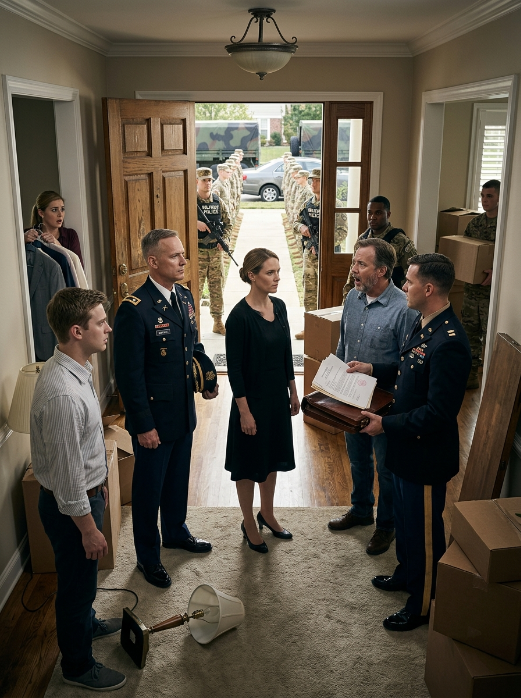
The rear doors of the dark sedan opened first, and Colonel Vance stepped out onto the frosty pavement, wearing his full service dress uniform with the polished brass buttons catching the pale yellow winter sun. Behind him came Captain Miller, the battalion legal officer, carrying a thick black leather briefcase with the JAG insignia stamped in gold leaf near the clasp. From the two transport trucks parked behind them, eight armed military police soldiers in crisp duty uniforms and polished combat boots stepped down onto the asphalt, falling into two silent, perfectly straight lines along my front walk without a single shouted order.
My family stood completely frozen in the middle of the living room, their bodies stiff as fence posts as the heavy, rhythmic sound of military boots mounted the front porch steps with calculated precision.
A firm, measured knock echoed through the solid oak front door, three distinct raps that vibrated straight through the floorboards under my feet.
I walked past my father, past my mother, and past Chad, who was still holding my desk lamp as if it were a shield against an oncoming bayonet charge. I reached out, unlocked the heavy brass deadbolt with a single smooth turn of my wrist, and pulled the door open wide enough to let the cold Colorado wind sweep into the hallway.
Colonel Vance pulled off his service cover, held it tucked neatly under his left arm, and came to an immaculate, rigid position of attention on my welcome mat.
Permission to enter, Major Mercer? he asked, his voice carrying that gravelly battalion-commander resonance that filled the entire open-plan house from front door to back patio.
Behind me, I heard my father swallow so hard the sound was audible over the hum of the refrigerator. Major? my father whispered, his voice cracking slightly on the second syllable.
Permission granted, Colonel, I replied clearly, my chin up and my eyes fixed on the silver oak leaves pinned to his shoulders. Thank you for arriving precisely on time.
Colonel Vance stepped across the threshold into the entryway, followed by Captain Miller and the two armed MPs who immediately took up position on either side of the front door, their gloved hands resting casually but purposefully near their utility belts.
Major, Colonel Vance said, letting his eyes sweep the chaotic interior of the house, noting the stack of wardrobe boxes by the coat rack, my bedside lamp sitting near the front entry where my father had dropped it, and my sister holding my dry-cleaned suits like a trophy. We are here to complete the official inventory of late Captain Mercer’s personal service records and execute your housing security protection protocol per your verbal request logged at 0729 hours.
My mother stepped out from the kitchen, her face gone the color of skim milk, her hands clutching her apron as if she were trying to tear the cloth in half. Wait a minute. Who are you people? You can’t just march into a private home like this! Julie is not a Major; she works in some kind of base office administration, she’s just a girl!
Colonel Vance slowly turned his gaze toward my mother, his face settling into that flat, expressionless mask that junior officers learned to fear during their first week at company command school.
Ma’am, Major Julie Mercer is the Battalion Logistics Executive Officer for the 4th Infantry Division stationed right here at Fort Carson, he said, his tone as cold and level as a block of winter ice. She outranks nearly every field-grade officer on this installation, and she is the sole legal homeowner of record for this property under federal and state military housing statutes.
Captain Miller snapped open his black leather briefcase, pulled out a stack of heavy, cream-colored legal documents bearing the red seal of the El Paso County court system, and stepped past my mother toward my father and Chad.
I have here the warranty deed registered with the county recorder’s office three weeks after the closing date, Captain Miller stated, his voice ringing through the room with the dry rattle of a courtroom clerk. Sole ownership belongs exclusively and unconditionally to Major Julie Mercer. I also have the active Military Protective Order and official Trespass Warning filings executed through base provost marshal headquarters and local municipal law enforcement, identifying these premises as a restricted private residence under military command authority.
Chad’s face drained of whatever color it had left, and the desk lamp slipped from his fingers, hitting the Persian rug with a dull, muffled thump that sounded remarkably small in the silence. Trespass warnings? We’re her family! We drove twelve hundred hours to help her move her stuff!
You are unauthorized civilian occupants currently interfering with an active-duty military officer’s official residence during a period of command-sanctioned bereavement leave, Captain Miller said, his voice completely devoid of human sympathy. Major Mercer logged a formal command complaint forty-five minutes ago stating that her household was being forcibly altered, her property removed, and her occupancy rights violated without her written consent.
My father looked at me, his mouth opening and closing like a landed trout trying to find water in the dust. Julie… you called the military police on your own flesh and blood? On Thanksgiving morning?
I asked you to put my furniture back at 7:26 AM, I said, taking two steps toward him until he had to look up to meet my eyes. You laughed in my face. You assumed that because Graham died, I was helpless, alone, and easily pushed around in my own home because you remembered me as the girl who couldn’t balance a checkbook at twenty. You thought my uniform didn’t count for anything once I took it off to have a baby.
Colonel Vance didn’t wait for them to process the words; he jerked his chin toward the back hallway with a crisp, economical motion.
Soldiers, Vance commanded sharply, his voice dropping into the register that meant business. Return all of the Major’s personal items from the garage back into her master suite immediately. Handle her belongings with total care and log every single piece as it crosses the threshold.
Six young soldiers moved with the smooth, terrifying efficiency of a well-drilled loading detail, slipping past my family into the garage and beginning the process of carrying my lamps, my clothes, my books, and my nightstands back into the house. They didn’t look at Chloe, who had pressed her back against the hallway wall as if she were trying to melt into the drywall, and they didn’t acknowledge my mother, who had finally started to cry in dry, choked gasps near the pantry door.
As for the rest of you, Colonel Vance said, turning back to face my parents, Chloe, and Chad with a look of undisguised disgust. You have exactly fifteen minutes to gather your personal luggage from the guest rooms and clear these premises entirely. If you remain on this property past 0745 hours, military police and Colorado Springs sheriff’s deputies will escort you directly to the county detention facility for unlawful entry, harassment of a service member, and interference with military administration.
By 8:15 AM, the street outside was so quiet you could hear the wind whistling through the dry stalks of the neighbor’s garden across the street. My family had loaded their suitcases and plastic totes into the bed of my father’s Ford pickup truck in absolute, terrified silence, not daring to utter a single word while two armed military police officers stood at the edge of the frosty driveway watching their every move with their thumbs hooked into their pistol belts. Chad had jammed the truck into reverse so violently his tires spun on the patches of ice near the curb, kicking up gravel and black tire smoke before tearing away down the mountain road without a single backward glance.
The soldiers had restored every single piece of my furniture to its exact place in my master bedroom, wiping down the wood with clean rags and making sure my clothes were hanging back in the closet in order of color and season. My bedside lamp sat on my nightstand once more, its small brass switch catching the morning light that filtered through the window, illuminating the framed photograph of Graham and me laughing on a bench in Manitou Springs during our last four-day pass before the battalion rotation began.
Colonel Vance stood in my kitchen before heading back to his vehicle, holding a heavy ceramic mug of coffee I had poured for him while the last of the transport trucks finished turning around in the cul-de-sac.
You handled that with tremendous operational discipline, Major, he said gently, his military sternness dissolving into the warm, lined face of an old friend who had known Graham since they were lieutenants together at Fort Benning. Graham would have been immensely proud of the way you held the line today.
Thank you, sir, I said quietly, wrapping my hands around my own mug to draw the heat into my skin. I just needed my home back where it belonged.
Your unit is behind you every step of the way, Mercer, Vance said, setting his cup down in the sink and settling his service cover back onto his head with a smooth, practiced motion. You take all the time you need for yourself and that little one on the way. We look after our own, and nobody gets to treat one of our majors like dirt while her boots are still drying.
After the military convoy rumbled down the hill and out of sight behind the stand of pine trees, I walked to the front door, turned the deadbolt until the heavy brass clicked into the frame, and walked back into the quiet center of the house. The air smelled of clean linen and fresh coffee, completely free of the sour, rancid smell of entitlement and old family grudges that had choked the hallways for the last forty-eight hours. There were no raised voices, no demand for space, no entitled chatter, and no greed cluttering my floorboards.
I walked over to the sliding glass door in the dining room and pulled the heavy curtains all the way back, letting the cold Colorado sun pour across the granite counters and the hardwood floors until every corner of the room was bright and sharp. Outside in the backyard, the frost was finally beginning to melt from the tips of the grass, turning the lawn into a patchwork of silver and green under the bright blue sky.
I stood there in the absolute, beautiful silence of my own house, placing one hand flat against the side of my belly where the skin was stretched tight and warm. Beneath my palm, I felt a strong, rhythmic movement, a steady, pulsing reassurance from the life growing inside me that needed no permission from anyone to take up space.
Outside, a sudden gust of mountain wind caught the bare branches of the young red maple tree Graham had planted by the porch rail, making the dark wood sway and bend with an elastic, stubborn strength that refused to snap. The red leaves were gone for the winter, buried deep under the mulch and the cold earth, but the trunk was thick, straight, and rooted deep into the soil where it belonged.
I took a long, clean breath of the mountain air through the cracked patio door, held my baby close against my ribs, and realized with a quiet, certain clarity that the winter had finally broken.