How My Husband Tried to Serve Me Divorce Papers on Our 25th Anniversary and Met Our Server Clara

The smell of raw beef and hot white truffle oil always hung heavy in the back booths of The Oak Room, a rich, iron-smelling grease that somehow cost eighty-five dollars an entrée downtown. I remember the exact weight of the heavy linen napkin on my knees, stiff enough to scratch if I moved too fast, and the small brass table lamp that cast a yellow circle right over Richard’s right hand. It was seven o’clock on a Tuesday evening, twenty-five years to the day since we stood in a windblown gazebo outside Des Moines while my cousin Jerry fumbled with a rented video camera.
Richard had made the reservation three weeks in advance, making sure to ask for Booth Four because the high leather back kept out the draft from the swinging kitchen doors. I spent an hour with the curling iron that afternoon, turning my graying curls into something that looked halfway decent in the mirror, wearing the navy dress he bought me two birthdays ago when we still pretended to like each other’s gifts. I had spent the last twelve months convincing myself that the silence across our breakfast island was just normal middle-age fatigue, the quiet settling of a house where the mortgage was finally paid off and the kids had long since stopped calling except to ask if we still had their winter boxes in the garage. He looked tired across from me, his shoulders slightly rounded inside his tailored charcoal blazer, and I felt that old, stupid stitch of pity in my chest that always made me want to reach across the white cloth and smooth down his collar.
The lead server brought over a bottle of 2018 Cabernet without asking us to taste it, because Richard had been coming here with his firm’s junior partners long enough that the staff knew which label he liked before he even sat down. Richard did not pick up his glass to toast our silver anniversary, which should have told me everything I needed to know, but instead he waited until the young man in the black vest set down our plates of dry-aged strip and moved back into the shadows of the walnut-paneled room. He leaned his elbows on the linen, square and heavy, and looked straight into my eyes without a single blink, the way he used to look across the conference table when he was about to tell a client why their fourth-quarter projections were short by three hundred thousand dollars. “Nora,” he said, his voice flat and perfectly controlled, sounding like he was reading the agenda from an executive committee meeting. “I am not going home with you tonight.
I’m moving into my own place, and I want to keep this simple.” The Oak Room hummed around us with the soft clink of silver against bone china and the low murmur of men in expensive suits talking about mergers, but my ears felt like they had been stuffed with wet cotton. I looked down at my plate, where the parsley garnish looked entirely too green against the dark crust of the meat, unable to process the words coming out of the mouth of the man I had shared a medicine cabinet and a tax return with since I was twenty-seven years old.
“Richard,” I managed, my throat tightening up so fast I could barely push the syllables past my teeth. “What are you talking about? It’s our anniversary.” That’s why I brought you here, he said smoothly, his tone not even wavering by a fraction of a note. He glanced briefly toward a table of older couples near the front windows, knowing I would never cause a scene in a dining room full of downtown lawyers and bank presidents, because my mother had beaten it into my head from the time I was six that a lady never makes a public spectacle of her own misery.
He was counting on my manners to keep me pinned to that leather bench while he dropped the bomb. “I wanted to give you the news in a public setting so we could handle it like two rational adults,” he continued, as if he were explaining a sensible relocation policy to a department head. “I’ve already packed my essential bags. They’re in the trunk of the sedan. I’ll take the car, and you can call a cab.” He picked up his heavy silver-plated fork and cut into his steak with an easy, practiced motion, exactly as if he had just delivered a routine quarterly summary about office supply budgets. He actually expected me to nod, swallow my tears, and surrender twenty-five years of my life before the bread basket was even cold.
Before I could find my breath to tell him he was out of his mind, our server stepped quietly beside our booth to refill my water glass, her movements practiced and entirely unhurried. Her name tag caught the yellow light from the table lamp, showing the engraved name Clara in neat silver letters above a small gold star for twenty years of service. Her hair was silver-streaked and pulled back into a tight bun that didn’t have a single strand out of place, and her eyes lingered on Richard for a fraction of a second with a sharp, guarded look that had seen about ten thousand messy downtown breakups across these very tables. As she reached across the linen to adjust my side plate, her fingers moved with deliberate, surprising precision, pressing a small, tightly folded piece of paper directly beneath the heavy rim of my bread plate where Richard’s line of sight was blocked by the water goblet. Clara walked away without saying a single word, her black shoes making no sound at all on the thick Persian carpet, leaving me staring at the small white square hidden just inches from my thumb while Richard went right on talking about the division of our mutual funds like he was reciting a grocery list.
Richard was busy chewing his meat, entirely unaware of what had just passed between my bread plate and the server’s apron pocket, taking a slow sip of his Cabernet and wiping his mouth with his linen napkin with that infuriating little flick of his wrist. “I have the paperwork drafted,” he said, keeping his tone measured and reasonable, the voice of a man who had consulted three different family law specialists before he ever bought the anniversary dinner. “We can sell the house next spring and split the equity after fees, or you can buy me out if you can swing the mortgage on your own. There’s no reason to make this messy, Nora. We’re civilized people.” My hand was trembling so hard the water in my glass was rippling against the rim, but I forced myself to rest my fingers flat on the edge of the bread plate, feeling the small, hard lump of folded paper against my knuckles. I slipped the note down into my lap with a slow, clumsy motion, keeping my eyes fixed on Richard’s face so he wouldn’t notice the sudden, sick heat rising up the back of my neck. “Civilized,” I repeated, the word tasting like tin in my mouth. Yes, he said, nodding once as if confirming a minor inventory check. People grow apart. It happens.
Under the edge of the heavy tablecloth, where the dim light from the chandelier barely reached, I unfolded the paper with my thumbs, my fingernails clicking slightly against the cheap stock. It was not a restaurant receipt or a note pad from the kitchen; it was a handwritten message jotted down in blue ballpoint on the back of a duplicate merchant copy of a credit card slip. The handwriting was neat, hurried, and sharp, written by someone who had clearly taken no chances with the spelling: He was sitting at this exact table on Thursday night with Evelyn from his firm. He ran your joint card for $1,420 and bragged about blindsiding you tonight so you wouldn’t hire a lawyer. Check your account alerts. Don’t sign anything he gives you. Beneath the note was the attached merchant slip itself, the carbon paper slightly faded around the edges. The date was two nights ago, right in the middle of what he told me was a late budget review with the regional partners.
The time was 8:42 PM. The card number matched the final four digits of our joint family checking account down to the letter, and the total charge was exactly $1,420.00, right down to the zero tip he must have left because he was probably too busy whispering across the corner of the booth to care about the service.
My mind instantly flashed back to Thursday evening, like a slide projector clicking through a roll of film I hadn’t wanted to see. I had been standing in the laundry room folding warm cotton pillowcases from the dryer when my phone gave that short, dry chime of a bank notification in my apron pocket. When I looked down at the screen, it said $1,420 at The Oak Room, and my heart had given a small, stupid flutter because I thought maybe he was planning something special for our anniversary three days early. When I asked him about it later that night while he was sitting at the kitchen island checking his email, he had kissed my forehead right where my hair was starting to thin, claimed he had taken three prospective corporate clients out for dinner to close the Henderson account, and told me not to worry about the balance because it would be fully reimbursed on his next monthly expense report.
I had believed him without a second thought, because after twenty-five years you stop looking for the lie in the way a man smells like laundry detergent and peppermint gum when he walks through the back door. I had folded his shirts and put them in the drawer and thanked God we had enough in the savings account to cover a high-end business dinner in the middle of the week.
I looked up from the note in my lap, and Richard was already looking at his watch, a heavy gold Omega I had bought him for our twentieth using the bonus from my inheritance after my father passed away. “Look, Nora,” he said, leaning forward across the linen with that terrible, condescending patience he used when he was explaining a contract clause to a stubborn client. “Take the weekend to think about it. I have a temporary rental lined up near the river. We don’t need to involve third parties. If we start hiring lawyers, they’ll just drain our savings on retainers.” He wasn’t trying to spare my feelings or make the transition easier; he was trying to lock down the paperwork before I realized he had been funneling our marital funds into a separate life for the last six months. He had rehearsed this entire speech forty-eight hours ago over expensive wine with Evelyn in this very booth, using our joint money to practice how he was going to discard me like an old winter coat before the weather even turned. The shock that had paralyzed my fingers moments earlier cleared away like fog burning off the river, leaving behind a calm, heavy certainty that felt cold and solid in my chest.
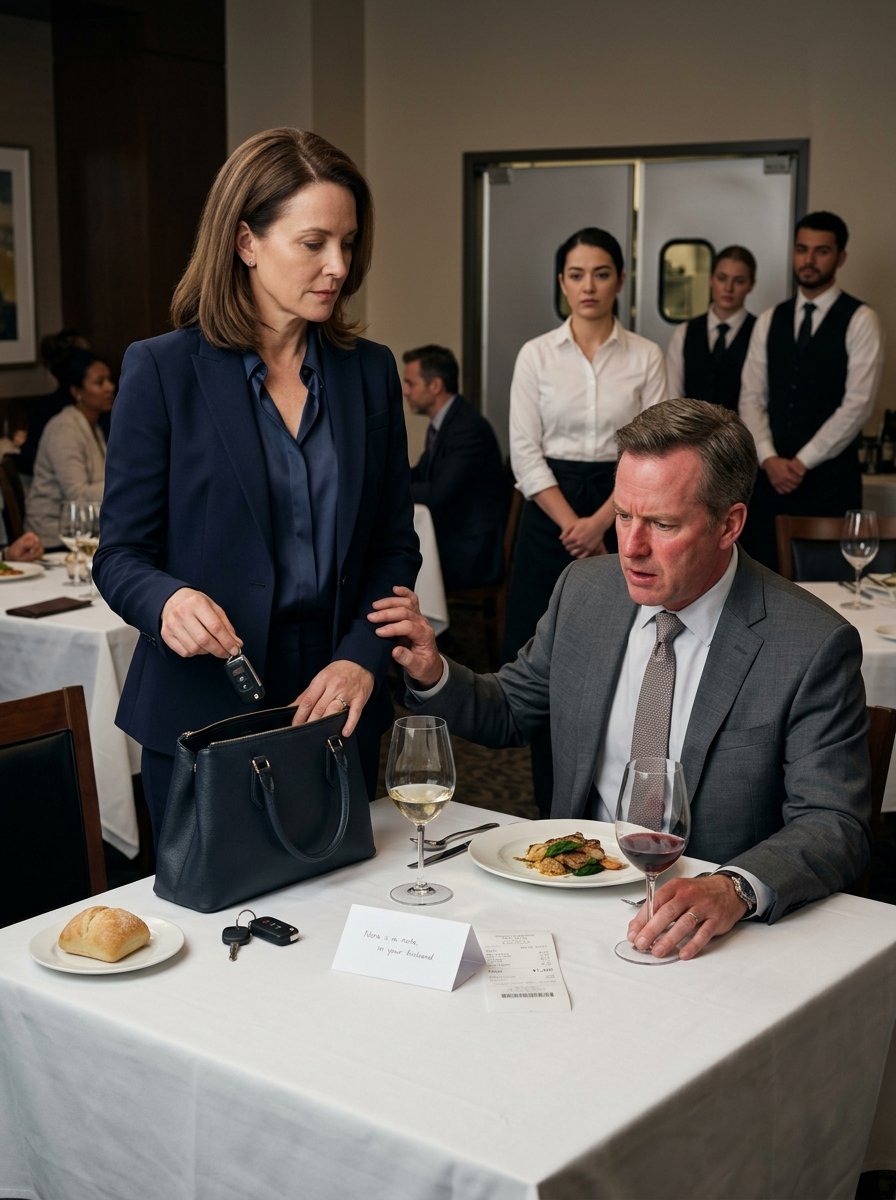
I didn’t yell, and I didn’t knock over my water glass or make a scene that would give the older couples at the front tables anything to gossip about over their coffee. I simply set the folded note and the $1,420 receipt right in the center of the white tablecloth, right between his wine glass and the untouched half of his strip steak, smoothing the paper out with two fingers so he couldn’t miss a single word of Clara’s handwriting. Richard glanced down at the paper, his expression hardening instantly into irritation at the interruption, but as his eyes registered the printed card slip and the sharp blue ink, the smug confidence drained entirely from his posture until he looked about ten years older than he had ten minutes ago. “Where did you get this?” he whispered, his voice losing its polished executive edge and dropping down into something thin and panicked that didn’t carry past the salt and pepper shakers. “Clara remembered you,” I said evenly, keeping my voice lower than his so he had to lean in to hear the truth. “She remembered you and Evelyn sitting at this exact table on Thursday night. She remembered you spending $1,420 of our joint money to rehearse how you were going to throw away twenty-five years of my life.”
Richard looked wildly toward the server station near the kitchen doors, but Clara was standing right there under the brass wall sconce, watching him with calm, unmistakable disapproval that didn’t waver when his eyes found hers. Two other waitstaff members stood nearby beside the ice machine, their attention locked on our table with that heavy, collective silence that only restaurant people can manage when they smell blood in the water. The public setting Richard had chosen to trap me in had turned completely against him, because in a place like The Oak Room, the people who carry the trays remember who tips five dollars and who treats their girlfriends better than their wives. “Nora, keep your voice down,” he hissed, glancing around nervously at the nearest booth where a man in a gray suit was buttering a roll. “Let’s go outside and talk about this in the parking lot.” We aren’t going anywhere together, I said, pushing my chair back just enough to let the wooden legs scrape against the carpet with a sharp, definite sound. I reached across the table, picked up the electronic key fob to our gray sedan that he had casually set next to his bread plate, and dropped it straight down into my leather handbag with a heavy thud.
You said your bags are already packed in the trunk, I said, standing up from the booth and looking down at him from my full height while he sat there blinking like an owl caught in a car headlight. I’ll leave them on the front porch by nine o’clock tonight so you don’t have to worry about where you’re sleeping. If you set foot inside the house before my attorney contacts you on Monday morning, I will call the county sheriff and have you removed for trespassing. Nora, you can’t just take the car and leave me stranded here in the middle of downtown, he muttered, his face turning a dull, mottled red as he reached out a desperate hand to grab for my wrist across the table. I stepped back out of his reach before his fingers could even brush my sleeve, keeping my chin up the way my mother taught me when things got ugly. You planned this dinner, Richard, I said, looking right down into his frightened, small eyes. You pay for the steak.
I walked through the center of the dining room without rushing a single step, my heels clicking a steady rhythm against the hardwood floor between the tables where people were pretending not to watch the drama unfold. Clara met my eyes as I passed the host stand near the heavy oak front doors, her expression as neutral as a stone monument, but as I drew level with her station she gave me a brief, firm nod of solidarity that told me everything I needed to know about women who work for a living. I paused long enough to reach into my bag, pull out a fifty-dollar bill, and press it firmly into her hand for the water service and the truth that saved me six months of legal guessing. The night air outside on the downtown sidewalk was cool and quiet, smelling of exhaust fumes and damp pavement from an earlier drizzle, and for the first time in a year my lungs felt like they were taking in actual oxygen instead of dust.
I walked to our sedan parked in the gravel lot behind the restaurant, unlocked the doors with a single click, and climbed up behind the steering wheel where my hands didn’t even shake when I put the key into the ignition. I took off my silver anniversary band, the simple flat band I had worn through twenty-five years of mortgages and hospital visits and Sunday dinners, and dropped it right into the plastic cup holder beside the gear shift. I didn’t turn back to look at the glowing windows of The Oak Room or wonder how Richard was going to explain his bill to the manager without his car keys. I put the car in reverse, backed out of the space with a smooth turn of the wheel, and drove home through the dark streets to lock my front door from the inside.