How My Late Brother’s Forged Will Met the Harbor Master Logbook and Protected Our Six Hundred and Fifty Thousand Dollar Wharf

The cold paper cup of church coffee had gone completely flat in my hand by the time Brenda walked up behind me near the coat rack. The reception hall smelled of damp wool, funeral lilies, and cheap instant coffee that had been sitting on the hotplate for hours. Thomas had been dead for less than four days, his heart giving out suddenly on the deck of his skiff at forty-six years old, and I was still walking through the hours like I was wading through deep river silt.
We had run Miller & Sons Commercial Wharf together since our father passed away, carrying on three generations of hauling fish, tying down barges, and keeping the cedar pilings steady against the tide. The wharf was worth $650,000 on paper, but to us, it was simply where we lived and worked, the place where our boots wore down the same gray planks year after year.
Brenda was Thomas’s ex-wife, though they had been divorced for three years after a bitter separation that nearly drained Thomas’s savings down to the bedrock. She ran a sagging, four-room bed-and-breakfast up on the ridge, a place that was constantly one bad summer away from public auction and tax sales. She hadn’t come to the hospital when Thomas was brought in, and she hadn’t called our house to say she was sorry when the coroner’s van pulled away from the slip. But here she was at the wake, wearing a black trench coat that looked brand new and a look of tight, nervous energy that didn’t match the room at all.
She didn’t offer a hug or even pretend to be sad about my loss. Instead, she leaned in close, pulled a folded piece of heavy ivory paper from her leather purse, and pressed it hard against my chest.
“You need to see this,” Brenda whispered, her voice too sharp and bright for the quiet church hall. “Thomas came by the inn two weeks ago to talk. He wanted to make things right between us after everything that happened. He signed this in front of a notary right at my kitchen table.” I unpicked the heavy paper with cold, stiff fingers, feeling the rough texture of the stationery. It was a handwritten codicil to Thomas’s will, single-spaced and typed out with clean margins. It stated that in light of past financial obligations and unsettled matters from their divorce, Thomas was transferring his full fifty percent share of Miller & Sons Commercial Wharf directly to Brenda upon his death, giving her total operational control and sole property rights.
“This is crazy, Brenda,” I said, my voice shaking so hard the paper rattled between us. “Thomas would never give up the wharf. Our father built those docks with his own hands. My own sweat is soaked into every single one of those planks.” She didn’t flinch at my anger, just tapped the bottom of the page with a manicured fingernail like she was pointing out an item on a menu. “It’s signed and notarized,” she said, her tone flat and businesslike. “Look at the date right there. Tuesday, October 14th at 2:00 PM. He was at my place for lunch. He knew I needed security, and he felt guilty about how bad the divorce settlement left me.”
I stared down at the paper, reading the lines while the noise of the reception faded into a dull hum in my ears. At the bottom, next to a smudged purple notary seal, was Thomas’s signature written in bright, fresh blue ballpoint ink that hadn’t faded at all.
My first instinct was to cause a scene right there among the folding chairs and flower arrangements, to demand how she could bring real estate papers to her ex-husband’s memorial while his body was barely cold in the ground. But the grief was sitting heavy in my throat like a stone, and I had always hated public conflict. I didn’t want to make a circus out of Thomas’s final memory in front of our neighbors and the people who had known our family for decades. So I swallowed my rage, folded the paper back up, and slipped it into my suit jacket pocket.
Brenda gave a tight, satisfied smile that didn’t reach her eyes. “I’m having a commercial loan officer visit the docks on Friday morning to appraise the collateral,” she said softly, leaning in just enough for me to smell her expensive perfume. “I suggest you have his office cleared out by then so Mr. Vance doesn’t have to step over your old paperwork.” She turned on her heel and walked out the heavy double doors into the cold rain without looking back once. I stood alone by the coat rack for a long time, my heart pounding hard against my ribs. I pulled the document back out of my pocket and looked at that date line again, tracing the numbers with my thumb: Tuesday, October 14th, 2:00 PM.
A cold spot formed in the very center of my stomach, spreading out until my hands felt numb. October 14th wasn’t just some random Tuesday two weeks ago. It was the afternoon a sudden, violent nor’easter blew out the support beams on Dock 3 and sent three municipal fishing boats careening toward the sea wall. I remembered that afternoon with absolute clarity because the tide had surged four feet above flood stage, and Thomas and I had spent six straight hours knee-deep in freezing salt water trying to secure the hydraulic winches. There was no physical way Thomas was eating lunch at Brenda’s bed-and-breakfast up on the ridge at two o’clock on October 14th.
I left the reception hall thirty minutes later without saying goodbye to anyone, slipping out the side door while people were busy talking over coffee and ham sandwiches. The rain was coming down hard as I drove the two miles down the coastal route to the harbor, the windshield wipers slapping rhythmic, desperate lines across the glass. The commercial harbor was dark except for the yellow safety lights glowing along the pier like stubborn little fires against the gray soup of the evening. I parked near the gate, pulled my rain jacket over my suit, and walked past the stacks of wet lobster traps toward the small weathered building at the end of the main pier where the harbor master kept watch.
Harbor Master Captain Frank Miller was inside, sitting behind his iron desk with a steaming mug of black tea, listening to the low, rhythmic crackle of the marine radio. Frank had managed the harbor traffic for thirty years, ever since our father was running the town council. He had known us since we were kids scraping barnacles off skiffs for pocket change, and he knew every bolt and piling on the property. “You ought to be home resting, kid,” Frank said softly, looking up over his wire-rimmed reading glasses with tired eyes. “It was a nice service for Thomas today. The whole town showed up to pay their respects.”
“Frank,” I said, stepping into the warm room and shutting the heavy wooden door hard against the wind. “I need to see the logbook for Tuesday, October 14th.” Frank frowned, setting his tea down on a stack of charts. “October 14th? The day of the big gale warning?” “Yes,” I said, leaning over the edge of his desk. “I need to know exactly where Thomas was between noon and four o’clock that day.” Frank didn’t ask questions or make jokes; he saw my face and knew something was wrong. He reached behind his desk, unlocked a heavy steel cabinet with a brass key, and pulled out the leather-bound Harbor Master Logbook. It was a massive, brass-bound ledger where every commercial vessel movement, emergency call, and municipal work crew assignment was recorded by hand and stamped with official harbor coordinates.
Frank flipped the thick cream pages back to October 14th, his calloused thumb running down the entry column until he found the right section. “Here it is,” Frank said, pointing to the dark ink entries made in his own hand. “Gale warning issued at 10:30 AM. At 11:15 AM, Dock 3 started losing structural stability on the north piling because of the storm surge. I called in Harbor Barge 4 for emergency underwater pile driving right away.” “Who was on Barge 4?” I asked, my voice dropping lower. Frank pulled a secondary radio transponder sheet from the back of the binder and smoothed it out. “Thomas was piloting Barge 4. He was at sea miles out in the main channel from 11:00 AM straight through until 6:00 PM. He had three Coast Guard officers aboard helping secure the municipal heavy rig against the swell.”
Frank pointed to three formal blue Coast Guard stamps inked across the margin, complete with official time logs and officer identification numbers. At 2:00 PM on October 14th, Harbor Barge 4 was anchored three miles off the point, fighting six-foot seas while Thomas operated the hydraulic driver against the howling wind. “He never left the water that whole afternoon,” Frank said firmly, tapping the logbook page. “He couldn’t have. If he had stepped off that barge, the municipal rig would have listed and smashed the sea wall to pieces. I signed his hours myself at sunset when they brought the barge back in.” I pulled Brenda’s folded paper from my coat pocket and laid it flat on the desk next to the leather ledger. Frank leaned down, reading the notary line where Brenda claimed Thomas had sat at her kitchen table in town at 2:00 PM signing over a $650,000 property.
“This is forged,” Frank said, his voice dropping into a hard, dangerous register that made the hair on my arms stand up. “And whoever wrote this didn’t bother to check municipal sea records or talk to anyone who was actually at the harbor that day.” “She has an appraiser coming to the docks on Friday morning,” I said, staring at the blue ink signature. “She’s trying to use the wharf as heavy commercial collateral to save her bed-and-breakfast from foreclosure.” Frank picked up his desk telephone and dialed a four-digit internal extension without hesitation. “Not on my watch she isn’t. I’m calling Chief Bradley at the harbor precinct right now. We’ll have certified copies of this logbook and the Coast Guard transponder logs printed before midnight.”
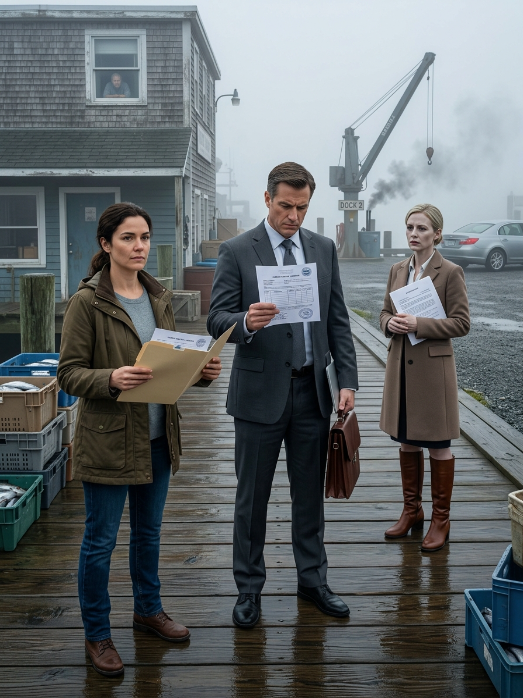
By nine o’clock on Friday morning, the rain had finally stopped, leaving a heavy ocean fog clinging to the cedar planks of the wharf like a damp gray blanket. I was sitting in Thomas’s old office above the bait shop, looking down through the salt-crusted window at the harbor entrance. On the desk in front of me sat a sealed Manila folder containing certified copies of the municipal logbook, the Coast Guard transponder stamps, and a formal police incident report for probate fraud signed by Chief Bradley himself. At 9:15 AM, Brenda’s silver sedan pulled onto the gravel lot at the foot of the pier, kicking up small stones as she parked near the gate.
She stepped out wearing polished leather boots and a tailored coat that looked entirely out of place among the diesel smoke and stacked fish crates. A tall man in a dark grey suit followed her out of the car, carrying a leather briefcase and an iPad under his arm. It was her bank loan appraiser, come to size up our livelihood to pay for her failing inn. Brenda walked up the wooden ramp with her chin up, pointing out the diesel fuel tanks and the commercial crane near Dock 2 as if she already owned every nail in the wood. I stood up, picked up the folder, and walked down the creaking wooden stairs to meet them on the pier before they reached the office.
“Clara,” Brenda said, stopping ten feet away. She didn’t expect me to be waiting there, but she quickly pulled her composure back together into a tight mask. “I told you to clear out Thomas’s personal belongings. Mr. Vance here is from Regional Commercial Credit. He’s conducting a formal collateral survey on my fifty percent share of the property.” The appraiser nodded politely to me, offering a professional smile. “Good morning. We’re verifying property boundaries and physical assets for a commercial debt consolidation loan.” “Mr. Vance,” I said, keeping my voice quiet and steady against the sound of the gulls. “Before you walk any further down these planks, you should read what is in this envelope.”
Brenda’s eyes narrowed into sharp slits. “Don’t listen to her, Mr. Vance. My sister-in-law is grieving and emotional, and she’s trying to make trouble. I have the signed and notarized codicil right here in my bag.” “Show him the date on your document, Brenda,” I said, stepping closer until I could see the nervous twitch in her jaw. “Tell him the exact hour Thomas allegedly signed away a $650,000 commercial wharf.” Brenda pulled the paper out of her leather bag, holding it up defensively like a shield. “Tuesday, October 14th at 2:00 PM. Signed and sealed by a registered notary.” I opened my Manila folder and handed a single printed sheet directly to the loan appraiser without breaking eye contact with Brenda.
“That sheet is a certified copy of the Harbor Master Official Logbook,” I told the appraiser, watching his eyes scan the text. “On October 14th at 2:00 PM, Thomas was three miles offshore on Harbor Barge 4, assisting the United States Coast Guard during an emergency gale response. He was on the water for seven continuous hours. His presence is verified by three Coast Guard officers, radio transponder pings, and municipal payroll logs.” The appraiser looked down at the paper in his hands, his professional smile vanishing instantly. His eyes moved across the official Coast Guard stamps and the municipal seal, reading the details twice before looking up at Brenda.
Brenda’s face drained of color until she looked almost as gray as the morning fog. “That… that’s an administrative error. He must have misremembered the exact day, or the logbook has a typo…” “The notary seal on your paper is dated October 14th,” I said, looking her straight in the eyes with a coldness I didn’t know I had in me. “You forged his name on a blank notary form you had left over from your marriage, or you found a crooked notary to sign off on a lie because your bed-and-breakfast faces judicial foreclosure in forty-eight hours. Chief Bradley from the harbor precinct has already opened a criminal investigation for felony probate forgery.”
The appraiser immediately snapped his iPad shut with a sharp click and slid it into his briefcase. He turned to Brenda, his face cold and professional. “Mrs. Miller,” the appraiser said crisply. “Regional Commercial Credit is terminating this assessment effective immediately. Attempting to pledge fraudulent collateral on a commercial loan application is a federal offense, and our legal department will be notified by ten o’clock this morning.” He turned on his heel and walked briskly back down the pier toward his car, leaving his tires to crunch loudly on the gravel as he sped away from the wharf.
Brenda stood alone on the wet planks, her polished leather boots coated in fish oil and sea salt. Her hands were shaking so hard she dropped her purse onto the damp wood, spilling her papers across the pier as the wind caught them. “Clara, please,” she gasped, her voice cracking as the reality of her situation collapsed around her like a rotten piling. “I was desperate. The bank is taking the inn next week. I spent everything I had trying to keep the roof on that place. Thomas owed me… he owed me a life after everything that happened between us.”
“Thomas didn’t owe you anything,” I said softly, looking down at her without a trace of anger left in my chest, only a deep, cold clarity that felt like winter air. “And you don’t get to rob his memory to pay for your mistakes.” Two harbor precinct patrol cars pulled onto the gravel lot at the end of the pier, their tires rolling slowly past Brenda’s parked sedan with the blue lights dark on the roof. Officer Miller got out of the lead cruiser and walked up the ramp toward us, his boots heavy on the wood. Brenda didn’t run or try to argue anymore; she simply stood there as Officer Miller asked her to step down toward the cars to answer questions regarding the forged document in her purse.
I watched her walk down the ramp until she was taken away and the cruisers turned around and headed back up the coastal road. I turned and walked back into the harbor master’s office where Frank was standing by the window, holding a hot pot of coffee. He didn’t say a word about what had just happened; he just handed me a clean ceramic mug and gave my shoulder a gentle squeeze before stepping outside to let me be alone with my thoughts. I sat down at Thomas’s old desk, the wood worn smooth by years of his elbows resting there while he checked the tide charts. I opened the heavy brass drawer, pulled out our family’s business ledger, and turned to the section marked Property Ownership.
Using a fresh pen, I recorded the date and noted for the record that the entire $650,000 commercial wharf asset remained fully secured under the Miller Family Trust, untouched and protected for the future we had built. I walked back out onto the high deck of Dock 1 as the fog finally lifted over the water, revealing the deep blue of the main channel and the calm swell breaking against the pilings. I took a deep breath of the cold, salty air, listening to the gulls calling over the harbor, knowing that my brother’s memory was safe at last, his work was honored, and the legacy we built together was finally at peace.