How I Sent My Mother Three Thousand Dollars Every Month for Childcare and Met Her Kitchen Confession

The smell of hot red clay and wet pine timber has stayed in the back of my throat ever since I worked those twin foundations downtown, a dry, gritty taste that comes back every time I think about how stupid I was. I used to think hard work was a shield. I figured if I just poured enough hours into the forms and stayed late enough to watch the concrete trucks wash out their drums, nothing could touch the people waiting for me on the other side of town.
I was wrong about that. I was wrong right from the start because I trusted the ink on a wire transfer slip instead of looking at the way my wife’s shoulders had started to curve inward over the crib.
It was Saturday, and Frederick was turning one year old. The commercial build on Church Street had wrapped up its pour ahead of schedule, so the project manager told the crew to clear out by noon. I had a red tin toy wagon strapped into the bed of my Dodge alongside a wooden puzzle we bought off an artisan up in Gallatin. Amy had been running on fumes for six straight months, looking smaller in her old denim shirts and keeping track of every single diaper change on a dogeared legal pad she kept behind the toaster. I wanted to walk through the front door three hours early so she could take a real shower, lie down on top of the covers, and just breathe before my family showed up for cake at four.
I pulled up and killed the engine, parking right by the curb instead of backing up our long gravel driveway so I would not block my mother’s Buick. The air was thick with that heavy Tennessee humidity that makes your shirt stick to your spine before you even reach the gate. Walking up our side path toward the backyard patio, I didn’t expect to hear anything except the hum of the cicadas in the privet hedge.
Then my mother’s voice cut right through the leaves.
“She does what I tell her to do,” Teresa said. Her voice had that sharp, ringing snap she always used whenever she was holding court with her sisters down at the parish hall. “If I say jump, Amy asks how high. Connor gives me three thousand dollars every single month to run this household because the girl simply cannot manage a budget. She thinks they’re flat broke. It keeps her humble.”
A couple of my aunts let out that high, thin bray of laughter that always used to make me tighten my jaw when I was a kid.
I stood there by the wooden latch with the red toy wagon under my arm and my boots planted in the dead grass where the shade killed the sod. Teresa had been coming to our house four days a week since Frederick came home from Vanderbilt Hospital. When the engineering firm took on those two commercial builds at the same time last year, the seventy-hour weeks nearly buried me under blueprints and structural change orders. My mother stepped in with what looked like a blessing. She offered to manage the groceries, pay the house utility stubs, and handle the infant care supplies so Amy would not drown while recovering from an emergency delivery that left her in bed for two weeks.
The agreement was supposed to be simple and clean. I set up an automated monthly wire transfer of exactly $3,000 directly from my personal checking account to her credit union ledger every single first of the month. That added up to $36,000 over the past twelve months while I was breaking my back on rebar and grade beams. In exchange, Teresa was supposed to buy the organic formula from the specialty market, stock our pantry with real food, cover the cleaning supplies, and help Amy watch Frederick during the daylight hours so my wife could sleep for more than three hours at a stretch.
Instead, when I pushed the back screen door open and stepped into our kitchen, I saw no catering platters, no party trays from the deli down on West End, and no mother holding a baby.
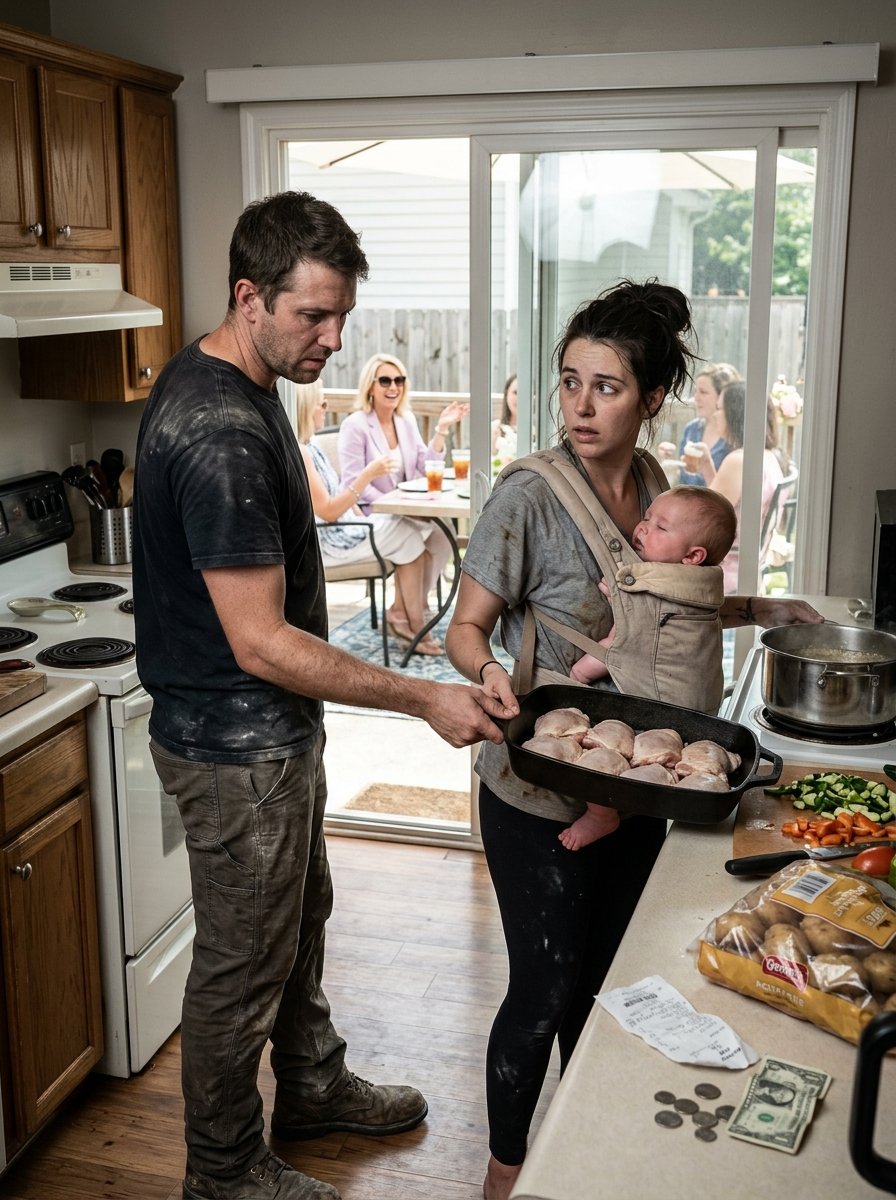
Amy was standing by the stove in an old washed-out cotton shirt with grease stains across the hem. Frederick was strapped to her chest in a gray fabric carrier, his small face flushed bright red and his forehead damp with sweat that smelled sour and hot. She was balancing a heavy black iron roasting pan full of twenty cheap chicken thighs with one hand while trying to stir a pot of grey, watery potatoes with the other. Her wrists were shaking so hard I could hear the metal handle of the pot clattering against the burners.
“Connor?” she whispered, nearly dropping the heavy pan onto the tile counter. “You’re not supposed to be home until four. Teresa said you had mandatory overtime on the parking deck.”
I set the wooden puzzle on the table and reached out to take the iron pan from her fingers before she dropped it on her bare feet. “Why are you cooking for twenty people by yourself? Where are the party trays I told Mom to order from the market?”
Amy looked down at the linoleum floor, lifting the hem of her shirt to wipe her forehead with the back of a pale forearm. “We couldn’t afford platters, Connor. Teresa told me things have been tight with your company because of the delays on the bridge project. She said you barely had enough to cover our property taxes this month.”
She reached slowly into the deep pocket of her apron and pulled out a crumpled strip of thermal paper. It was a receipt from the discount grocer off Madison Boulevard. The items listed were small and bleak: cans of store-brand carrot puree, marked-down drumsticks nearing their sell-by date, and generic rice cereal, paid for with fifteen dollars in crumpled one-dollar bills and a handful of loose nickels and dimes.
“I had to dig through our change jar in the closet just to get the baby’s fever medicine yesterday,” Amy said quietly, her voice cracking right in the middle of the sentence. “I didn’t want to bother you at work while you were under so much stress with the inspectors.”
I looked down at that greasy piece of thermal paper, then looked past the kitchen table toward the sliding glass door that led out to our patio. Through the glass, I could see my mother sitting comfortably in a brand-new pastel linen blazer, holding a tall glass of iced tea with mint sprigs while she laughed at something Aunt Clara said.
A cold, heavy certainty settled into the bottom of my stomach like wet lead. For the last six months, every time I came home from a twelve-hour shift with lime dust in my hair, Amy looked smaller, quieter, and more worn down than she had the day before. Whenever I asked her why she looked so pale, she always told me she was just trying her best to save our family money because things were tight. Whenever I walked into the pantry and found nothing on the shelves except bulk beans and generic flour, Teresa told me Amy was just wasteful with meal planning and refused to listen to older women’s advice.
I had trusted my mother because she was my mother. I thought she was protecting our home while I was out building other people’s office towers. I thought the $3,000 leaving my account on the first of every month was turning into milk and diapers and light in our hallway.
“Amy,” I said, unbuckling the gray straps of the baby carrier from her shoulders and lifting Frederick into my arms. “Did you know I have been transferring three thousand dollars to my mother every single month since last August?”
Amy stared at me with her mouth slightly open. No sound came out for several seconds, just a shallow little hitch in her chest.
“Three thousand?” she whispered, her voice dropping so low I almost couldn’t hear it over the refrigerator hum. “Connor, she told me you were taking a fifty percent pay cut to keep your crew from getting laid off. She told me you were too proud to look me in the eye and tell me. Every time a power bill came in the yellow envelope, she took it off the counter and told me she would pay it out of her own social security check because you were drowning.”
“Look at me,” I said, stepping closer until I could smell the wood smoke and grease on her shirt. “Our bills are auto-paid through my main business account. Our mortgage is paid twelve months in advance. We are not broke. We have never been broke.”
Amy’s knees buckled slightly, and she had to reach out and grip the edge of the kitchen island with both hands to keep herself upright. The realization of what she had lived through for an entire year hit her all at once, taking the air right out of her lungs. She had skipped lunch for months, cut her own hair with kitchen scissors in the downstairs mirror, and counted quarters at the register while my mother pocketed $36,000 of our family’s money to buy linen jackets and go on cruises down in the Gulf.
I carried Frederick into the cool quiet of the nursery, laid him gently in his crib with a cold damp cloth across his forehead, and measured out the infant drops Amy had bought with her spare change. Once his breathing evened out and his little chest stopped hitching so hard, I walked back out to the kitchen, pulled my phone from my pocket, and opened my banking application.
I opened the live wire ledger. Twelve separate line items, each one showing an outgoing transfer of $3,000.00 to Teresa Bradley’s private checking account at the First Tennessee branch on Gallatin Pike.
I slid the patio door open and stepped out into the glaring afternoon sun.
The patio went dead quiet the second my boot hit the concrete slab.
My mother sat at the head of our teak table, wearing designer tortoiseshell sunglasses and gold hoop earrings that caught the light. Around her sat my aunts, my cousins, and their husbands, all holding cold drinks that Amy had spent the morning brewing and chilling while her own baby burned up with a fever inside.
“Connor!” my mother beamed, waving her hand as if she owned the title to the deed. “Look who finally decided to show up for his son’s first birthday. I was just telling Aunt Clara how hard you’ve been working down on the square. Sit down, dear. Tell Amy to bring out the chicken. People are getting hungry out here.”
I did not sit down. I walked straight to the head of the table and stopped right beside her chair, looking down through my sunglasses at her face.
“The chicken isn’t coming out, Mom,” I said. My voice didn’t sound like mine; it sounded flat and hard, like gravel sliding down a chute.
My mother’s smile tightened at the edges until her lips went white. “Don’t be dramatic in front of your family, Connor. Amy should have had that meat carved twenty minutes ago. Honestly, the girl moves at a snail’s pace when there’s real work to be done.”
“Amy has a sick baby with a hundred-and-one fever strapped to her chest while she cooks thirty pounds of food by herself,” I said, looking across the table at my aunts one by one. “Because according to you, our family is too destitute to buy party trays.”
Aunt Clara set her glass down on the wood with a sharp clack. “Destitute? Teresa told us Connor was doing wonderful at the engineering firm. She said you bought her that new pastel coat as a thank-you gift for helping with the baby.”
“I didn’t buy that coat,” I said.
I unlocked my phone, turned the screen brightness up until it glared, and held it right in front of my mother’s face. Then I turned it slowly toward Aunt Clara and my cousins so they could read the numbers themselves.
“This is my banking ledger,” I said, loud enough for every person on that patio to hear without straining. “On the first of every month, three thousand dollars leaves my account and goes straight into Teresa Bradley’s account. That is thirty-six thousand dollars over the last twelve months. It was sent under one condition: that it would be used to buy our family’s groceries, pay for Frederick’s formula and clothes, and make sure Amy had help while I was working seventy-hour weeks.”
My mother’s face hardened instantly, her cheeks flushing dark red under her powder. “Connor, lower your voice right now. That is private family business. How dare you air our private arrangements in front of company?”
“No,” I said, and the word came out harder than I meant it to. “You aired it five minutes ago through the cedar fence when you bragged about treating my wife like a maid. You told your sisters that keeping Amy thinking we were broke keeps her humble.”
The patio became so quiet you could hear a car shifting gears out on the main road three blocks away. Nobody reached for their iced tea. Aunt Clara looked from my phone screen to my mother, her expression shifting from friendly confusion to deep, flat disgust.
“Teresa,” Clara said slowly, leaning forward. “Is that where your cruise money came from in April?”
My mother stood up so fast her wicker chair tipped backward and clattered against the iron railing. “I earned every single penny of that money! I gave up my free time to come to this house and raise that boy! If Amy had any backbone, she would have managed her own kitchen, but she’s weak, Connor! She needed discipline, and you needed a mother who actually knows how to run a home!”
“You didn’t run a home,” I said, stepping between her and the sliding glass door so she couldn’t get back inside. “You starved our pantry, stole our money, and let my wife dig through change jars to buy baby medicine while you bought designer clothes and took luxury trips.”
I held out my open hand, palm up, right in front of her chest.
“Give me your key to my house.”
“Connor, you cannot talk to your mother this way,” she shrieked, her voice cracking as the panic finally broke through her pride. “I am the reason you have a career! I sacrificed everything for you when your father left!”
“The key, Mom. Right now. Or I call the county police and file a formal report for financial fraud with this banking ledger as my primary evidence.”
Her mouth snapped shut with an audible click. She reached into her leather handbag with trembling fingers, unhooked our brass house key from her heavy ring, and threw it down onto the wooden table so hard it bounced twice.
“Everyone needs to leave,” I told the rest of the table, not looking away from my mother. “The party is over.”
Nobody argued with me. My cousins stood up quietly, grabbed their jackets off the backs of their chairs, and began walking down the side path toward the street without saying another word. Aunt Clara paused at the wooden gate, looked back at me with genuine sorrow in her eyes, and said, “I’m so sorry, Connor. We had no idea.”
My mother was the last one to leave. She marched down the gravel driveway without looking back once, got into her Buick, and slammed her car door hard enough to rattle the windows in our garage.
I walked back into the house and threw the deadbolt.
The first thing I did was sit down at my desk, log into our banking portal, and permanently delete the recurring monthly wire transfer to my mother’s account. Then I opened our joint family savings and transferred fifty thousand dollars directly into an account that only Amy and I could touch.
When I walked into the nursery, Amy was sitting in the wooden rocker with Frederick sleeping against her chest. His fever had broken after the drops and the cool cloth, and his small fingers were curled around the hem of her worn shirt.
She looked up at me as I crossed the floor. Her eyes were still red around the edges, but the tight, frightened posture she had carried for the last twelve months was gone from her shoulders.
I knelt down beside the rocking chair, took her rough, tired hands in mine, and apologized for every single warning sign I had been too blind to see. I had let old family loyalty make me careless with the people who mattered most.
“It’s over, Amy,” I told her, my voice dropping back down to normal. “She is never getting another dollar, and she is never stepping foot inside this door again.”
Amy let out a long, quiet breath that sounded like she had been holding it for a year, and rested her forehead against mine while Frederick slept between us in the warm room.
Later that evening, after the baby was tucked safely into his crib for the night, Amy and I took two mugs of chamomile tea and walked out onto the back patio. The yard was quiet. The sun was going down over the Tennessee hills, painting the sky in deep shades of amber and smoke. We sat side by side on the wooden bench, listening to the crickets in the grass, finally alone in our own home.