How My Mother-in-Law Tried to Have Me Arrested at a Navy Ball and Met My Destroyer Squadron

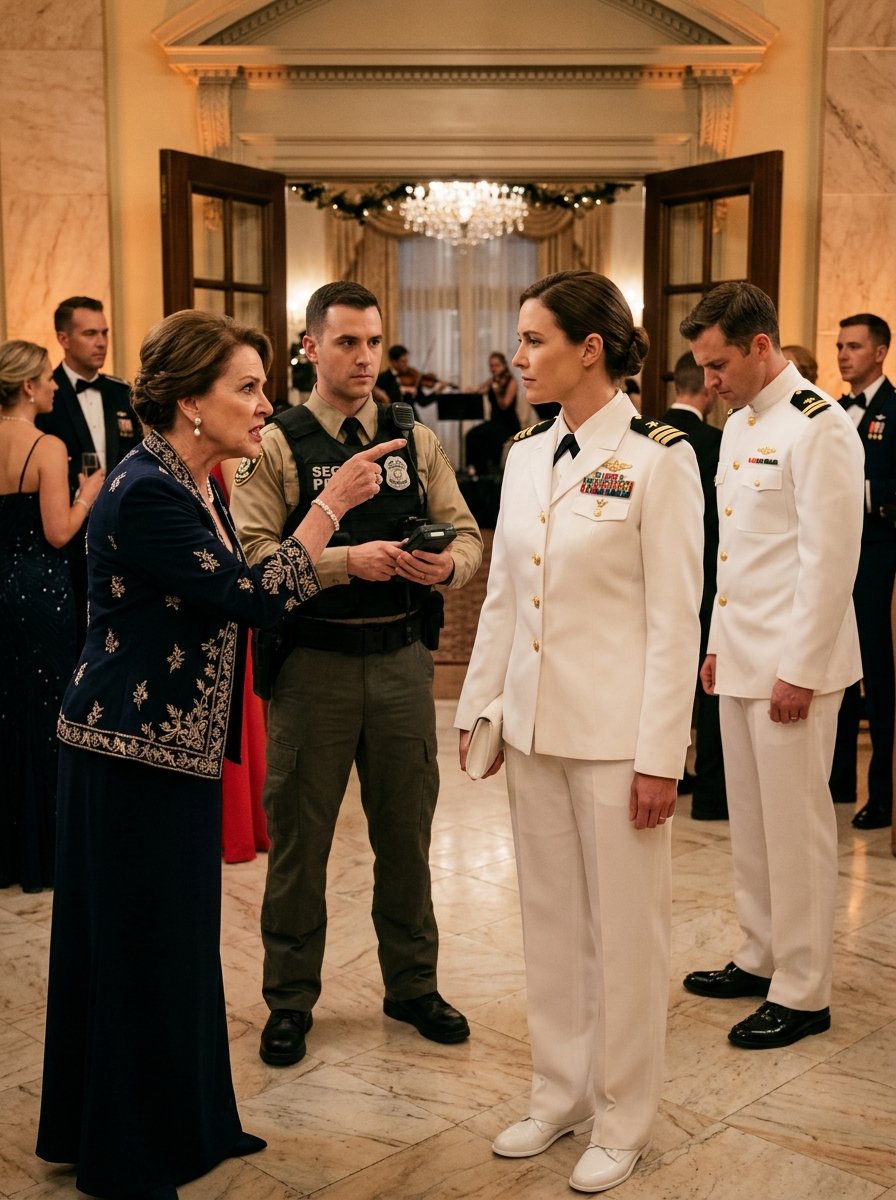
The brass-trimmed ballroom doors of the Harborview Officers Club always carried a faint smell of floor wax and sea salt whenever the humidity off the bay climbed past eighty percent. Helen grabbed the arm of an armed military police officer right there by the entrance check-in and pointed a diamond-covered finger straight at my face with enough force to shake her heavy pearl earrings. She didn’t bother lowering her voice against the string quartet playing waltzes down the hall, and honestly everyone within twenty feet stopped what they were doing to watch the show she was making.
Officer, arrest this woman immediately, Helen said, her voice carrying over the music like a siren in a fog. She has no right to wear that uniform. She is impersonating an officer and bringing absolute shame to my family.
I stood right there on the polished marble floor of the Grand Ballroom foyer in my Service Dress White uniform, feeling the familiar wool weight of the jacket across my shoulders where the gold oak leaves of a U.S. Navy Commander rested. Above my left pocket sat my Surface Warfare Officer breast insignia and my ribbon rack, including the Bronze Star I had earned during my second operational deployment in the Persian Gulf back when Frank was still trying to decide if he wanted to go into logistics or corporate law.
Standing two steps behind Helen was my husband, Lieutenant Frank Vance, looking like he wished the marble floor would simply open up and swallow him whole. Frank was an O-3 staff officer assigned to regional supply logistics down at the annex, spending his days shuffling requisition forms and worrying about his golf handicap. He wore his own dress whites, but instead of stepping forward to put a stop to his mother’s public tantrum, he stared down at his polished black dress shoes with a look of pure panic. His jaw twitched once, twice, but he kept his mouth completely shut.
For seven long years, I had tolerated Helen treating my naval career like an embarrassing hobby she wished she could sweep under the rug. She lived in a world of Greenwich country clubs, legacy trusts, and social pedigree that made everyone else look like common help. To Helen, Frank was the golden child who was supposed to take over an investment portfolio after completing his required service window. In her mind, I was merely the quiet girl Frank met in Virginia, an administrative nobody who typed memos in some forgotten basement office while waiting for her husband to bring home the real paycheck.
Every single time Helen introduced me to her country club friends at Thanksgiving dinners or family reunions, she used the exact same dismissive phrase with that tight little smile of hers. This is Claire, she would tell them while looking right past me at someone more important. She does minor clerical support on the base while Frank handles his officer duties.
I had never corrected her at those holiday dinners or family gatherings because Frank had always begged me not to make waves or upset the apple cart. He told me his mother was fragile about social standing because of her heart condition and her upbringing. He told me that letting her believe she was the undisputed head of the family kept the peace and secured our standing in the family dynamic. I had loved him enough to mistake his cowardice for filial respect, telling myself that family harmony was worth a little swallowed pride. I had stayed quiet, swallowed my irritation, and let her condescending remarks slide right off my back year after year.
I had arrived at the ball separately because my official duties as a Surface Warfare squadron commander required me to inspect logistics and security cordons before the main event doors opened to the guests. When Frank and Helen arrived together in her town car, Helen had spotted me standing near the main entrance check-in where I was confirming the seating arrangements for the fleet commanders. The sight of gold oak leaves on my shoulders, rather than an evening gown suited for an escort standing quietly behind a husband, had sent her into an immediate, blind rage.
Helen, lower your voice, I said, keeping my tone level and steady the way I did when a bridge watch team started losing their focus during a rough maneuver. You are causing a scene at an official military function.
Do not speak to me with that false authority, Claire, Helen snapped, her eyes wide with indignation as her chest heaved under her embroidered jacket. Frank told me months ago that you were just a civilian contractor helping with desk paperwork down at the annex. You went out and bought these medals and shoulder boards at a surplus shop just to humiliate me in front of Frank’s senior commanders. You think you can parade around playing soldier?
She turned her sharp gaze back to Master-at-Arms Second Class Miller, the young security guard stationed at the foyer perimeter who looked like he was barely twenty-two years old and completely out of his depth. You have standard operating procedures for uniform fraud, do you not? I demand you remove her in handcuffs right now before I speak to the base commander about your negligence.
Miller looked from Helen’s furious face to my uniform, his youthful features tightening into a mask of official caution. He did not touch his holster, but his posture went rigid and professional. He unclipped the handheld Defense Biometric Identification System scanner from his tactical vest with practiced ease.
Ma’am, please step back, Miller told Helen firmly, using his command voice. Then he turned to me, his tone neutral and careful. Ma’am, I need to see your military identification card, please.
Frank took half a step toward me, reaching out a hesitant hand before letting it drop back to his side. Claire, just walk back to the car, he whispered under his breath, his eyes darting toward the ballroom doors. We can fix this outside before someone important sees us and makes a report.
I looked down at my husband of seven years, taking in the slump of his shoulders and the nervous tic in his cheek. In his eyes, I did not see concern for my dignity or respect for my fourteen years of service across three oceans. I saw pure terror. But it was not fear of base security or military law. It was fear of his mother discovering the massive web of lies he had spun for nearly a decade to protect his standing in the family trust.
I did not step backward, and I didn’t let my hand shake. Instead, I reached into my small white leather clutch, pulled out my Department of Defense Common Access Card, and handed it directly to Petty Officer Miller without breaking eye contact with my husband.
Petty Officer Miller took my Common Access Card between his thumb and forefinger and slid the smart chip into the top slot of his handheld scanner with a practiced click. The device gave a low electronic chirp, and Miller stared down at the small monochrome screen as the secure biometric database retrieved my personnel file from the Pentagon servers.
Helen stood with her arms crossed over her embroidered evening jacket, a triumphant smirk spreading across her powdered face as she waited for the guard to drag me out in disgrace. Go ahead and check his records, she told the young sailor, as if she owned the base and everyone on it. You will find out she is nobody. Frank, tell the officer how she spent two hundred dollars on internet costumes just to embarrass us tonight in front of everybody.
Frank did not say a word. He looked like he was about to be physically sick right there on the Persian rug in the foyer, swallowing hard as his throat bobbed up and down.
The real reason for Frank’s agonizing silence had nothing to do with my uniform or a misplaced dress code. It had everything to do with hard cash and family greed. Two years into our marriage, Frank’s grandfather had passed away in Richmond, leaving a $650,000 family legacy trust distribution that was entirely controlled by Helen until Frank turned thirty-five years old. Helen had made it crystal clear during numerous family dinners that the Vance legacy belonged only to men of distinguished social pedigree and traditional family structures, not men who played second fiddle to an ambitious working woman in the armed forces.
When I was selected for early promotion to Commander and given operational command of Destroyer Squadron 21, Frank had begged me not to mention my rank to his mother during her visits. He told me Helen’s heart was weak and unstable. He claimed that if she found out his wife outranked him by two entire pay grades, she would view him as an emasculated embarrassment and immediately reallocate the entire $650,000 trust distribution to his estranged cousins in Charleston.
For years, I had accepted his pathetic excuses because I wanted our marriage to work and I believed in supporting my partner through family friction. I had hidden my service dress uniforms in the back of the spare bedroom closet when she came to stay for the weekend. I had attended civilian luncheons where she spoke to me like a paid servant while I smiled and passed the tea sandwiches. I had convinced myself that protecting my husband’s fragile emotional comfort was an act of high marital loyalty, a sacrifice a good military spouse should be willing to make behind closed doors.
Standing under the blazing chandeliers of the Officers Club, looking at Frank’s slumped shoulders and Helen’s spiteful, waiting grin, the fog in my mind completely cleared away. It had never been about Helen’s fragile health or her old-fashioned sensibilities. It had been entirely about Frank’s greed, his profound insecurity, and his gutless cowardice. He had gladly traded my dignity, my professional achievements, and fourteen years of blood, sweat, and long sea deployments so he could stay in line for a six-figure inheritance from a woman who despised everything I was.
The handheld scanner chimed a long, high confirmation tone that cut cleanly through the murmur of the foyer.
Petty Officer Miller’s eyes widened slightly as the bright screen displayed my full official record in crisp green text: active-duty O-5, Commander Claire Mitchell-Vance, commanding officer of Destroyer Squadron 21, active top-secret security clearance, verified keynote guest of honor for the Atlantic Fleet annual gathering.
Miller immediately pulled the card from the reader with a crisp motion, snapped his heels together on the marble, and brought his right hand up to the brim of his cover in a razor-sharp, textbook military salute that would have made a drill instructor proud.
Commander Mitchell-Vance, ma’am, Miller barked, his young voice ringing clear and loud through the entire entrance hall over the sound of the string quartet. Your credentials are confirmed active and valid. My apologies for the delay and the inconvenience, ma’am.
The foyer went completely dead silent in an instant. Several junior officers and their spouses standing in the security line stopped talking entirely and turned their heads toward us, their eyes darting between my gold oak leaves and Helen’s stunned expression.
Helen blinked twice, her smug smirk faltering for the very first time since she had walked through the front doors. What is the meaning of this insolence? she demanded, her voice rising an octave. Why are you saluting her like that? She is just a low-level clerk! Frank, tell this stupid guard he is making a terrible mistake right now!
He isn’t making any mistake at all, Helen, a deep, authoritative voice boomed from the double doors leading directly into the main dining ballroom.
Rear Admiral Thomas Harris, Commander of Naval Surface Force Atlantic, walked out into the foyer with his hands clasped behind his back. Four gold stripes gleamed brightly on his blue sleeves, and two silver stars sat solidly on his stiff collar points. Beside him were two senior aides and the base commanding officer, all of them wearing expressions of mild annoyance at the interruption near the entrance.
The entire security line and the guards snapped instantly to attention, their posture straightening like rods of steel.
Admiral Harris ignored Helen completely, walking straight past her as if she were a piece of stray luggage on the platform, and stopped right in front of me with an outstretched hand and a warm, approving smile. Claire, there you are, the Admiral said, his voice carrying easily across the silent room. We have been waiting for you in the VIP reception suite. The fleet commanders are eager to hear your remarks tonight on the new destroyer logistics protocols.
Helen rushed forward, stepping directly into Admiral Harris’s path with a look of frantic desperation on her face. Admiral, excuse me, but there has been a terrible misunderstanding here, she stammered, her hands trembling slightly against her silk dress. This woman is my daughter-in-law. My son, Lieutenant Frank Vance, is the real naval officer in this family. She is just an administrative assistant who borrowed that surplus jacket for attention.
Admiral Harris stopped dead in his tracks and looked down at Helen with cold, unyielding scrutiny. He did not smile, and his eyes narrowed the way they did when a captain failed a safety inspection.
Ma’am, I do not know who you are or what your game is, Admiral Harris said, his voice dropping into the icy, flat tone he reserved for operational failures and insubordination, but you are addressing Commander Claire Mitchell-Vance. She has served fourteen years in the Surface fleet, commanded two guided-missile destroyers through contested waters in the Pacific, and is currently the commanding officer of our frontline squadron. Furthermore, she is tonight’s invited keynote speaker for the entire Atlantic Fleet Ball.
Helen turned her head so fast her pearl earrings rattled against her collarbone. She stared at Frank, her mouth opening and closing repeatedly without producing a single sound, like a fish out of water. Frank? What on earth is he talking about? she whispered, the shrillness returning to her tone. You told me she answered phones at the administrative annex in Norfolk. You said she was a civilian.
Frank shrank back against the floral wallpaper of the ballroom wall, looking smaller than I had ever seen him in seven years of marriage. Mom… please, he muttered, staring at the floorboards. Let’s just go home now. Please, just stop talking.
You lied to me about this? Helen’s voice went completely shrill, echoing off the high ceiling. You let me believe you were the senior officer in this marriage? You let me make a complete fool of myself in front of base leadership?
Lieutenant Vance, Admiral Harris said, turning his cold gaze away from Helen and fixing it squarely on my husband. Frank instantly snapped to attention out of pure reflex, his face completely drained of any color until he looked like chalk. Your civilian guest is creating an unauthorized disturbance at a secure official function and attempting to file false reports against a superior officer. Master-at-Arms Miller, escort this civilian woman to the perimeter lounge immediately. If she causes another disruption of any kind, have base security remove her through the main gate.
Aye, aye, Admiral, Miller responded instantly, stepping forward and placing a polite but immovable hand near Helen’s elbow.
No, wait a minute! Frank, do something right now! Helen protested loudly as Miller guided her firmly down the long hallway toward the outer lobby and the exit doors. She looked back over her shoulder at me one last time, her eyes filled with a toxic mixture of shock, sputtering fury, and the sudden, crushing realization that her entire social hierarchy was nothing more than an imaginary fairy tale.
Admiral Harris turned back to me, his expression softening immediately with professional respect and warmth. Commander Mitchell-Vance, are you ready to join the head table in the reception hall? The guests are seated.
I looked over at Frank one last time. He was standing completely alone by the entryway wall, thoroughly humiliated in front of his peers, his chain of command, and the base leadership who would no doubt whisper about this in the wardroom for months to come. He looked at me with wide, pleading eyes, hoping against hope that I would say something to rescue him, to smooth it over, to pretend our marriage was still built on mutual respect and shared loyalty.
Go ahead to your assigned table, Lieutenant Vance, I told him quietly, using his rank instead of his name, my voice as steady as an anchor chain. We will speak tomorrow morning when you pack your bags and clear out of the quarters.
I turned my back on him without another word, smoothed the front of my white dress jacket with both hands, and walked side by side with Admiral Harris through the grand double doors into the brilliant lights of the ballroom.
When the Master of Ceremonies introduced me twenty minutes later from the raised dais, the applause from four hundred active-duty sailors and officers echoed off the vaulted timber ceiling like rolling thunder. I stood at the podium beneath the great gold seal of the United States Navy, looked out over a room of dedicated men and women who actually understood the heavy cost of service and integrity, and delivered my address on leadership, accountability, and the quiet, unbreakable burden of personal honor.
The next morning, the sun broke over the gray Norfolk harbor, casting a pale, cold gold light across the gray hulls of the destroyers berthed tightly along Pier 4.
I stood alone on the second-floor balcony of the Officers Club with a heavy ceramic mug of black coffee in my hand, watching the steam curl up into the crisp air. Down below on the water, the morning tide was coming in hard, lapping against the concrete pilings with a steady, rhythmic splash that sounded like a metronome keeping time.
Frank had left six frantic voicemails on my phone between midnight and sunrise while I was finishing up the post-ball command debriefs. In the first three messages, he tried desperately to blame Helen for the entire disaster, insisting that he only kept my rank a secret so we wouldn’t lose out on the $650,000 trust distribution that Helen held over his head like a club. In the fourth and fifth messages, he begged for forgiveness through hiccups and stammering, claiming that he had always been secretly proud of me even if he was too cowardly to show it in public.
In the final message, sent around 5:15 in the morning, his voice had broken completely into desperate, ugly tears. He realized with absolute certainty that the base commanding officer had already noted his conduct in his fitness report, that Helen was furious enough to freeze his trust funds permanently out of sheer embarrassment, and that his comfortable, deceitful marriage was finally over for good.
I didn’t reply to a single one of those messages. I had already contacted my staff judge advocate first thing at 0600 to draft the legal separation paperwork, and I had instructed the base housing office to revoke his electronic access to my command quarters by noon sharp.
For seven long years, I had allowed myself to shrink down to a smaller size so that Frank could feel tall and important in his mother’s overbearing eyes. I had foolishly believed that staying quiet and playing the supporting role was the price of keeping a home and a marriage together. But standing at that podium the night before, looking out at the rows of sailors who trusted me to lead them safely into harm’s way, I had remembered precisely who I actually was.
A cool sea breeze swept across the balcony, carrying the clean, sharp smell of salt water, damp concrete, and heavy diesel fuel from the yard tugs moving down the channel. I set my coffee mug down on the wooden railing with a soft click, took a deep, clean breath of the morning air, and watched the lead destroyer prepare to cast off its heavy mooring lines for a three-week patrol. My life was finally my own again, and I was standing firmly in full command.