How My Old CEO Fired Me to Cover a Two Million Dollar Mistake and Lost Everything When I Bought His Company

I should have looked closer at the math five years before that Monday morning in October instead of trusting that things were being handled by people who wore expensive suits and spoke with that smooth, corporate authority that makes you feel small. When you spend a decade building something from the ground up, moving freight schedules and tracking cold-chain pharmaceutical routes through freezing midwestern winters, you tend to believe that the system rewards loyalty and hard work. You tell yourself that the board of directors knows what they are doing, that the internal compliance audits are airtight, and that a company as large as Apex Logistics does not simply invent villains out of thin air when a two million dollar account goes sideways.
I ignored the small signs for months. I ignored the way the IT director started locking the server room doors after hours, and the way Arthur Pendelton suddenly stopped dropping by my desk to ask about transit times, and the weird discrepancies in the secondary routing tables that kept showing up on Tuesday nights. I told myself it was just routine administrative clean-up. I told myself I was being paranoid because the quarterly pressure was getting to everyone on the executive floor. I was so busy covering my shifts and making sure our healthcare clients didn’t lose a single pallet of temperature-sensitive vaccines that I never saw the trap being built around my own ankles until the security guard was already standing beside my chair with a cardboard box.
The security guard at the front desk of Apex Logistics didn’t recognize me when I walked through the glass revolving doors on that brisk Monday morning, and honestly, why should he have.
Five years ago, I stood in that exact same lobby holding a cardboard box containing my cheap desk lamp, a framed 4x 6 photo of my wife, and my ten-year service award made of heavy glass that felt like dead weight against my palm. I had been escorted out of the building like a common criminal while forty of my former team members sat at their cubicles and watched in stunned silence, their eyes fixed on their glowing computer monitors because nobody wanted to catch my eye and risk getting pulled into the undertow. That morning five years ago, the CEO, Arthur Pendelton, held an emergency company-wide meeting in the main conference room with the glass walls. He stood at the head of the mahogany table, looking very presidential in his custom-tailored navy suit, and announced to the entire floor that I had been terminated for gross operational negligence. He told them I had deliberately misrouted two million dollars worth of critical pharmaceutical shipments to an unauthorized destination, causing our largest healthcare client, Midwest Health Network, to cancel their multi-million dollar contract on the spot.
It was a total, calculated lie from start to finish, constructed with just enough technical jargon to convince a nervous board of directors that I had somehow gone rogue overnight. I knew the routing software inside and out, every line of code, every automated handoff, and every manual override protocol, and I knew I had logged every single transfer correctly. But when I tried to pull the system logs from my workstation to prove my innocence, my administrative access was instantly revoked before I could even export the files to a thumb drive. The server logs presented to the board showed my personal login ID attached to the corrupted routing files, time-stamped right in the middle of the night when I was sound asleep three towns away. I lost my career, my professional standing, my pension projections, and the four hundred and eighty thousand dollar equity and severance package I had spent ten grueling years earning through eighty-hour work weeks and missed family dinners.
Arthur offered me a choice back then that wasn’t a choice at all: accept the summary termination without severance and go quietly into the night, or face a public civil lawsuit for corporate sabotage and fraud that would drag my name through every legal gutter in Illinois. Blacklisted across the Chicago logistics sector and unable to afford a high-priced corporate defense attorney on short notice, I had to pack up my life, swallow the bitter pill of total humiliation, and start over entirely from scratch in a rental apartment three sizes too small for my family.
I spent the next five years rebuilding my life out of the ashes of that humiliation, working sixty and seventy hours a week at a mid-tier freight brokerage before catching a lucky break with Vantage Capital Partners, a top-tier private equity firm based downtown. I didn’t tell anyone at Vantage about my history at Apex because in the private equity world, once you are labeled a liability, nobody cares whether the label was pinned to you by a liar. I just kept my head down, analyzed freight balance sheets until my eyes burned, and worked my way up from senior analyst to lead Managing Partner through sheer, unyielding stubbornness. Which brought me right back to the thirty-fourth floor of the Apex building, standing on the polished terrazzo tiles with a fresh briefcase and a portfolio of acquisition documents that gave me absolute control over the company’s immediate survival. Apex Logistics was drowning in eighteen million dollars of short-term debt, facing mounting lawsuits from unpaid carriers, and hurtling headfirst toward an inevitable bankruptcy filing that would wipe out every last employee on the operations floor.
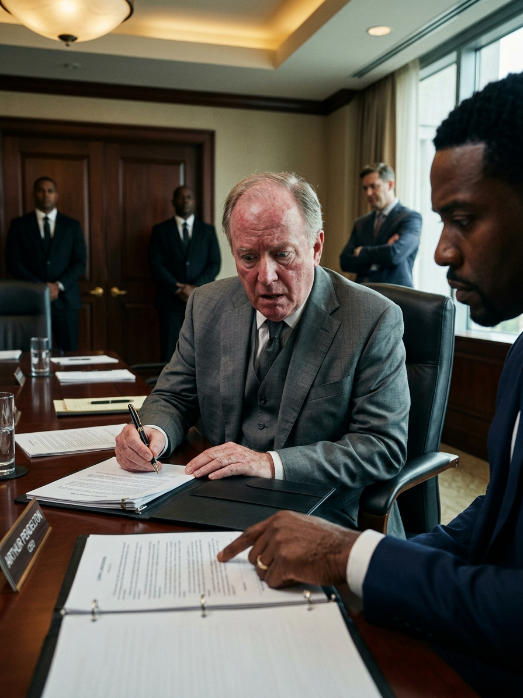
Vantage Capital was leading a potential fourteen point five million dollar acquisition to buy out the toxic assets, wipe out the crippling debt, and restructure the entire operational framework. As the lead Managing Partner on the deal, I held the final, absolute approval over whether the buyout went through or whether Apex went into Chapter 7 liquidation and the doors were chained shut by Friday afternoon. The elevator doors slid open with a soft chime onto the executive floor, and my junior associate, David, stepped out beside me carrying our heavy black leather acquisition binders. When we walked into the glass-walled boardroom where I used to present my quarterly logistics reports, Arthur Pendelton was standing at the head of the table in another bespoke navy suit that cost more than my first used car. Beside him sat his nervous Chief Financial Officer, a man named Henderson whose forehead was already glistening with sweat, and their outside corporate legal counsel flipping nervously through a stack of red-lined contracts.
Arthur looked noticeably older now, his hair significantly thinner on top and graying sharply at the temples, but his posture still carried that same insufferable, arrogant entitlement I remembered from the day he threw me under the bus.
Arthur stepped forward with an extended hand and a rehearsed, oily corporate smile that didn’t reach his eyes. “Marcus,” Arthur said, his voice smooth, resonant, and entirely confident as he bridged the distance across the room. “It is genuinely wonderful to see you again after all this time. When I saw on the preliminary paperwork that Vantage had placed you as the deal lead for this acquisition, I was thrilled to my core. I always knew you had the grit and the raw talent to succeed out there in the market after your… unfortunate exit from our team.” I looked down at his outstretched hand, lingering for three agonizing seconds just long enough for the smile on his face to begin twitching at the corners, and then I looked him dead in the eye without a flicker of warmth. I didn’t take his hand. I pulled out the heavy leather chair at the absolute head of the table, the very seat Arthur had occupied when he fired me, and sat down slowly, resting my briefcase on the mahogany surface. “Let’s skip the pleasantries and the fake reunions, Arthur,” I said quietly, opening my leather-bound notepad and uncapping my pen. “We have two hours to review the preliminary discovery audit for the fourteen point five million dollar purchase agreement before my partners call in for the status vote.
Let’s look at the actual numbers instead of wasting time talking about the weather.” Arthur’s professional smile twitched hard this time, the skin around his jaw tightening visibly, but he quickly recovered, cleared his throat, and sat down at the side of the table, tapping his gold-plated pen against his leather folder. “Of course, Marcus,” Arthur said, leaning forward and turning on his best boardroom charm. “As you know from the confidential memorandum we submitted last month, Apex remains a premier logistics provider with unmatched regional routes. Our core underlying infrastructure is exceptionally solid. We simply need this capital injection from Vantage to clear some legacy liabilities and move forward into the next profitable quarter.”
“Legacy liabilities,” I repeated, turning a page in my audit notes and looking straight at him. “That is a remarkably polite phrase for an eighteen million dollar operational deficit and unpaid vendor invoices stretching back six months.” “Market headwinds, Marcus,” Arthur replied smoothly, shrugging his shoulders with a theatrical display of weary patience. “Every logistics firm in the Midwest faced severe margin compression over the last three years due to fuel spikes and labor shortages. We had to make some tough operational calls to keep the lights on.” “Let’s talk about one of those tough calls, Arthur,” I said, leaning back in my leather chair and folding my hands over my stomach. “Section Four of our pre-acquisition audit covers historical operational losses and flagged anomalies. Specifically, the two million dollar supply chain failure from five years ago that resulted in the sudden termination of the senior operations director.” Arthur froze instantly.
The color drained slightly from his cheeks, leaving his skin a sallow, unhealthy gray, and his CFO, Henderson, shifted so violently in his seat that his leather chair let out a loud squeak against the floor. “Marcus,” Arthur said, lowering his voice into a warm, patronizing tone that he used when he wanted to bully someone in private. “I completely understand that you might still carry some lingering personal feelings about how your time here ended half a decade ago. But this meeting is about the future of a fourteen point five million dollar transaction that will keep this company solvent. Bringing up an old, closed personnel matter from the past is neither relevant nor professional at this stage of the negotiation.” “It is entirely relevant, Arthur, every single word of it,” I said, setting my pen down on the table with a sharp click that made Henderson jump. “Because as part of our standard pre-acquisition discovery protocol, Vantage Capital doesn’t just review the high-level financial ledgers provided by management.
We execute a deep-level forensic digital audit of every core operational server, database, and archive going back seven years.” Arthur’s hand tightened around his gold-plated pen so hard his knuckles turned bone-white against the dark metal. He looked sideways at his CFO, then looked back at me, and for the first time, a tiny, undeniable flicker of cold panic surfaced in his eyes.
I watched Arthur try to maintain his composure while his internal machinery started grinding to a halt. For five years, he had operated under the cozy assumption that the past was safely buried beneath non-disclosure agreements, wiped hard drives, and corporate silence that money could buy. “Our IT infrastructure has been completely updated and modernized since your departure, Marcus,” Arthur said, his voice taking on a sharp, defensive edge that he couldn’t quite mask. “Our legacy physical servers were decommissioned three years ago under standard data retention protocols. There is nothing left to audit from five years ago because those hard drives were wiped and recycled according to industry compliance standards.” “Legacy physical servers can be decommissioned and recycled, Arthur,” I replied softly, not raising my voice an inch. “But enterprise logistics companies use off-site cloud mirrors and redundant data vaults for insurance and tax compliance backups. Your IT department back then paid a third-party vendor in Milwaukee to host shadow backups of every transaction log, email archive, and routing manifest from that era.
And as part of our absolute acquisition discovery rights under the LOI, Vantage acquired full, unredacted access to those off-site archives forty-eight hours ago.” The room went completely, suffocatingly quiet. You could hear the faint hum of the rooftop HVAC unit through the vents and the steady tapping of rain against the thirty-fourth-floor windows. Arthur’s CFO turned his head slowly to look at his boss, his mouth slightly open as if he were waiting for Arthur to deny it, but Arthur said nothing. “David,” I said, nodding quietly to my associate sitting beside me. David opened his heavy leather briefcase and pulled out a stack of thick paper folders with red compliance tabs, placing one precisely in front of Arthur, one in front of Henderson, and sliding the third toward the wall-mounted video monitor where the board chairman was dialing in from his home in Winnetka.
“Five years ago,” I said, leaning forward and resting my forearms flat on the polished table, “I was accused of misrouting four hundred cold-chain pharmaceutical containers to a dead depot in Indiana, resulting in a two million dollar spoilage loss and the immediate termination of my contract for gross negligence.” Arthur didn’t touch the heavy folder sitting right in front of him. He just stared down at the red compliance tab as if it were a venomous snake coiled on the paper. “The server logs presented to the board back then showed my administrative credentials logged into the routing portal at eleven forty-two p.m. on a Tuesday night,” I continued, my voice measured and steady. “Case closed. Gross negligence. Fired for cause. Equity forfeited. Severance canceled. Everyone went home happy.” I tapped my finger against the cover of the folder in front of Arthur. “Page twelve of the unredacted off-site audit log tells a very different story,” I said. “At eleven thirty p.m. that exact night, an administrative override ticket was generated directly from the CEO’s private office terminal on this floor.
Ten minutes prior to the routing change in the system, the server recorded a direct administrative login using your master key, Arthur.” Arthur swallowed hard, his throat working convulsively. His chest rose and fell in fast, shallow movements beneath his custom suit jacket. “The unredacted logs show that the four hundred pharmaceutical containers were not misrouted by mistake or incompetence,” I said, keeping my tone completely flat and clinical. “They were deliberately redirected to a third-party cold-storage warehouse in Joliet owned by Apex Sub-Contracting LLC. A private entity registered quietly to your son-in-law, Bradley Vance, who needed quick cash to pay off gambling debts.” The board chairman’s face on the wall monitor went entirely rigid, his eyes narrowing as he leaned closer to his camera. “What did you just say, Marcus?” “Arthur didn’t make an operational mistake five years ago,” I explained directly to the board chairman, keeping my eyes fixed on Arthur’s sweating face. “He systematically diverted two million dollars worth of client inventory to his son-in-law’s struggling subcontractor business to keep the business afloat and draw off-market storage fees under the table.
When the client discovered the delivery delay and the pharmaceutical product spoiled in unmonitored trucks, Arthur panicked. He used an administrative IT command to wipe the primary routing table, altered the local server timestamp to attach my user ID to the fraudulent change, and used me as a scapegoat to cover up his family embezzlement.”
“This is an absolute lie! This is a fabricated witch hunt!” Arthur suddenly slammed both palms down onto the oak table, standing up so fast his leather chair rolled back and crashed against the glass wall behind him. “This is a malicious smear campaign! You are using your position at Vantage to execute a personal vendetta because you’re bitter about getting fired fairly a half-decade ago! Chairman, I demand this meeting be adjourned immediately and these fraudulent documents thrown out!” “Sit down, Arthur,” the board chairman said from the monitor, his voice cold as arctic ice. “Marcus, continue with the audit findings.” Arthur remained standing for five agonizing seconds, his chest heaving under his tight vest, his face mottled red and blotchy. But when he looked around the room and saw the silent, stone-faced security guards standing quietly by the double doors and the terrified, averted eyes of his own CFO, he slowly lost the fight and sank back down into his chair like a deflated balloon. “The forensic trail does not end with the server logs, Arthur,” I said, turning to the next page of my binder without missing a beat. “We tracked the capital flow from Apex Sub-Contracting LLC through three separate shell accounts.
Over the eighteen months following my termination, your son-in-law’s company funneled six hundred thousand dollars back into a private trust account in the Cayman Islands registered under your maiden name, Arthur, using your mother’s maiden surname as the beneficiary.” I looked across the table at the man who had ruined my professional reputation, my finances, and my peace of mind five years ago without losing a single night of sleep. “You didn’t just frame an innocent employee to save your corporate bonus,” I said quietly. “You committed grand larceny, wire fraud, and falsification of corporate records to enrich your own family while driving this company into eighteen million dollars of unrecoverable debt.”
Arthur slumped forward in his chair, resting his forehead in his trembling hands. The arrogant, polished corporate CEO was gone, stripped away in the span of twenty minutes. In his place sat a terrified sixty-two-year-old man who finally realized his entire life’s work, his social standing, and his freedom were crumbling into dust right in front of his peers. “Marcus,” Arthur stammered, his voice cracking pathetically as he finally reached out with shaking fingers to touch the corner of the paper folder. “Please… we can talk about this privately between us. The company needs this buyout desperately. Forty people down in operations will lose their livelihoods and their health insurance if Vantage walks away from this deal today. You know those people. You worked beside them for ten years. Don’t let your personal anger toward me destroy their families.” I stared at him for a long, quiet moment, watching him try to hide behind the very employees he had exploited and lied to for years. “I am not walking away from the buyout, Arthur,” I said, my voice steady and firm. “Vantage Capital is going to acquire Apex Logistics for fourteen point five million dollars as planned.
The company will survive, the debt will be restructured, and every operational worker on the floor will keep their job, their seniority, and their retirement benefits intact.” Arthur let out a long, ragged breath, a sudden, pathetic wave of relief washing across his pale face. “Thank you, Marcus. I always knew you were a reasonable, honorable man. We can draft a quiet press release regarding my early retirement…” “You are not retiring, Arthur,” I interrupted cleanly, cutting him off mid-sentence.
Arthur stopped breathing, his mouth hanging half-open. “Vantage Capital’s acquisition of Apex Logistics is subject to three non-negotiable closing conditions,” I stated, reading directly from the legal document in front of me. “First, Arthur Pendelton’s employment as Chief Executive Officer is terminated effective immediately for documented cause and criminal malfeasance. You will vacate this building and hand over your security badge by twelve o’clock today. Second, your entire executive exit package, including all stock options, golden parachute clauses, and deferred compensation, is completely revoked and forfeited back to the company treasury. Third, you will execute an immediate restitution wire transfer of four hundred and eighty thousand dollars directly to my personal account. That is the exact value of the equity and severance package you stole from me five years ago, adjusted for standard market interest.” Arthur stared at me across the table, his eyes wide with absolute horror. “Four hundred and eighty thousand dollars?
That is nearly all my liquid savings and retirement reserves!” “Then I strongly suggest you call your personal wealth manager and write the check before one o’clock, Arthur,” I said, closing my binder with a definitive thud. “Because if that transfer is not completed by the time the financial markets close today, Vantage Capital will hand these unredacted audit logs and offshore banking records directly to the United States Attorney’s Office for the Northern District of Illinois for formal criminal indictment.” The room was completely dead silent. Henderson looked away, staring fixedly at his fingernails. The board chairman on the video monitor slowly nodded his approval and signed off the call with a click. Arthur looked around the table, searching for an ally, searching for a legal loophole, searching for anyone to rescue him, but no one moved. The trap he had built five years ago had finally sprung shut around his own neck.
He reached into his jacket pocket with a shaking hand, pulled out his Montblanc pen, and signed the immediate resignation and asset restitution agreement on the dotted line.
At two o’clock that afternoon, I walked down the carpeted stairs to the third-floor operations bullpen where the real work of the company happened every day. The vast room was filled with rows of desks, glowing computer monitors, and the constant hum of phone calls from freight dispatchers coordinating loads across the country. As I walked down the center aisle, several older employees looked up from their screens with tired, anxious expressions. Dave Miller, a senior logistics coordinator who had worked alongside me for a decade and stayed through all the lean years, stood up slowly from his desk, his eyes wide with disbelief as he recognized me. “Marcus?” Dave asked, stepping out into the aisle and blocking my path. “Is it true what the morning memos are whispering? We just got an email from the board saying Vantage bought the company out.” “It’s true, Dave,” I said, stepping forward and shaking his hand warmly. “The acquisition is fully complete.
The legacy debt is cleared, and your jobs are safe.” “And Arthur?” Dave asked in a low, cautious voice, looking around as if the former CEO might still materialize out of thin air. “Arthur has been permanently removed from the premises,” I said quietly. “And as part of the new management structure, I am appointing you as the interim Director of Operations starting Monday.” Dave stood there frozen for a moment, tears welling visibly in the corners of his tired eyes, before reaching out and gripping my shoulder with a heavy, trembling hand. “You came back for us, Marcus,” he whispered. “I came back for the truth, Dave,” I said gently, looking around at the rows of familiar desks. “And to finish what we started.”
Later that evening, I sat alone in the corner office on the thirty-fourth floor, the same room where Arthur had tried to destroy me five years ago. The autumn rain was falling softly over the Chicago skyline, reflecting the amber city lights against the high glass windows in long, wavering streaks. On the heavy mahogany desk in front of me sat a printed wire transfer receipt showing four hundred and eighty thousand dollars successfully deposited into my personal account. Right beside it sat a small, framed photo of my wife and my old ten-year service award made of heavy glass, which Dave had rescued from the trash years ago, kept safe in his lower desk drawer, and brought up to my office an hour before he went home. I picked up the small glass award, tracing the engraved brass plate with my thumb where my name and years of service were stamped.
Five years ago, I left this exact building feeling smaller than I had ever felt in my life, carrying a cardboard box and believing that power and money could rewrite reality and turn an honest man into a scapegoat. I had carried the bitter weight of that humiliation in my chest for years like a stone in my shoe. I set the award down squarely in the center of the desk, pulled my raincoat on over my suit, and reached out to turn off the overhead office lights. As I walked out into the quiet hallway and pressed the elevator button for the lobby, I didn’t feel a rush of spite or petty triumph. I felt a deep, quiet, unshakeable peace settling into my bones. I had not destroyed a company to get revenge; I had saved it, protected the people who actually built it, and forced the ugly truth out into the light where it belonged.
The elevator doors slid open with a soft chime, and I stepped inside, heading home to my family.